Kōdō: A Journey into the Japanese Art of Incense Appreciation and the Genji-kō Diagram

The Art of Appreciating Incense in Japanese Culture
In Japan, the art of appreciating incense is known as Kōdō, an ancient practice that combines sensory experience with centuries-old cultural traditions. This art is not limited to enjoying the scent of incense alone, but also involves precise rituals and aesthetic and spiritual dimensions deeply rooted in Japanese heritage.
The Genji-kō Diagram: From Literature to Visual Art
At the heart of this practice lies the Genji-kō Diagram, a visual design inspired by The Tale of Genji, one of the greatest and most influential works in Japanese literature.
This novel consists of multiple chapters, each reflecting a different aspect of life, whether about love, loss, or profound human experiences.
A Visual Language Translated from Literature
The Genji-kō Diagram seeks to transform these chapters into a unique visual language, where five vertical lines are drawn to form the general framework for 52 distinct patterns, each representing a chapter of the novel.
In this way, literature is transformed into an art form that can be perceived visually, adding a new layer of appreciation to this classical masterpiece.

Patterns as a Bridge Between Literature and Sensory Experience
The patterns of the Genji-kō Diagram are not merely decorative elements; they embody the emotional depth and complex narratives carried by The Tale of Genji.
In the design of some incense burners inspired by this diagram, a carefully selected set of these patterns is chosen to blend the literary elegance of the novel with the sensory experience of practicing Kōdō, making the design itself an extension of the contemplative nature of this art.
Collaboration with Incense-Making Expertise
A notable example of merging artisanal heritage with design is the collaboration with Shoyeido in Kyoto, one of Japan’s oldest companies specializing in incense production, with a history spanning over three centuries.
These incense burners benefit from Shoyeido’s expertise in crafting various types of incense, whether sticks, cones, or spiral-shaped coils, offering the user flexibility in choosing the method that best suits them.
Origami as Design Inspiration
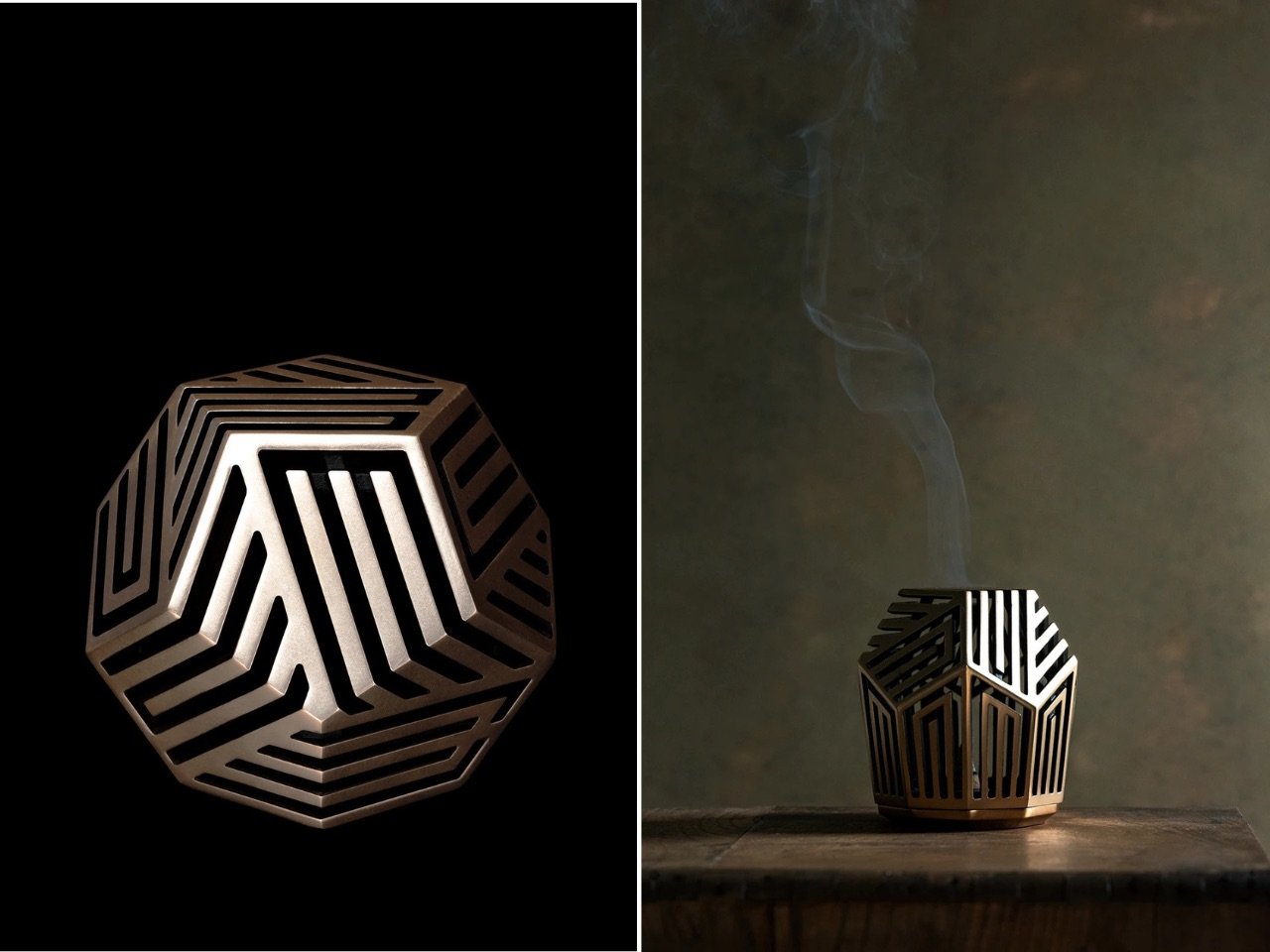
The design of these incense burners reflects the beauty of simple Japanese craftsmanship, drawing inspiration from the art of origami (paper folding).
By incorporating Genji-kō Diagram patterns into precise folds, the body of the burner takes shape as an elegant dome, combining practicality with visual appeal, turning the piece into a work of art as much as a functional tool.
A Design that Enhances Smoke Flow
One of the distinctive aspects of these incense burners is the design that guides the movement of incense smoke with smooth elegance.
The removable top reveals a dedicated space for placing a coil of incense, and as it burns, the smoke passes through the gaps and holes formed by the folded pattern, gently rising and dispersing into the air.
Here, the design becomes part of the ritual itself, as the form interacts with the smoke to create a deeper sensory experience more closely connected to the essence of Kōdō.
A Metallic Finish with a Calm Spirit
The matte bronze finish lends the burner a touch of understated elegance, while its neutral color allows it to blend seamlessly with various interior styles, whether traditional Japanese or minimalist contemporary.
This visual balance makes it suitable for placement in multiple settings, such as living rooms, offices, or meditation spaces, where it adds a silent yet impactful presence.
Atmosphere and Visual Warmth
The finish is not limited to an aesthetic role; it also conveys a sense of warmth and familiarity, enhancing the tranquility provided by burning incense.
Thanks to its simplicity and unpretentious presence, these burners become a harmonious element within the space, enriching the atmosphere without overpowering it.

✦ ArchUp Editorial Insight
From the standpoint of architecture and design, this incense burner can be viewed as a case study that merges cultural inspiration with functional innovation.
On the positive side, the design highlights how small products can convey architectural and cultural identity through selected visual elements and materials, a concept that can be applied to interior space design or even architectural façades. In such applications, patterns and motifs move beyond mere decorative features to become symbols carrying deeper meaning. Furthermore, drawing inspiration from the art of origami opens opportunities for architects and designers to apply folding techniques in creating contemporary structural or ornamental solutions.
Conversely, the challenge remains that such designs, despite their beauty, may remain confined within their narrow cultural context. This calls for careful consideration when applying them in different environments to ensure harmony with the local identity. Additionally, an excessive focus on aesthetic aspects may reduce attention to practicality, especially in daily use, making it necessary to seek solutions that maintain a balance between form and function.
Prepared by the ArchUp Editorial Team
Don’t miss the chance to explore more from Architecture in fields like Design and Projects on the ArchUp website.