

Belgrade Military Headquarters Hotel Project Cancelled

Serbian President Aleksandar Vučić announced the cancellation of a plan to convert the former Yugoslav military headquarters in Belgrade into a hotel following the withdrawal of Affinity Partners, a company linked to U.S. President Donald Trump’s son-in-law, Jared Kushner. The company cited a “smear campaign” as the reason for its exit, emphasizing that the decision respects the people of Serbia and Belgrade.
Project Background and Opposition
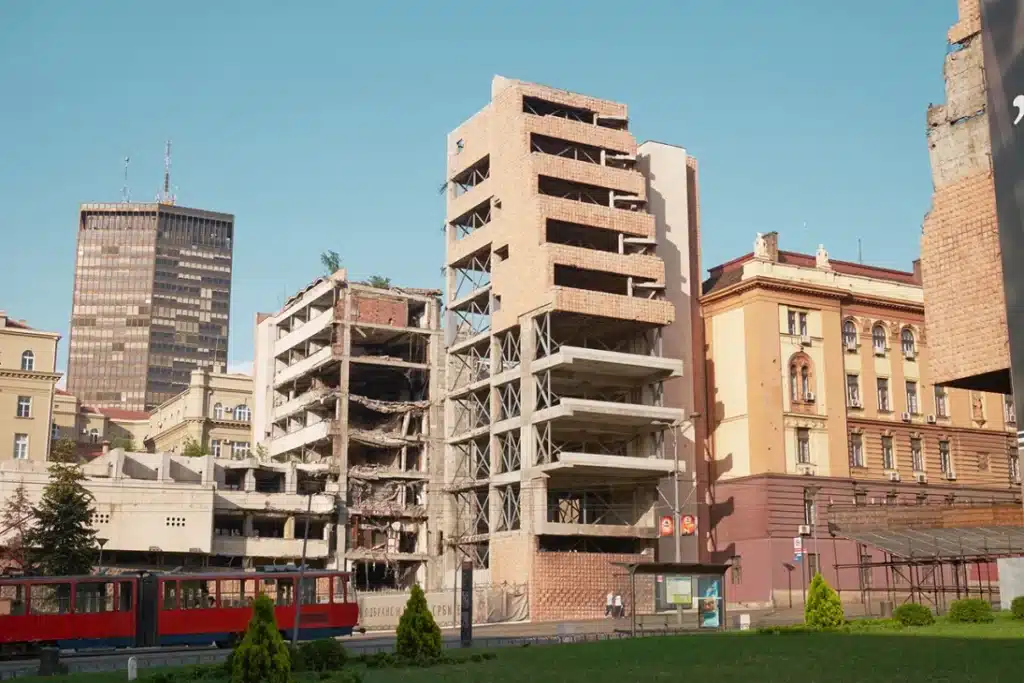
The project aimed to transform the war-damaged building from the 1999 NATO bombing into a high-rise hotel valued at at least €750 million. It faced continuous public opposition and corruption allegations, especially after government officials including the Minister of Culture were accused of falsifying documents to remove the building’s heritage protection.
Protests and Heritage Preservation
The allegations reignited public protests, with demonstrators demanding the preservation of the ruins due to their architectural and historical significance, serving as a reminder of the 1999 NATO bombing.

Statements from Vučić
President Vučić blamed the failure on a “smear campaign against the investor and any proposed changes,” promising to take action against those who blocked the deal, while expressing regret that the project faltered despite a 99-year redevelopment agreement between the government and Affinity Partners.
✦ ArchUp Editorial Insight
The cancellation of the planned conversion of Belgrade’s former Yugoslav military headquarters into a luxury hotel underscores the tensions between Contemporary adaptive reuse ambitions and heritage preservation within post-conflict urban contexts. The project, envisioned as a high-rise intervention on a war-damaged site, highlighted material expression through monumental form while seeking to generate economic and symbolic value. However, persistent public opposition, allegations of procedural manipulation, and concerns over contextual relevance illustrate the challenges of reconciling investment-driven redevelopment with collective memory and urban identity. The withdrawal of the international investor further emphasizes the fragility of functional resilience when social legitimacy is contested. Ultimately, the episode reflects an architectural ambition constrained by civic accountability, signaling that meaningful urban transformation must balance heritage, memory, and strategic redevelopment objectives.


ArchUp: Technical Analysis of the Cancelled Hotel Project at the Former Yugoslav Army Headquarters in Belgrade
This article provides a technical analysis of the cancellation of the hotel project at the former Yugoslav Army Headquarters in Belgrade, as a case study in the conflict between economic development and the preservation of memory and heritage in urban areas. To enhance archival value, we present the following key technical and design data:
The proposed project aimed to convert the damaged military headquarters building into a luxury high-rise hotel, with an estimated investment cost of at least €750 million. The Serbian government signed a 99-year lease agreement with the company “Avenity Partners,” granting the investor long-term development rights. The project faced strong opposition due to heritage conservation concerns, including accusations of document forgery to revoke the building’s protected status and its removal from the national register of protected sites.
In terms of architectural and historical challenges, the building suffered severe damage during the NATO bombing in 1999, making it a historical symbol. Its classification as a heritage site was revoked in October 2024 by a government decree, a decision that faced legal challenges. The building was designed by Serbian architect Nikola Krasnov in the early 20th century, featuring early modernist architecture, which gave it architectural value beyond being merely a war ruin.
Regarding urban and social impact, the project sparked public protests demanding the preservation of the ruins as a historical witness. It posed a challenge to policies for redeveloping sensitive sites in Belgrade, a debate common in many European cities balancing urban renewal with memory preservation. The withdrawal of the international investor due to what they described as a “smear campaign” led to the project’s cancellation, leaving the site’s future uncertain between options for cultural regeneration or memorial preservation.
Related Link: Please refer to this article for a broader discussion on the conflict between development and heritage in other urban contexts:
Architecture of Civilizations: Tracing the Built Timeline of the Middle East
https://archup.net/the-demolition-of-tuniss-iconic-du-lac-hotel-a-clash-between-heritage-concerns-and-development-plans/