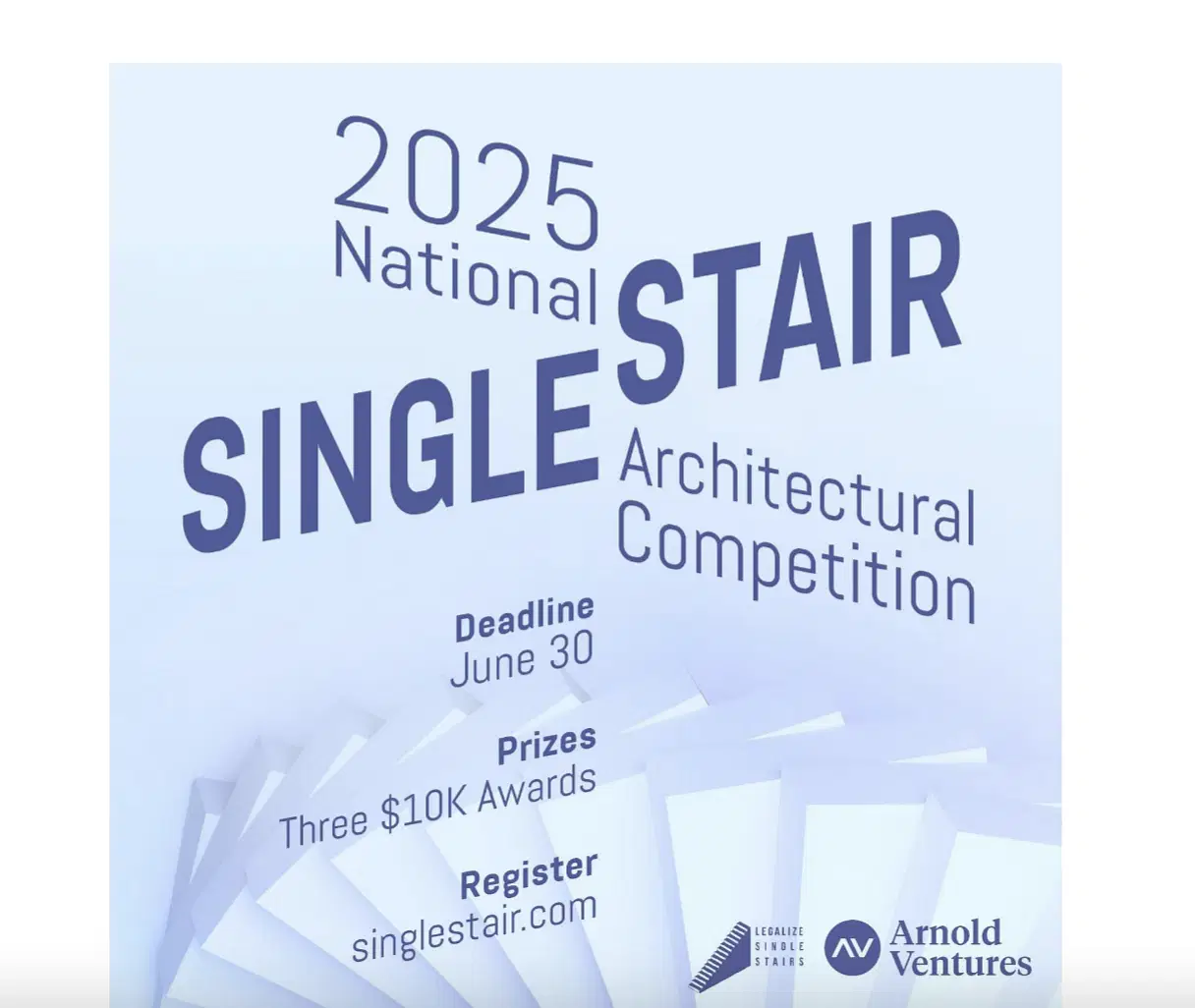
National Single Stair Architectural Competition 2025

Overview
The 2025 National Single Stair Architectural Design Competition invites architects, designers, students, and urban planners from around the world to propose innovative multifamily housing designs using single-stair configurations on typical urban parcels across the United States.
This competition responds to outdated building codes requiring double-loaded corridors in multifamily housing—an approach that often results in inefficient layouts and poor access to light and air. Inspired by recent reforms in Los Angeles and other cities, the competition encourages new models that enhance livability, spatial efficiency, and environmental performance.
Three urban lot types will serve as design sites, each with a $10,000 award, offering multiple opportunities to compete and win.
Why You Should Participate
- Design freedom: Explore new residential forms with minimal regulatory constraints.
- Impactful innovation: Contribute to a national conversation on housing reform and code modernization.
- Multiple prizes: Submit to one, two, or all three site challenges to maximize your chances of winning.
- Recognition: Winning entries will receive national attention and professional exposure.
- Open access: Available to individuals and teams worldwide, regardless of nationality.
Key Highlights
- Design Focus: Multifamily buildings using single-stair access configurations.
- Sites:
- Portland Site: 50×100’ mid-block lot without alley access
- San Francisco Site: 25×110’ mid-block lot without alley access
- Austin Site: 45×135’ mid-block lot with alley access
- Eligibility:
- Open to anyone 18 years or older.
- Anonymity of entries is enforced for fairness.
- Immediate family of jury members’ firms cannot participate.
- Entrants affiliated with sponsoring organizations may enter.
Entry Fees
| Entry Category | Fee |
|---|---|
| All Categories | Free Entry |
There are no entry fees to participate in this competition.
Prizes and Recognition
| Site Location | Prize Amount |
|---|---|
| Portland (50×100’) | $10,000 |
| San Francisco (25×110’) | $10,000 |
| Austin (45×135’) | $10,000 |
- Participants may submit to one, two, or all three site categories.
- Entrants may win more than one award if selected for multiple sites.
- Honorable mentions may be awarded at the jury’s discretion.
Submission Details
- Submit 1–3 vertical 24” x 36” sheets in a single PDF (max 50MB).
- Include a 50-word project summary directly on one of the boards.
- Project name should be included at the bottom right corner of each sheet.
- Optional: A 3D model per site (max 100MB each).
- Submit a separate document with team or individual bio and a photo (for press purposes).
Important Dates
| Milestone | Date |
|---|---|
| Submission Deadline | June 29, 2025 |
How to Join
- Choose your site(s): Portland, San Francisco, Austin.
- Develop your design using the single-stair configuration.
- Prepare up to three vertically oriented 24” x 36” boards per site.
- Combine your drawings into one PDF (max 50MB).
- Prepare optional 3D models if desired (max 100MB).
- Prepare a separate document with a short bio and photo.
- Submit both your competition entry and the bio document as instructed by the organizers.
Judging Criteria
The jury will evaluate submissions based on the following dimensions:
Identity
- Variety of unit types and adaptability to diverse populations.
- Affordability and replicability of the proposed structure.
- Neighborhood compatibility and urban integration.
- Intended users and community impact.
Sustainability
- Climate responsiveness and adaptability.
- Inclusion of green spaces and plantable areas.
- Communal spaces and potential for shared amenities.
- Mixed-use possibilities to support economic growth.
Mobility
- Accessibility for pedestrians, cyclists, and transit users.
- Universal design for people of all abilities and ages.
- Compliance with accessibility standards.
Creative Use of Code Flexibility
- Maximizing design opportunities afforded by reduced restrictions.
- Strong use of open space, privacy, cross-ventilation, and natural lighting.
- Innovative layouts enabled by the elimination of the second stair.