

Nomadic Architecture Meets Geological Force: A Dialogue Between the Mongolian Ger and the Ulanhad Volcanoes

Introduction: A Cultural Identity on the Brink of Marginalization
In the rising tide of globalization, local architectural expressions, particularly the architecture of the steppes and nomadic culture, face an existential threat of homogenization. This project emerges as a profound and bold attempt not only to preserve this identity but to revitalize it through a contemporary dialogue. At the heart of this dialogue is the Mongolian Ger – a traditional dwelling that is not merely a shelter, but a complete spatial vessel for a nomadic people’s philosophy of life, manifested in its concentric circular plan, its prefabricated, portable structure, and its deep wisdom of living in symbiosis with nature without disrupting its balance.
A Dialogue of Opposites: Between the Volcano’s Permanence and the Ger’s Flexibility
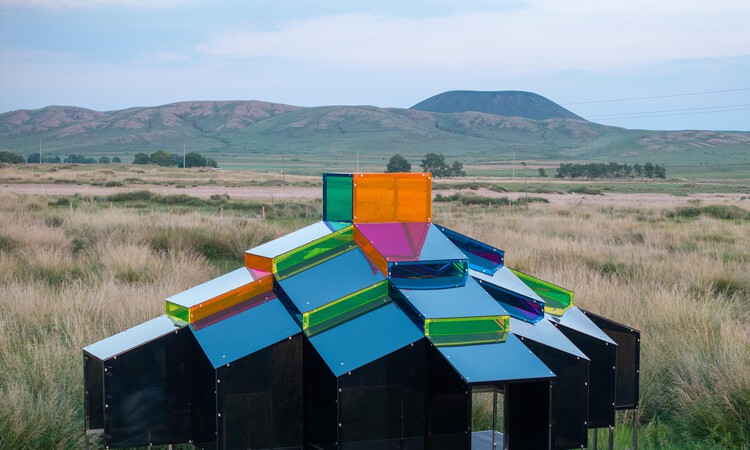
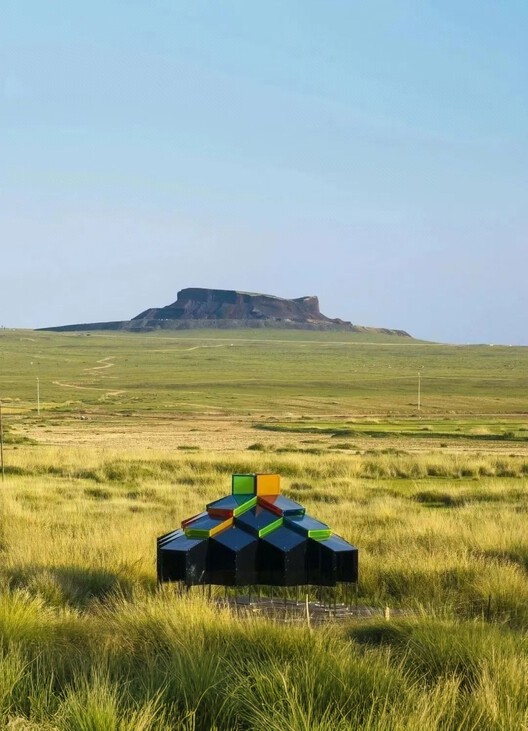
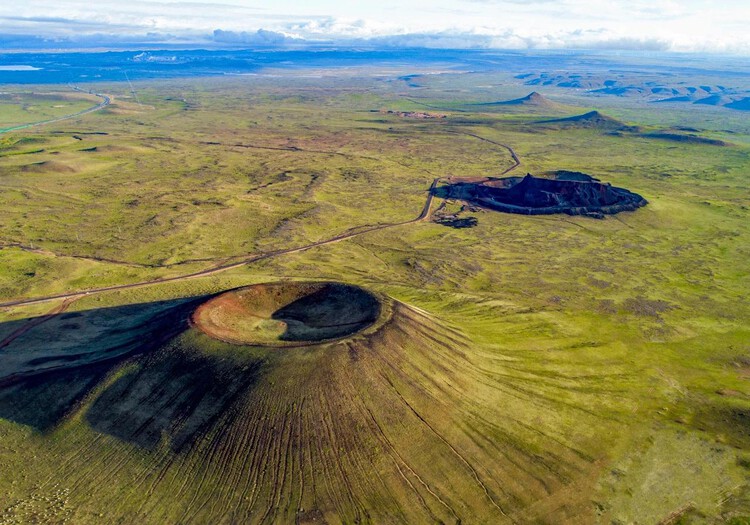
The project is situated near the Ulanhad volcanic cluster in Inner Mongolia, establishing a dramatic dialogue between two poles: the massive, timeless, and fixed geological landscape represented by the volcano, and the flexible, temporary, and mobile human space embodied by the Ger. The volcano here is the embodiment of the earth’s primordial and raw forces, a power that acknowledges only its own geological logic. In contrast, the Ger represents the pinnacle of intelligent and adaptive human response to that nature; it does not resist nature but adapts to its rhythm. From this collision between permanence and movement, between raw force and adaptive intelligence, exceptional spatial narratives are born, telling the story of humans and the earth.
Site Response: Transforming Topological Similarity into Architectural Language
Subheading: From Natural Form to Architectural Form
The first design ingenuity lies in discovering a hidden topological similarity between the geometric formation of the Ulanhad volcanic cones and the sectional curves of the Ger. This similarity is not purely formal, but rather a relationship of fundamental geometric properties. The design undertook a precise process of geometric abstraction of these forms, following a strategy of recombining and integrating the conical shape of the volcano with the domed shape of the Ger.
As a result of this process, the design does not become a mere miniature reflection or passive imitation of the surrounding geological landscape. Instead, it becomes an active medium that reinvents the traditional spatial expression of the Ger itself. This strategy establishes poetic correspondences in scale and form, achieving an advanced topological transformation from natural landforms into a tangible, experiential architectural language, deepening the visitor’s sense of belonging to the place on both the micro (human) and macro (geological) levels.
Cultural Translation: Extracting the Ger’s Environmental DNA
Subheading: From Traditional Wisdom to Contemporary Performance
The design moves beyond a superficial view of form to delve into the essence of what makes the Ger a model of sustainability and adaptation. It excavates the ecology of the nomadic dwelling, tracing the features of environmental compatibility evolved over centuries. The design focuses on analyzing the intelligent passive climate regulation systems that enable the Ger to withstand the harshest climatic conditions, from hot summers to freezing winters.
Then comes the phase of contemporary translation: these systems are converted into new spatial elements and vocabulary. Through strategically positioned upper apertures (similar to the traditional “Toono”) and lower openings, micro-airflows are passively guided to maintain thermal comfort within the space and reduce energy dependence. This process ensures the preservation of the cultural and environmental “DNA” of nomadism, while meeting contemporary comfort and performance requirements, without falling into the trap of pastiche or reviving form without substance.

Experience Design: Weaving Temporal Narrative into the Fabric of Space
Subheading: Transforming Stasis into a Breathing, Living Entity
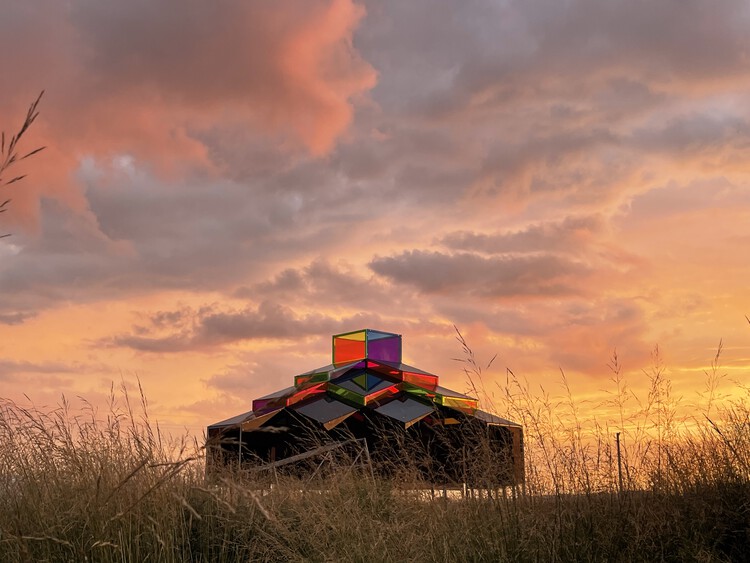
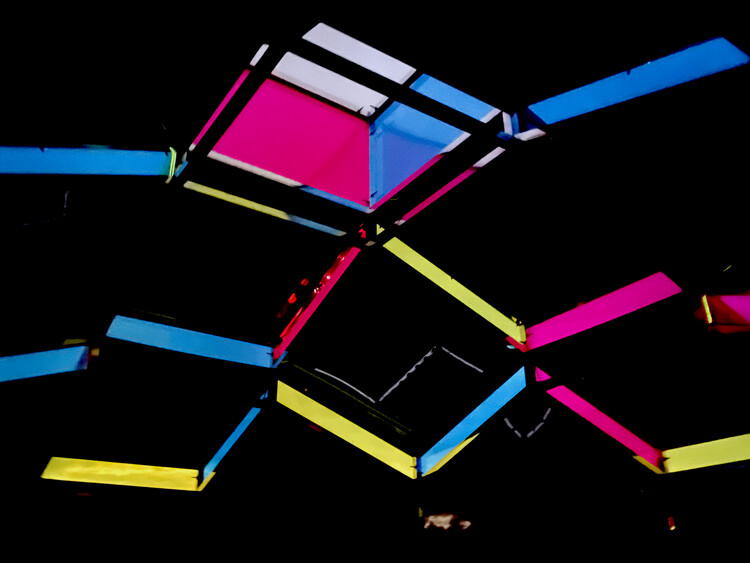
Space in this project is not a static mass to be viewed, but a sensory phenomenon to be lived and experienced as it changes. The goal is to transform the static space into a living, “breathing” entity possessing a vital temporal dimension. To achieve this, the design employs geometric spatial configurations using panels of colored and opaque acrylic, arranged in an alternating pattern.
This calculated composition acts as a mediator between the sky and the interior, creating continuously evolving light and color projections. These projections are not static; they respond and change with the apparent movement of the sun throughout the day, and with the speed and direction of moving clouds in the sky. Thus, the design weaves a dynamic visual narrative, offering the visitor a unique sensory experience where the same moment of light never repeats itself, redefining the sense of place from a fixed entity to a perpetually renewing event.
Conclusion: Towards a New Model for Human Settlements in the Steppe
This project, through its prototype-based exploration, offers more than just a design solution; it presents a methodology for creative translation. It successfully transforms traditional nomadic culture from a heritage preserved in memory into a contemporary architectural language capable of engaging with modern challenges. Through a deep synthesis of precise site analysis, conscious cultural translation strategies, and rich sensory experience design, the project demonstrates the possibility of achieving a genuine organic integration of heritage, nature, and modernity. This opens new horizons and offers innovative perspectives for developing human settlements in the steppes and similar environments, where identity and sustainability are the core of design.
✦ Archup Editorial Insight
The project addresses the revitalization of nomadic architectural identity by creating a dialogue between the permanence of the volcanic mass and the flexibility of the Ger dwelling. The spatial dialogue relies on a topological abstraction of the formal relationship between the volcano and the Ger, raising the question of whether this purely geometric convergence can convey the functional and cultural complexity inherent in the structural and environmental system of the original nomadic shelter, where the priority given to the topological metaphor may oversimplify its fundamental structural principles. The contemporary translation of the ventilation system attempts to preserve climatic efficiency, but isolating this mechanism from the integrated structural context of the original Ger carries the risk of reducing it to an aesthetic element with limited effectiveness. The experiential value lies in the project’s ability to impart a dynamic, temporal dimension to the space through its interaction with changing natural light, continuously reshaping the perception of place.
Brought to you by the ArchUp Editorial Team
Inspiration starts here. Dive deeper into Architecture, Interior Design, Research, Cities, Design, and cutting-edge Projectson ArchUp.


