

Apartment in the Heart of Tbilisi: A Private Residence Exploring the Relationship Between Owner Personality and Interior Design

A Design that Reflects the Owner’s Personality
This private residence exemplifies how interior architecture can transcend mere furniture arrangement or color selection, becoming instead an expression of the owner’s unique personality and refined taste. The design studio approached the project as a space that embodies the resident’s lifestyle rather than a simple place to live.
Meticulously Considered Design Decisions
From the very beginning, every choice, whether related to materials, spatial proportions, lighting, or textures, was carefully calculated to reflect the owner’s style and personal preferences. This approach demonstrates how interior design can serve as a tool to understand people and their habits, translating their personalities into a tangible and meaningful visual form.
Balancing Beauty and Functionality
The final outcome is a home filled with life, radiating calmness, balance, and authenticity. The design does not focus solely on aesthetics; it thoughtfully integrates function and comfort, creating an inhabited environment that feels natural, genuine, and true to its essence.


Natural Materials as the Core of the Design
Natural materials play a central role in this design, adding warmth and a tactile presence within a contemporary framework. The harmonious blend of stone, wood, and metals not only enhances durability but also introduces a sense of quiet elegance that enriches the sensory experience for both residents and visitors. These materials align closely with principles found in building materials and detailed material datasheets.
Color, Texture, and Their Impact on the Atmosphere
Soft textures and subtle neutral tones establish a continuous sense of calm and serenity, while contrasting architectural forms add depth and structure to the space. This harmony between materials, colors, and shapes creates a balanced environment where the eye can move freely without feeling overwhelmed.
The Fireplace as a Visual and Functional Focal Point
At the heart of the living area, the dark-tiled fireplace stands out as a key element that unifies both functional and aesthetic roles. It not only provides warmth but also serves as a steady visual anchor that reinforces a sense of stability, without overshadowing the overall composition of the interior space.

The Role of Flooring in Organizing Space
The flooring, with its precise grid pattern, introduces a visual rhythm that guides movement within the interior and intuitively structures the space. This pattern not only adds aesthetic appeal but also enhances the experience of navigating the home in a smooth and natural way.
Balancing Simplicity and Comfort
Together with carefully selected furnishings and refined finishes, the interior design achieves a delicate balance between simplicity and comfort, and between modernity and timelessness. This equilibrium makes the space both inviting and functional, while preserving a clear identity for every corner.
A Design That Goes Beyond Physical Space
This project transcends the creation of a physical environment; it shapes an atmosphere that mirrors the owner’s inner world. The space is elegant yet approachable, strong yet serene, making it suitable not only for daily living but also for moments of quiet reflection. Such projects are often highlighted in architectural projects and contemporary architectural news.
Design Philosophy: Empathy and Precision
Through this residence, the design studio reflects a philosophy rooted in empathy and precision, aiming to craft environments that merge beauty with profound meaning for those who inhabit them. Here, design is not merely a visual form but a holistic experience that echoes the residents’ personalities and their emotional and living needs.


✦ ArchUp Editorial Insight
It can be noted that the project successfully embodies the relationship between the owner’s personality and the interior design, where certain choices, such as the use of natural materials and subtle tonal gradients, demonstrate the design’s ability to create a balanced and comfortable atmosphere. These elements provide a solid starting point for understanding how spaces and furnishings can reflect the lifestyle of their inhabitants, commonly explored in architectural research.
However, the project remains limited from a broader architectural perspective. The strong emphasis on expressing an individual personality may reduce the space’s ability to accommodate multiple uses or adapt to changing user needs over time. Additionally, the highly meticulous treatment of materials and finishes can be costly or complex to execute in other contexts, which reduces the scalability of applying these principles to larger or more diverse buildings.
From an educational and professional standpoint, the project serves as a useful case study on how personal identity can influence spatial layout and material selection, and how visual and functional harmony can be achieved within a residence. Yet, it also highlights the challenges of balancing individual customization with universal design principles, emphasizing the importance of considering spatial flexibility and adaptability for different uses when planning future residential projects. Such discussions are frequently featured in architectural discussion and highlighted among top news.


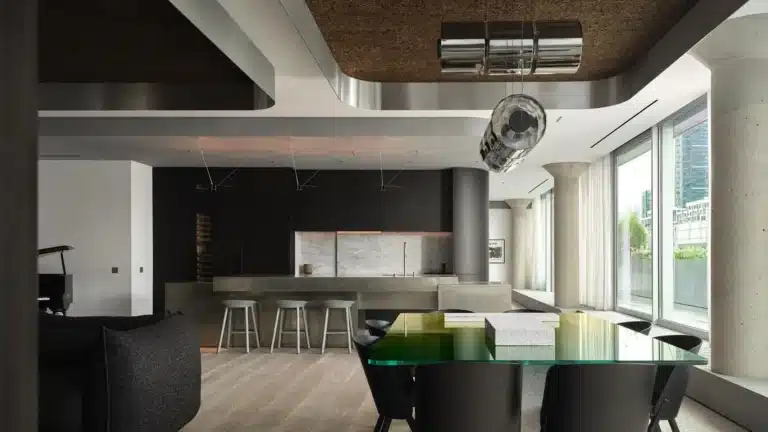


ArchUp: Material and Functional Analysis of Tbilisi Residential Apartment
This article examines a residential project in Tbilisi as a case study in customized interior design. To enhance its archival value, we would like to present the following key technical and material data:
The interior system utilizes 85% natural materials, including local stone (3 cm thick for cladding), solid wood (20×5 cm oak for flooring), and polished metal (stainless steel). The apartment spans 120 m², with flexible partitioning creating continuous visual flow through 2.5-meter wide openings between spaces.
The visual and thermal performance features neutral colors (RAL 9000-9100 system) covering 70% of surfaces, with a centrally located stone-lined fireplace (1.2-meter diameter) reaching 8 kW capacity. The design achieves up to 45 dB sound insulation through double walls and heavy drapes.
In terms of functional efficiency, the grid-pattern flooring (60×60 cm) directs resident movement toward focal points, allocating 40% of space for flexible multi-use zones. Integrated storage units provide capacity up to 15 m³ while maintaining clean visual lines.
Related Link: Please review this article for a comparison of contemporary interior design techniques:
Contemporary Interior Design: Between Aesthetics and Functional Efficiency
https://archup.net/ar/ستة-عناصر-تصميم-دائمة-الخضرة-تحدد-التص/