Palisade House cladding with tall fir palisade to protect the dunes

Aiming to protect the natural sand dunes and native plant species,
Lisbon-based architecture studio BICA Arquitectos designed a dwelling wrapped in a tall fir-bark fence.
In addition to ensuring the privacy of residents in Troia, Portugal.
Design features
The building has an area of 300 square meters and is named Palisade House.
The building is situated in a Landscape of Outstanding Natural Beauty,
facing the sea and aligned with many neighboring buildings.
Drawing the overall volume on an elongated plan, the overall volume emerges with the interplay of solid and void spaces,
as interior courtyards are dispersed between the solid volumes.

The main reason for this bulkhead, made of fir wood,
is to preserve the natural environment in which the house sits, with an emphasis on environmental support for the dwelling.
Taking cues from these ideas, BICA Arquitectos created large sand dunes covered
with native plant species to surround the house.
The house appears to rise from the sand dunes with the hedge,
complementing the colors and textures present in it.
The dune has enhanced the natural characteristics of the context,
favoring local sustainability at the same time, because it was created with sand removed from neighboring buildings.
Complementary, a tall fir barrier was erected to maintain the new dunes.
This defines the perimeter of the building while concealing the different sizes that the house includes.

Design form
The one-storey building is enriched with evenly interspersed courtyards,
while the first volume consists of a large living-dining room, kitchen and toilet.
The six back volumes are reserved for private spaces, primarily bedrooms.
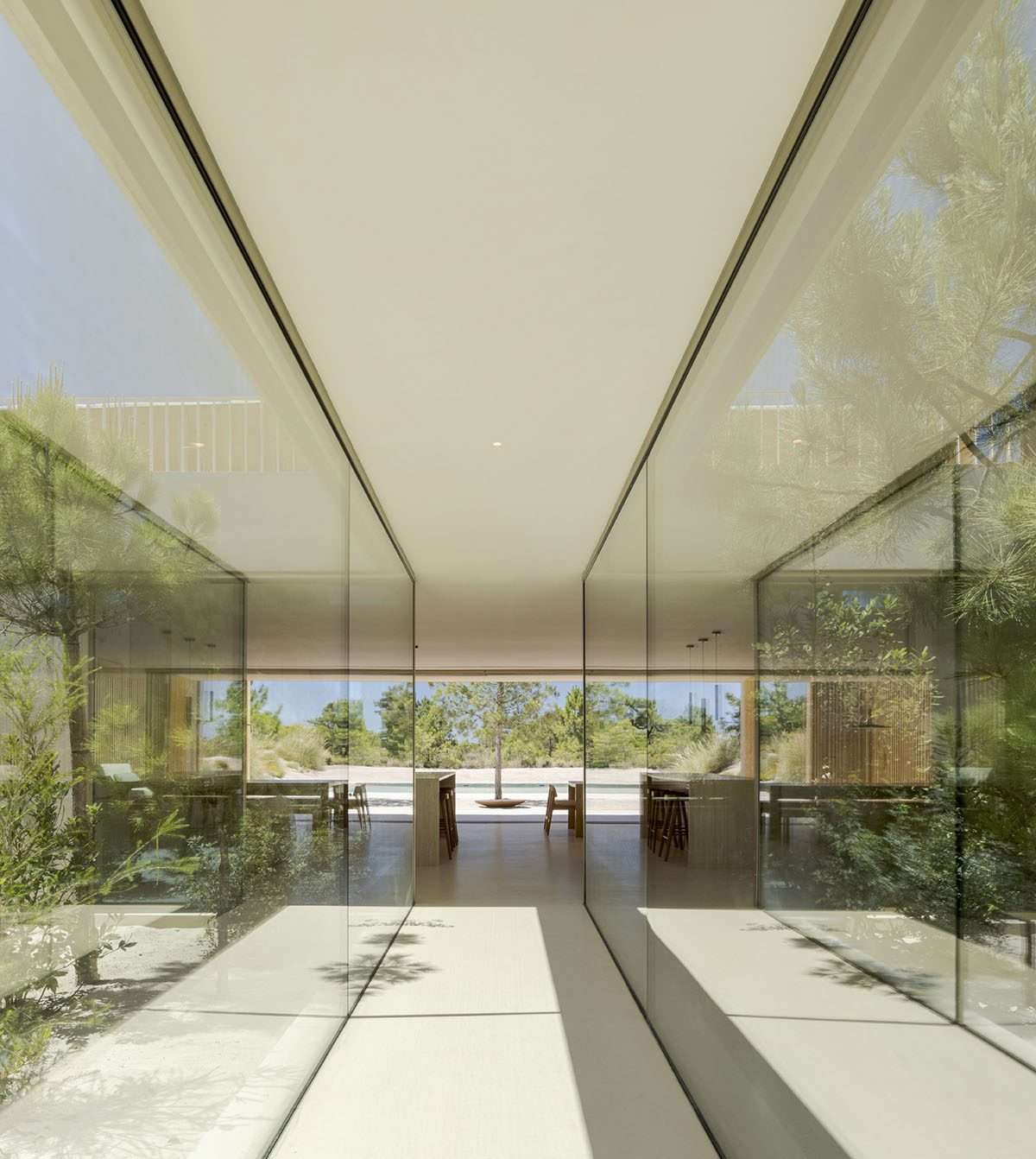
Inside, along a long central corridor, the private spaces of the house are located symmetrically and punctuated by courtyards.
Where previously existing plant species, such as pines, eucalyptus, and shrubs, were preserved.

The social area of the house was also designed at the end of this corridor,
and the social area is distinguished by its relationship with the landscape.
And also opening to the outside, in a part of the terrain where the neighboring buildings are no longer visible.
While the design of the pool anticipates the presence of the sea, which is a few meters away,
and is accessed through a ramp covered in sand-based mortar.
Establishing continuity with the sand dunes, the entertainment area extends to the roof terrace,
from which the view is visible.

There is also an outdoor swimming pool, accessed via a sand-mortared ramp, at the front of the dining room, a few meters away.
Establishing this continuity with the dunes, the entertainment area is defined on the roof terrace extending from the front part of which the sea is visible.
Design materials
The house was built in keeping with the principles of the resort:
a main bearing steel structure with a light steel frame clad in OSB and thermal insulation,
finished with sand based mortar on the walls.
The interior design follows the same principle and is completed with similar finishes.
The same materials and color palette are applied to the floors, resulting in perfect harmony with the surroundings.
Architects choose the limestone material, because the material is very similar to sand layers.
This painting would not be complete without bringing fir and ash wood for the outdoor and indoor furniture,
contributing to defining a whole that establishes continuity with the landscape.
For more architectural news