

Palm Jebel Ali Friday Mosque: Contemporary Reinterpretation of Islamic Form

The designs for the Palm Jebel Ali Mosque have been unveiled, presenting a contemporary approach to religious architecture in Dubai. The design integrates geometric clarity with climatic responsiveness. It was developed in collaboration with an international architecture firm and delivered by a local real estate developer, accommodating 1,000 worshippers. Located along the island’s central spine, it reinterprets Islamic heritage through a modern design and aligns with the Dubai 2040 Urban Master Plan.

Design Concept
The design avoids literal historical replication. Instead, it uses abstracted Islamic geometry.A defining feature is the textile-inspired canopy that extends from the roof down to the courtyard. This references Emirati vernacular shade structures and coastal wind patterns. The canopy creates visual continuity between interior and exterior spaces. It also softens thresholds and guides movement through layered sequences. The 40 meter minaret serves as a vertical marker and geometric counterpoint. Spatial layout prioritizes intuitive circulation for ablution and prayer. This approach reflects broader trends in architecture, where form follows both ritual and environment. The project joins other contemporary religious structures documented on the global architecture platform.
Materials & Construction
The material palette is restrained but performance driven. Light toned stone, precast concrete, and perforated aluminum screens form the envelope. The screens reference traditional mashrabiya while enabling passive shading. The canopy uses PTFE coated fiberglass membranes on a concealed steel frame. These materials resist humidity and salt corrosion key concerns in coastal Dubai. Reinforced concrete serves as the primary structural system. This method is common in constrained sites, as seen in other regional buildings. Construction emphasizes modularity to reduce on-site labor. This aligns with evolving construction practices across the Gulf. The choice of building materials balances aesthetics, durability, and maintenance.

Sustainability
Environmental performance relies on passive strategies, not high tech systems. The canopy provides up to 70% solar shading on southern and western facades. Natural ventilation is optimized through courtyard orientation and window placement. Sea breezes flow through ablution zones and prayer halls. Daylighting reduces artificial lighting needs during daytime hours. Greywater from ablution areas irrigates native, drought tolerant plants. These measures reflect regional priorities tracked under sustainability frameworks. The project does not pursue formal green certifications. Instead, it embeds environmental logic into spatial and material decisions. This quiet integration is increasingly common in civic buildings.
Urban/City Impact
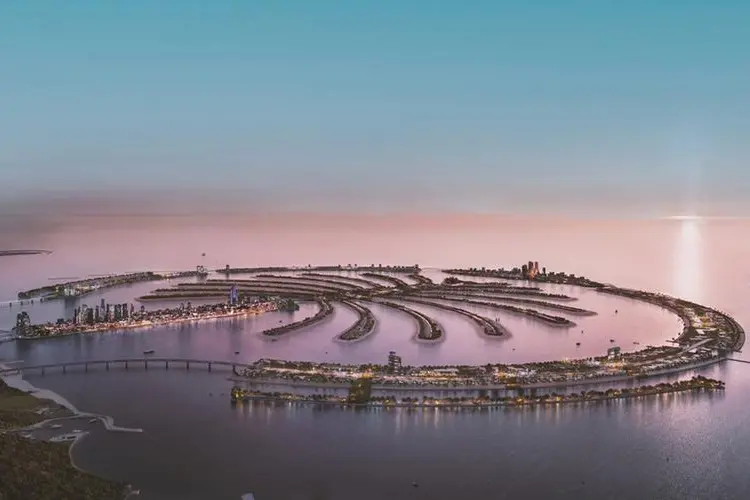
The mosque sits within Palm Jebel Ali a 13.4 km development of seven islands and 16 fronds. It functions as both a religious facility and a civic landmark. The minaret aids wayfinding across the island’s radial layout. This addresses a common issue in masterplanned communities: loss of human scale. By integrating the mosque into daily life not isolating it as a monument the project supports social cohesion. This model is relevant to debates about faith-based infrastructure in privatized districts. As the island advances under the Dubai Economic Agenda D33, planners and developers will put its cities strategy to the test. The architectural design of institutions like this shapes how new districts foster belonging beyond commerce.
The Palm Jebel Ali Friday Mosque shows how abstraction and pragmatism can coexist in religious architecture. But its success depends on use, not form. Will it become a living space for community ritual or remain a curated symbol?
Architectural Snapshot: A 1,000 capacity mosque in Dubai featuring a tensile canopy, 40 meter minaret, and passive climate strategies by SOM for Nakheel on Palm Jebel Ali.
ArchUp Editorial Insight
The article on Palm Jebel Ali Friday Mosque offers a technically precise account of a design merging geometric abstraction with climatic response, using measured architectural language and clear references. Yet its emphasis on visual motifs like the textile canopy obscures a lack of inquiry into how the space accommodates daily ritual or communal engagement. Credit goes to the project for avoiding literal historicism a rarity in contemporary religious architecture.Still, questions of temporal relevance linger: will people remember it in a decade as a sincere dialogue, or as a branded aesthetic exercise?


ArchUp: Technical Analysis of the Palm Jebel Ali Mosque in Dubai
This article provides a technical analysis of the Palm Jebel Ali Mosque as a case study in contemporary, climate-responsive religious architecture. To enhance its archival value, we present the following key technical and design data:
The design is based on an abstract geometry inspired by Islamic heritage, with a capacity for 1,000 worshippers. The prominent feature is an extended glass fiber tensile fabric canopy, supported by a hidden steel frame. This canopy provides 70% shade on the southern and western facades, with a 40-meter-high minaret serving as a visual and religious vertical landmark. The main prayer hall covers approximately 800 square meters, with direct access to an external courtyard.
The environmental system incorporates contemporary passive cooling strategies. Ventilation utilizes the “stack effect” principle, where cool air enters through the courtyard and open spaces, and warm air exits through upper openings. Perforated aluminum screens (modern mashrabiyas) are used on the facades to provide privacy and shade while allowing 65% of light and 80% of air to pass through. 100% of ablution water is recycled to irrigate local salt-tolerant plants, reducing freshwater consumption by 30%.
In terms of functional performance, the project successfully integrates ritual and sustainability. Facade materials were selected for their high resistance to corrosion in the coastal environment, where humidity can reach 85%, utilizing light-colored stone and precast concrete. The internal layout enhances the fluid movement from ablution areas to the prayer hall through shaded corridors, minimizing direct sun exposure. The mosque is organically integrated into the radial urban planning of Palm Jebel Ali, with a key orientation towards the waterfront.
Related Link: Please refer to this article for a broader discussion on the role of religious architecture in shaping cities:
Architecture of Civilizations: Tracing the Built Timeline of the Middle East
https://archup.net/ottoman-mosques-in-the-middle-east-architectural-elegance-and-spiritual-harmony/