A Design That Doesn’t Demand Attention: A Portuguese Lesson in Architectural Humility

When Architecture Disappears from Sight
Amid the cliffs of Cabo da Roca in Portugal, you might walk by without noticing a building at all. This visual vanishing act is no coincidence, it’s the result of a deliberate architectural vision by João Tiago Aguiar Arquitectos, who breathed new life into an old windmill, transforming it into an urban experience that plays with presence and absence.
Adaptive Reuse Beyond Restoration
Spanning 740 square meters, the project doesn’t stop at the windmill, it also incorporates three adjacent buildings, seamlessly unified to form a harmonious complex. This integration isn’t merely a collection of architectural elements; it’s a revival of spaces designed to engage with the dynamic rhythm of the surrounding Atlantic.
Material Dialogue with the Environment
What stands out in this work is not just its scale or location, but the meticulously chosen materials.
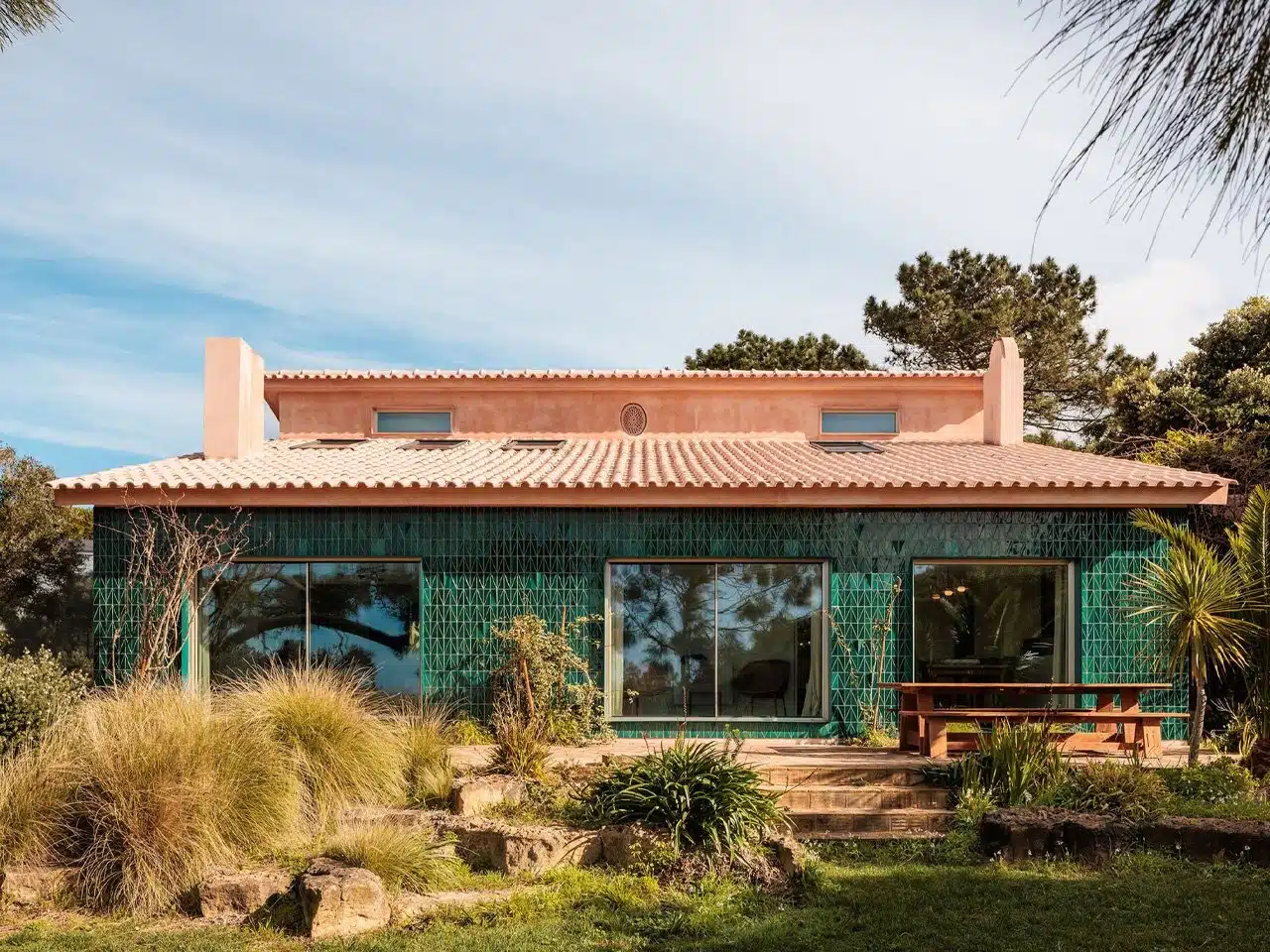
The building’s façade is clad in glossy green tiles that shift in hue with the movement of clouds, from deep emerald to tranquil jade, offering a transforming visual dimension that resists fixation.
Additionally, salt-spray-resistant ceramics are used, reflecting an acute awareness of the coastal site’s specific climatic challenges.
Terracotta: A Link to the Earth
The terracotta coating carries both symbolic and material significance. On one hand, it offers a tactile sense of warmth; on the other, it reconnects the structure to the red soil beneath it, imparting a sensory local character that goes beyond form to essence.
Architecture that Vanishes
Yet the most striking feature lies in the central glass portion. At certain times of day, especially in the afternoon, the glass reflects the sky with such purity that part of the building appears to vanish entirely. This visual “trick” is not just an aesthetic display but a profound architectural statement about blending with the environment rather than imposing upon it.


From Chaos to Character: How Flaws Became Features
When faced with an old structure like this Portuguese windmill, it’s easy for an architect to feel overwhelmed.
The building consists of three mismatched volumes, angled in seemingly random ways, with roofs that defy conventional geometry.
Such a composition would drive many to demolish and start anew.
But in this project, the approach went in the exact opposite direction.
Instead of resisting the chaos, it was embraced and transformed into a foundation for uniqueness.
The odd angles and unconventional intersections weren’t treated as obstacles, but as opportunities for a new kind of visual creativity.
A Dialogue Between Old and New
Walking through the building reveals a design language that weaves together history and the present.
The old stone isn’t hidden, it stands proudly, engaging in a visual dialogue with contemporary architectural elements.
What’s striking here is the design’s ability to transcend contradictions: no material feels out of place or artificial, but rather an organic part of the building’s fabric.
Windows Framed Like Paintings
Inside, nearly every window overlooks the ocean like a carefully composed photograph.
This intentional orientation goes beyond visual beauty; it deepens the relationship between the inhabitants and the natural world outside.
Fluidity of Movement and Light
Moving from one room to another follows the original logic of the windmill, not rigid design templates.
This gives the space a natural sense of continuity, as if the rooms flow organically rather than being forced into place.
Light plays a central role as well, filtering in from unexpected corners and bouncing off handcrafted tiles to create shifting patterns that evolve with the hours of the day.
The Human Scale of Living
Despite the architectural complexity, the interior spaces are grounded in human proportions.
There are no oversized showy halls or awkward, alienating corners.
Instead, there’s a clear invitation to pause, to stay, to live in harmony with the space.
And what heightens the sensory experience is the ocean breeze slipping through the windows, carrying the scent of salt and the sound of waves, reminding you that architecture here isn’t just a structure, but a seamless extension of nature itself.


Tiles as a Medium of Architectural Expression
In this project, tiles are far more than decorative cladding, they’re active agents in the building’s visual experience.
Each tile, with its three-dimensional design, captures light differently, creating constantly shifting shadows and glimmers across the façade.
Craftsmanship Serving Modernity
What truly distinguishes these tiles is their handmade nature, with slight variations that lend the façade a continuous sense of motion and life.
Up close, one can discern the fingerprints of traditional craftsmanship, elevated here to new heights of contemporary design without severing ties to its Portuguese roots.
A Palette in Dialogue with Time
The color gradient of these tiles ranges from deep ocean blues to soft aqua hues, depending on the sun’s angle and time of day.
This visual fluidity reinforces the building’s connection to its natural surroundings, making it feel ever-changing rather than static or rigid.
When Architecture Steps Back for Nature
What’s remarkable about this design is that the building doesn’t seek to dominate the landscape, it steps back with lightness and respect.
It acknowledges that it stands before one of Europe’s most dramatic coastlines, and so it doesn’t compete, but instead allows nature to make the first impression.
A Gradual Sensory Encounter
Visitors first encounter the sound of waves, the rawness of the cliffs, and the vast ocean horizon, only then do they begin to notice the subtle intelligence of a design that harmonizes with, rather than interrupts, its setting.
Here, architecture doesn’t shout; it whispers, gently and in tune, turning the entire experience into a kind of natural retreat, as if the building had emerged from the rocks themselves.


✦ ArchUp Editorial Insight
Despite the project’s aesthetic finesse and its remarkable ability to engage with nature effortlessly, a lingering question remains: Can architecture disappear without losing its expressive function?
The design offers an inventive answer, but it also opens the door to debate. While it succeeds in crafting a poetic spatial experience that blends seamlessly with its environment, one might also view it as an architectural gesture that verges on excessive modesty, almost erasing its own identity as an independent built form.
The reliance on glass as a medium for blending in, though visually compelling, raises questions about environmental performance and insulation efficiency in a harsh coastal climate.
And while the project is commendable for resisting the lure of architectural spectacle, this very restraint may not resonate globally, especially in urban cultures that view architecture as a bold vehicle for asserting identity.
Ultimately, the project delivers both a visual and critical lesson: about when architecture should speak, and when it’s better for it to fall silent… or even disappear.
Prepared by the ArchUp Editorial Team
Don’t miss the chance to explore more from Projects in fields like Design and Architectural News on the ArchUp website.