Qiddiya tennis complex stadium at night with illuminated floodlights and filled spectator stands

Qiddiya tennis complex: stadium design, capacity and opening status

Home » News » Qiddiya tennis complex: stadium design, capacity and opening status

Qiddiya tennis complex anchors Saudi Arabia’s national tennis development strategy. It is located in Qiddiya’s sports district near Riyadh. The facility supports international tournaments and public use. Its planning aligns with standards in architectural design.
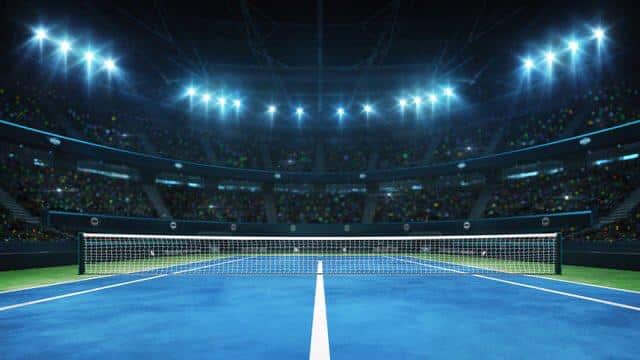
Night view of Qiddiya city masterplan including the tennis complex zone and entertainment districts
A digitally rendered view of the central court under bright stadium lighting, emphasizing scale and spectator capacity. (Image © Qiddiya)

Design Concept

The site uses natural terrain to shape viewing angles and movement paths. A central stadium holds 5,000 to 7,000 spectators. Around it, 10 to 15 courts offer varied surfaces. This layout echoes strategies seen in other events covered by the news section.
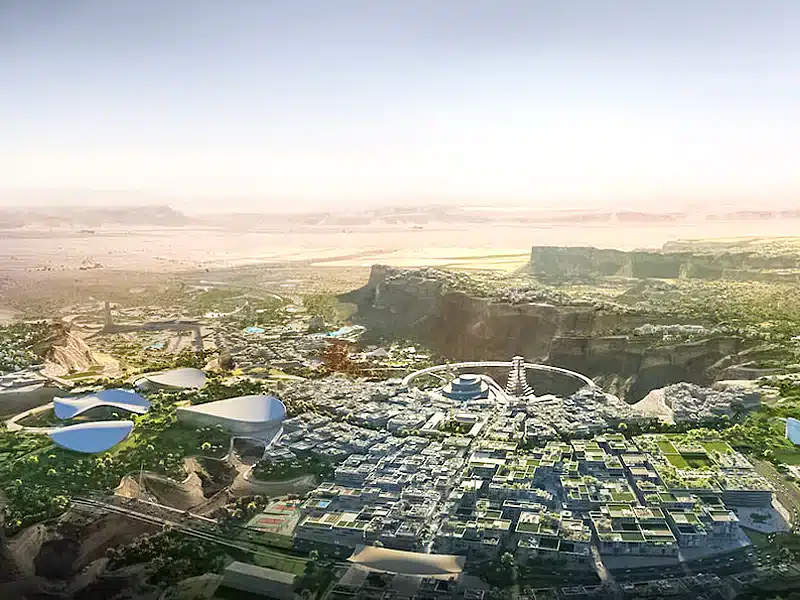
Daytime rendering of Qiddiya masterplan showing urban clusters near the tennis complex area
A conceptual visualization of Qiddiya’s phased development, illustrating density, open space, and topographic integration. (Image © Qiddiya)

Materials & Construction

Construction relies on reinforced concrete and structural steel. High-performance glass features in pavilions and viewing areas. These choices follow regional norms in building materials. The approach supports rapid assembly and heat resistance. Prefabricated elements reduce on-site construction time.
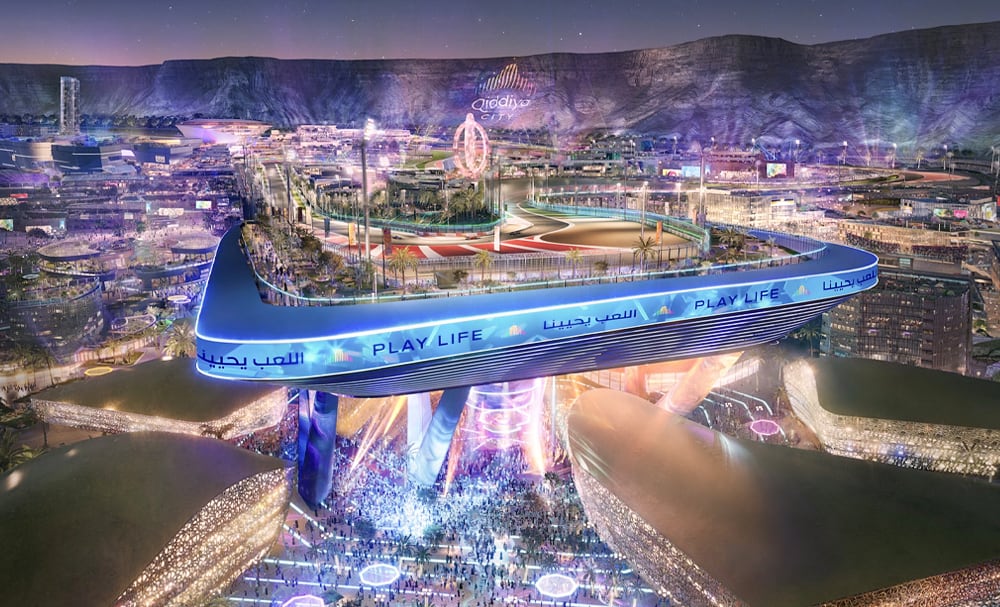
Night rendering of Qiddiya City’s central plaza with illuminated pedestrian bridge, event space, and mountain backdrop featuring the Qiddiya logo.
A digital visualization of the central public realm in Qiddiya City, emphasizing connectivity and programmed activity zones. (Image © Qiddiya)

Sustainability

Passive shading minimizes solar heat gain. Greywater systems irrigate courts and landscaping. Photovoltaic panels may power auxiliary functions. These tactics reflect broader trends in sustainability. They also appear in other Gulf sports buildings.
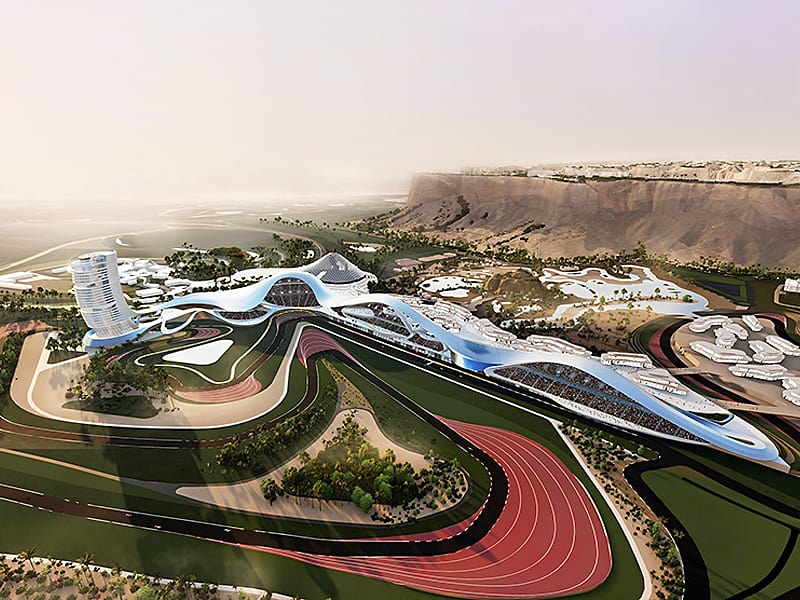
Aerial rendering of Qiddiya’s motorsport district featuring a curving racetrack, spectator stands, and sculptural buildings integrated into desert terrain.
Digital visualization of the racing circuit and adjacent facilities, emphasizing topographic integration and movement flow. (Image © Qiddiya)

Urban and Programmatic Role

The complex transforms desert land into active public space. It links to transport routes and nearby venues. This fits planning models documented under cities. Future phases could add a national tennis academy. No demolition plans have been announced. The National Tennis Complex in Qiddiya serves dual athletic and civic roles.

Will daily public use match the scale of its tournament ambitions? The National Tennis Complex in Qiddiya faces this test over time.

Architectural Snapshot: The National Tennis Complex in Qiddiya features a central stadium, multi surface courts, and climate-responsive design in Saudi Arabia’s Qiddiya district.

ArchUp Editorial Insight


The National Tennis Complex in Qiddiya functions as a programmatic node within Saudi Arabia’s sports diversification agenda, adopting a globally legible but contextually inert architectural language. Its design replicates international stadium typologies without interrogating local spatial culture or climatic intelligence, settling for compliance over innovation. Credit is due for integrating baseline sustainability measures in a region where environmental accountability remains rare. Yet its legacy may hinge less on form and more on operational inclusivity if it serves communities beyond ceremonial openings, it might outlive its promotional utility; otherwise, it risks becoming another infrastructural relic of ambition without adaptation.

Further Reading From ArchUp

  • Academy Awards Greenroom

    The Academy Awards Greenroom at Hollywood’s Dolby Theatre has long been a space of enchantment,…

  • The relationship between cinema and architecture

    The relationship between cinema and architecture, Architecture is all around us, as humans spend their…

  • Structural Stabilization in the World’s Longest Expressway Tunnel

    The Tianshan Shengli Tunnel opened to traffic . It applies structural stabilization principles to manage…

  • Studio Aisslinger designs Jägermeister’s HQ

    Studio Aisslinger, headquartered in Berlin, has given the Jägermeister office a colourful and playful interior design that pioneers modern casual office ideas. The Jägermeister headquarters in Wolfenbüttel, Germany is designed around creativity and a vibrant workplace that rebels against grey, uniform offices.The Jägermeister office design is a visual representation of how the world is changing

  • Rodolphe Parente respectfully rethinks a classic Haussmannian apartment in Paris

    French interior designer Rodolphe Parente has completed a contemporary overhaul of a 19th-century Parisian apartment, reflecting both the building’s heritage and the “radical” art collection of its owner. Originally built during Haussmann’s major reconstruction of Paris, the 150-square-metre flat is located in the Canal Saint-Martin neighbourhood in northeastern Paris. Rodolphe Parente has renovated a Haussmann-era

  • New Museum of Jesus’ Baptism to Rise at Jordan’s Sacred Site

    A recent news update has confirmed the winning design for the Museum of Jesus’ Baptism. The museum…

Leave a Reply

Your email address will not be published. Required fields are marked *