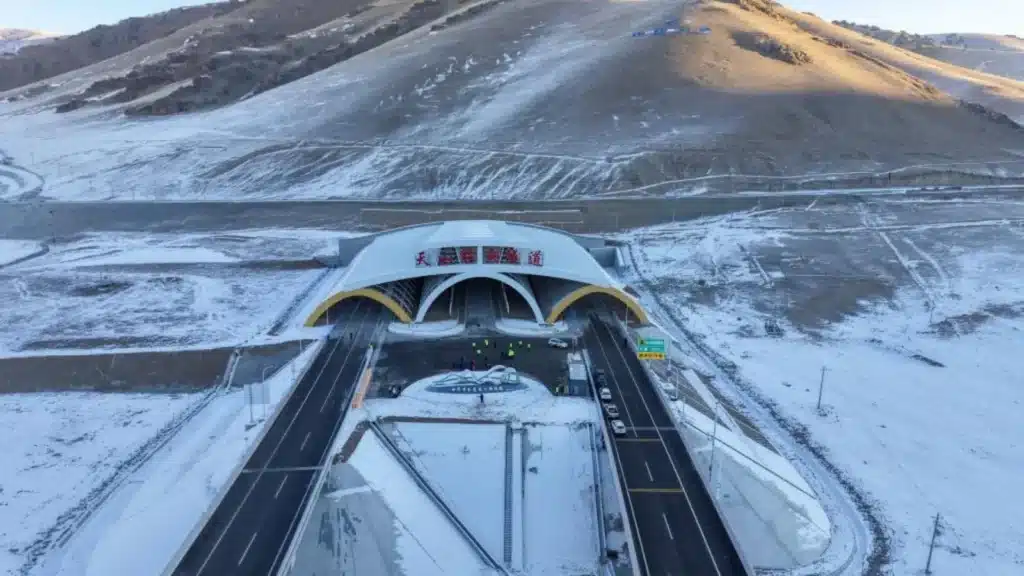
Structural Stabilization in the World’s Longest Expressway Tunnel


The Tianshan Shengli Tunnel opened to traffic . It applies structural stabilization principles to manage extreme geotechnical conditions. The tunnel runs 22.13 kilometers through the central Tianshan Mountains in China’s Xinjiang Uygur Autonomous Region. It forms the core of the G0711 Urumqi Yuli Expressway. Crossing time has dropped from several hours to about 20 minutes.
The expressway now links Urumqi with Korla and Yuli in roughly three hours down from seven. This improves north south connectivity across Xinjiang.

Improving Mobility Across Complex Terrain
The tunnel supports China’s push to modernize infrastructure in remote areas. Engineers prioritized function over form. They embedded structural stabilization into every major design decision to resist ongoing ground shifts. The route integrates cities and urban planning systems across isolated mountain zones.
Construction Methodologies and Geological Challenges
Work started in April 2020 at elevations above 3,000 meters. Crews faced fractured rock, temperatures below zero, and seismic hazards. The team used a three tunnels plus four shafts layout. This included two main traffic bores and a central pilot tunnel. Tunnel boring machines (TBMs) dug the pilot tunnel. Workers used mechanized drill and blast methods for the main tubes. A dual layer lining rock bolts, steel arches, and shotcrete delivers long term structural stabilization.

Supporting Regional Logistics and Development
Construction ran year round despite −30°C winters and unstable rock layers. Designers excluded non essential elements from architectural design. They focused solely on performance. The tunnel strengthens freight and passenger links between Xinjiang and eastern economic centers. Its safety relies on consistent structural stabilization under static and dynamic loads.
Engineering Documentation and Knowledge Sharing
The project now serves as a reference for high altitude tunneling. Teams archived technical records in the archive for engineering research. They also published findings on the architecture platform to support professional practice. These insights feed into current design competition topics like “Rethinking Core Drilling in Concrete Structures.” The work builds on recent progress in building materials and construction techniques.
Architectural Snapshot: The 22.13 kilometer Tianshan Shengli Tunnel the world’s longest expressway tunnel is engineered around structural stabilization to operate safely in one of Asia’s most seismically active alpine zones.
ArchUp Editorial Insight
The article presents technical details of the Tianshan Shengli Tunnel with factual precision, framing China’s infrastructure expansion through the lens of geotechnical necessity rather than national spectacle. It avoids promotional rhetoric and centers structural stabilization as both engineering strategy and narrative anchor. Yet it sidesteps critical questions: Who bears the ecological cost of tunneling through fragile alpine ecosystems? Whose land is traversed without mention? The omission of local context reduces a monumental intervention to a neutral engineering case study. Still, its disciplined focus on material performance shotcrete, rock bolts, TBMs offers a rare counterpoint to architecture’s obsession with form. In ten years, this text may be valued not for what it says about Xinjiang, but for how it documents a moment when infrastructure chose silence over symbolism.