

Brutalism Reimagined: How a Community Game Jam Is Redefining Virtual Architecture

A new cultural and architectural investigation, published today in the British newspaper The Guardian, examines how a grassroots video game event has evolved into one of the most ambitious experiments in virtual brutalist architecture and spatial design seen in contemporary gaming culture.
Originally conceived as a niche celebration of classic shooter level design, Quake Brutalist Jam has grown into a large-scale collaborative project that now borders on being a standalone game—one shaped not by commercial imperatives, but by architectural ideas, community craft, and spatial experimentation.
A Concrete Descent: Architecture as Narrative Space
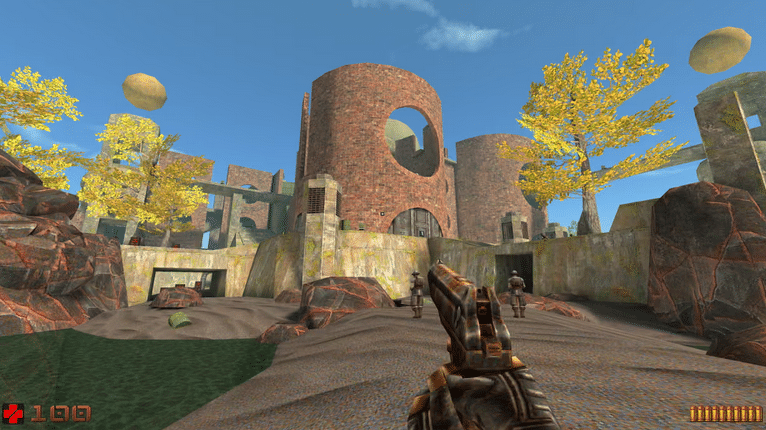
The latest iteration of the Jam opens with a stark architectural gesture: a lone concrete spire rising from a rocky basin, concealing a mechanical trapdoor that drops the player into a subterranean gallery. This structure functions simultaneously as threshold, museum, and navigation device, introducing players to dozens of spatial “pocket dimensions,” each defined by abstract geometry and combat-driven movement.

Here, architecture is not background scenery but a primary storytelling mechanism, echoing the ethos of brutalist design, where form, materiality, and mass communicate meaning without ornament.
From Level Design to Architectural System
First launched in 2022, Quake Brutalist Jam began as an exploration of old-school 3D level construction, attracting veteran developers, aspiring designers, and modders working within the framework of id Software’s 1996 shooter Quake. The unifying theme—brutalist minimalism—proved unexpectedly fertile.

By its third edition, contributors had produced 77 brutalist-themed environments, more than double the number of levels included in the original game. These spaces combine raw concrete aesthetics, severe lighting, and monumental forms with increasingly complex spatial logic.
New Tools, New Spatial Languages
The turning point came when the organisers expanded the Jam beyond map-making into a full total conversion, introducing new weapons, enemies, and mechanical systems. This shift allowed designers to rethink architecture not only as static geometry, but as interactive infrastructure—spaces shaped by movement, rhythm, and encounter.

Weapons that bounce, pierce, or fragment, alongside newly designed enemy behaviours, forced contributors to design environments that respond dynamically to combat and exploration, blurring the line between architectural planning and game mechanics.
Museums, Mazes, and Megastructures
The Jam’s “Start Map”—a playable mission-selection space—was reconceived as a brutalist museum, a dense architectural archive housing portals to every contributed level. This curatorial approach mirrors real-world architectural exhibitions, where circulation, compression, and sequencing become design challenges in their own right.
Contributed works range from short experimental spaces to vast, narrative-driven megastructures. The standout example, Escape from KOE-37, spans nearly three hours of playtime and features over 1,000 enemies, functioning as a self-contained architectural world inspired by linear storytelling traditions.
Preserving a Vanishing Design Discipline
The Guardian’s investigation situates Quake Brutalist Jam within a broader cultural context: the decline of linear, single-player first-person shooters in mainstream development. As the industry pivots toward open worlds and multiplayer platforms, the intricate maze-like spatial design pioneered by games such as Doom and Quake risks becoming a lost discipline.
Community-driven projects like this Jam, however, are not merely preserving that tradition—they are expanding it, exploiting decades of accumulated design knowledge to create spatial compositions that exceed what was technically or conceptually possible in the 1990s.
Architecture for the Public, Not the Market
Several contributors frame the Jam as an ideological project as much as a creative one. Drawing explicit parallels with brutalism’s social ethos, they describe the event as a form of public architecture—freely accessible, collectively built, and oriented toward future generations rather than profit.
In this sense, Quake Brutalist Jam functions as a digital analogue to postwar civic architecture: imperfect, uncompromising, but deeply invested in the idea of shared cultural space.
A Forward-Looking Perspective for Architects and Designers
For architects—particularly those interested in digital environments, game spaces, and experimental spatial systems—Quake Brutalist Jam offers several key insights:
Architecture as interaction, not object
The value of constraint-driven creativity
Community-based production as an alternative design model
The growing relevance of virtual brutalism as a testing ground for form, scale, and movement
As the organisers now consider developing a fully independent game, the project hints at a future where architects and designers increasingly operate across physical and virtual domains, using games not as entertainment alone, but as laboratories for spatial thought.
✦ ArchUp Editorial Insight
The Quake Brutalist Jam situates itself within a lineage of Brutalism, translated into a virtual architectural language where mass, abstraction, and spatial severity drive narrative and movement. Conceived as a collaborative digital environment, the project uses raw concrete aesthetics, monumental geometry, and compressed circulation to position architecture as an active system rather than passive backdrop, foregrounding Spatial Dynamics as a primary design tool. However, this experiment raises critical questions about Contextual Relevance within virtual culture: while the spaces are formally rigorous, their insularity risks privileging architectural autonomy over broader accessibility or experiential diversity. The emphasis on combat-driven interaction also tests Functional Resilience, as spatial logic becomes tightly bound to specific mechanics. Nonetheless, the Jam demonstrates a compelling Architectural Ambition, reframing virtual environments as laboratories where architectural ideas can evolve free from market constraints yet still engage collective authorship and cultural memory.

★ ArchUp: Technical Analysis of Hayashi Wardrobe: Material, Motion, and Interaction
Analysis of Integrating Traditional Japanese Philosophy with Interactive Furniture:
This article provides a technical analysis of the Hayashi Wardrobe, designed by Taishi Sugiura, as a case study in integrating traditional Japanese philosophy with contemporary interactive furniture design.
1. Structural System: Dynamic Sliding Branches: The core of the design is a simple frame onto which real Japanese cypress branches (2-4 cm in diameter) are mounted. Each branch has a built-in mechanical channel, enabling horizontal sliding. This allows the user to adjust gaps from a fully closed state (≤5 mm) to wide open (10-15 cm), offering dynamic control over visibility and ventilation.
2. Materiality and Aesthetics: Uniqueness from By-Products: The project champions material sustainability by using branches from forest thinning operations, a typically wasted resource. The unique grain and natural curvature of each branch ensure no two pieces are alike. Natural light passing through the variable gaps creates an ever-changing play of shadows, adding a time-based aesthetic dimension.
3. Philosophy and Performance: Intelligent, Electronics-Free Flexibility: The wardrobe reinterprets the traditional Shoji screen principle at a furniture scale, transforming a static object into an interactive tool. Its deliberate electronics-free design ensures intuitive, tactile interaction and long-term sustainability. This approach extends the product’s life through adaptability and gives new value to overlooked materials, achieving a profound synthesis of material and philosophical sustainability.
The provided link directed to an article about the “OAS/S-NEST” sensory beach installation, which explores light and nature in a temporary structure. While thematically different from the intended Ushida Shouten Headquarters project, it shares an interest in material experience. For a direct comparison on heritage reinterpretation, you might search ArchUp for the correct title or keywords like “Ushida Shouten” or “machiya renovation”.



✅ Official ArchUp Technical Review completed for this article.