
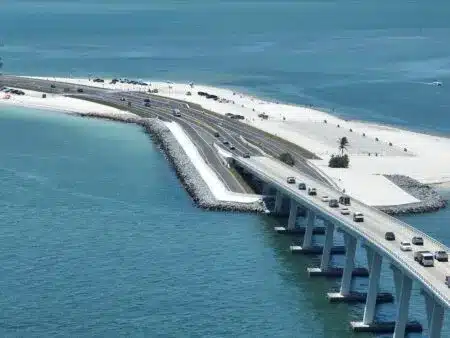
Sanibel Causeway Restoration Completed for $328M: A Resilient Reconnection After Hurricane Ian

Florida’s Department of Transportation has announced the completion of the primary restoration phase of the Sanibel Causeway restoration project. At a cost of £328 million, the 3-mile section connecting Sanibel Island to Florida’s mainland has been successfully rebuilt. The announcement was made on 20 May 2025—more than two years after Hurricane Ian devastated the causeway in September 2022.
Background: Hurricane Ian and the Urgent Response
Originally opened in 1963, the Sanibel Causeway stretches 12 miles over San Carlos Bay and includes three bridge spans separated by artificial islands. However, in September 2022, Hurricane Ian caused catastrophic damage, washing away ramps, bridge approaches, and parts of the roadway across the central island. This severed the critical lifeline between Sanibel, Captiva, and the rest of Florida, necessitating restoration efforts for the Sanibel Causeway.
Emergency crews responded rapidly. Within just 15 days, Jacksonville-based Superior Construction established a temporary link—beating the 12-day schedule set by FDOT. This quick fix allowed emergency access while permanent design and restoration of the Sanibel Causeway was underway.

Construction Strategy: A Multi-Phase Design-Build Process
The project marked FDOT’s first multi-phase design-build contract, carried out by a joint venture between Superior Construction and de Moya Group (Miami). Their goal was not only to restore but also to upgrade the causeway to withstand future climate challenges, making the Sanibel Causeway restoration crucial to resilience.
One of the project’s toughest requirements was to keep two-way traffic open throughout construction. This meant working in limited space with tight schedules, coordinating multiple trades simultaneously.
At peak intensity, work was carried out by several crews as shown below:
| Work Type | Number of Crews |
|---|---|
| Pile Drilling | 3 |
| Earthmoving | 4 |
| Stormwater Installation | 2 |
| Rebar Placement | 6 |
| Concrete Pouring | 8 |
| Asphalt Paving | 3 |
Key Resilience Features of the Rebuilt Causeway
To protect the infrastructure from future hurricanes and sea-level rise, the project included state-of-the-art storm mitigation components, including features essential to the Sanibel Causeway restoration.
| Feature | Quantity / Description |
|---|---|
| Steel sheet pile retaining walls | 750,000 sq. ft (26.2M pounds of steel) |
| Concrete slope coverings | 19,750 linear feet |
| Armor stone for wave energy reduction | 127,996 tons |
| Raised seawalls | Between 5 and 8 feet high |
| Advanced drainage systems | Installed throughout the structure |
| Asphalt paving | 19,500 tons |
| Marine erosion control mats | 25,225 sq. yds gabion mat + 79,000 tons of marine gravel |
| Permanent concrete traffic barriers | 6,900 linear feet |
| Decorative concrete paneling | 25,000 sq. ft |
Withstanding Florida’s 2024 Storm Season
In 2024, Florida faced multiple named storms including Debbie, Helen, and Milton. While some unfinished segments of the Sanibel Causeway experienced minor erosion and scour, the completed sections remained intact and fully functional—a strong testament to the resilience of the new construction achieved through the restoration effort.


The Human Impact: Reconnecting Lives and Livelihoods
For Sanibel Island’s residents, this wasn’t just infrastructure—it was a lifeline. The causeway supports local travel, jobs, education, emergency services, and supply chains. Its loss isolated communities and interrupted lives.
Therefore, the restoration has not only rebuilt a road but revived hope, safety, and economic continuity across the region, making the Sanibel Causeway restoration vital for reconnecting lives.
Timeline and Final Completion in 2025
The full completion of the Sanibel Causeway restoration is expected later in 2025, including decorative elements, sidewalk enhancements, and environmental restoration of affected marine habitats. However, the primary functional structure is already back online, providing secure access and storm protection as a result of the restoration project.
Conclusion
The Sanibel Causeway restoration stands as a landmark project in coastal resilience and emergency infrastructure recovery. Through seamless collaboration between state agencies and contractors, Florida has set a new benchmark for rebuilding in storm-prone zones—combining engineering excellence with community-centered planning. The restoration exemplifies the importance of strategic planning.
ArchUp is your platform for everything ‘architectural‘: news, analysis, and designs from the heart of the modern architectural movement.


