When Rooftops Become Power Stations: The Silent Transition in Training Future Builders

How the Integration of Solar Energy into Architectural Practice Reshapes Construction Sector Skills and Urban Employment
While architects compete to sketch sleek lines for polished glass facades and forward-looking rooftops designed to capture solar rays, a silent gap emerges that threatens to turn these design concepts into mere ink on paper: who will install, operate, and maintain these complex systems? The reality is that shifting toward building rooftops as energy generators requires not only advanced technology, but a fundamental restructuring of the construction workforce’s identity. The creator of space is no longer just a designer, and the electrician is no longer just a wire puller. The green transition has fused these disciplines, paving the way for a new generation of professionals who are reshaping the physical fabric of our cities and their daily ecological interactions.
Decentralized Generation Platforms: The Scale of Jobs Created by Urban Rooftops
When residential and commercial rooftops transform into micro-energy fields, a profound change occurs in the composition of the urban workforce. No longer a matter of hastily mounted panels, solar deployment has become a complex system generating extensive employment opportunities that transcend traditional energy sectors. Researcher Bob B., in his study of the United States solar sector, indicates that this industry employed approximately 373,000 Americans by 2016, placing the solar workforce on a scale comparable to established energy generation sectors. Architecturally and residentially, the residential photovoltaic (PV) sector served as the primary driver, accounting for nearly 55 percent of all solar jobs, despite representing only a third of sales revenue. This employment dominance of the residential sector demonstrates that decentralized residential architecture has become a massive, continuous workshop within urban spaces.
In a comprehensive study led by researcher T. M. Sooriyaarachchi and his team, the solar PV value chain creates direct and indirect jobs spanning structural design, manufacturing, project development, and operations. Direct jobs account for only about 32 percent of this employment, while the remaining 68 percent comprises indirect and induced jobs across the broader economy. In leading markets such as Germany, the renewable energy sector employed 278,000 people by 2008, with growth projected to continue. In emerging economies like India, the figures assume staggering geographic proportions. Analysis by D. Barki and his colleagues reveals that if India achieves its target of 100 gigawatts of installed solar capacity, the sector could generate up to one million full-time equivalent jobs, with an urgent need for more than 400,000 workers in engineering, procurement, and construction (EPC) roles, and over 234,000 technicians in operations and maintenance (O&M).
Skill Hierarchies: From Engineering Concept to Construction Detail
Integrating these environmental technologies into the built fabric requires diverse tiers of expertise that interface with the design and construction phases. Sooriyaarachchi categorizes these skills into precise levels, beginning with highly skilled professional and managerial roles, which include designers, engineers specializing in mechanical, electrical, and materials systems, and energy auditors. At this academic and professional level, there is an urgent need for engineering curricula that cover solar cell technology, manufacturing processes, and regulatory frameworks.
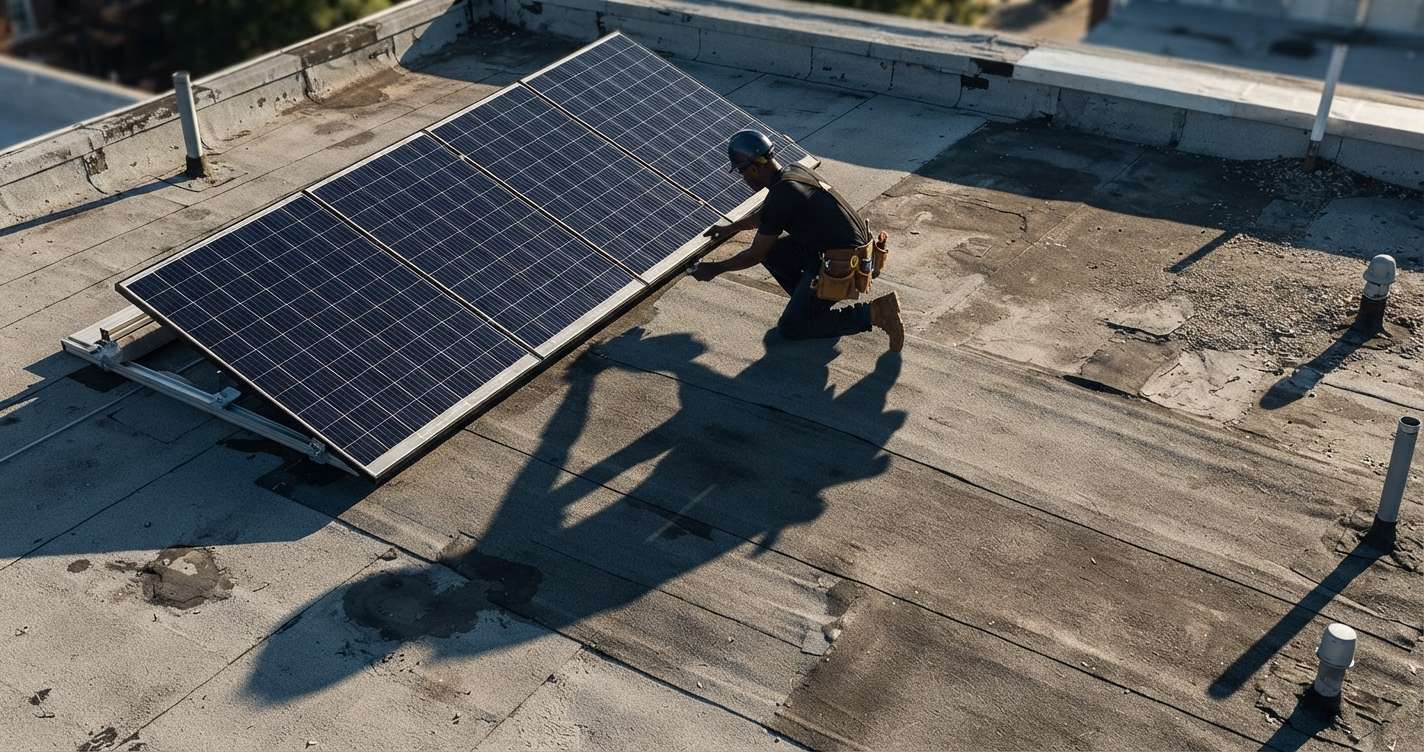
This is followed by medium-skilled roles, comprising installation technicians, site supervisors, and PV maintenance crews. These are the craftspeople who translate architectural drawings into physical reality, bringing a technical understanding of electrical safety, structural mounting, and system commissioning. In a related context, a study on professional competencies by C. G. Kuo and his colleague identified 11 essential dimensions for solar professionals. These range from materials development and PV applications to data analysis, regulatory knowledge, environmental green beliefs, and field work attitudes. This integration of technical “hard” skills and interactive “soft” skills ensures that the solar system is not treated as a discordant mechanical attachment to a building, but rather as an organic element of its structural and aesthetic language.
Digitalization and Digital Twins: When Rooftops Breathe Artificial Intelligence
The solar-equipped roof is no longer a passive plane for capturing light; in the era of the Fourth Industrial Revolution, it functions as an active digital interface communicating with the urban grid. This rapid digital transition demands a fundamental change in the skills required within the smart built environment. Employing tools such as artificial intelligence, big data analytics, the Internet of Things (IoT), and digital twin technology allows architectural firms and facility managers to monitor building performance in real time and optimize operations throughout the building life cycle.
Researcher I. Arcelay and her colleagues, in their study on future skills in the renewable energy sector, indicate that the competencies required for future engineers and builders fall into three main areas: purely technical skills such as cloud computing, machine learning, collaborative robotics, augmented reality, predictive maintenance, and cybersecurity; transversal skills such as advanced data analysis, digital communication, and financial literacy for project viability; and finally, green skills oriented toward comprehensive sustainability. This digital evolution increases the value of highly and medium-skilled professionals while simultaneously requiring lower-skilled workers to acquire basic digital literacy, as hazardous field tasks on high-rise roofs are replaced by automated and remote control operations that maximize safety and efficiency.
Professional Standardization: Structuring Training and Qualification Frameworks
To avoid disorganized installation practices that detract from building aesthetics and safety, international institutions have developed rigorous training and accreditation frameworks to ensure design quality and structural safety. Among the most prominent efforts is the global framework developed by the Institute for Sustainable Power (ISP) to accredit PV training programs and certify practitioner competencies. This framework comprises multiple certification levels tailored to the geographic and technical context of the installation, ranging from Installer Technician I (Solar Home Systems) for simple off-grid rural contexts to Installer Technician IV (Hybrid Systems) for complex urban grid-connected applications. This certification remains valid for three years, after which practitioners must demonstrate continuing education and active field experience to maintain their credentials.
In Europe, the TRAINEE project, funded by the Horizon 2020 program, emerged as a systematic approach to training designers and installers of small-scale renewable energy systems in buildings. As a study by researcher L. Stojanovska-Georgievska and her team demonstrates, the training was structured into two integrated modules: one targeting building professionals and designers at European Qualifications Framework (EQF) level 6, and another targeting manual workers and installers at EQF levels 3 and 4. This curriculum features a highly practical allocation, consisting of 10 percent examinations, 30 percent theoretical classes, and 60 percent hands-on practical training within construction sector companies, totaling 80 intensive training hours. In India, the Suryamitra program, launched by the Ministry of New and Renewable Energy (MNRE), follows a similar integrated pathway to expand green education, supported by the Skill Council for Green Jobs (SCGJ) to align the workforce with international standards.
Overlapping Trades: Bridging Traditional Construction Crafts and Future Technologies
Analyzing the realities of the construction site reveals that the solar industry does not grow in isolation from other skilled trades; instead, it draws from and integrates with them. In an analysis of contractor licensing data in California, researchers E. O’Shaughnessy and R. Margolis revealed that electrical contracting is the most common license held by PV installers at 53 percent, followed by general building contractors at 46 percent, and specialized solar contractors at 21 percent. The findings indicate that approximately 70 percent of PV installers hold a single enabling license, with electricians representing the largest share at 35 percent.
This trade overlap reveals two primary dynamics: industrial divergence, where technicians enter the solar sector from traditional fields like electrical work, roofing, or general construction while continuing to offer those services; and industrial convergence, where established installation firms expand to integrate other building trades into their business models. Indeed, the data shows that mature installers are 36 percent more likely to hold general building and roofing licenses. These facts indicate that urban policy and workforce planning should not treat solar installation as an isolated profession, but rather as part of the broader fabric of traditional construction trades. This perspective demands reducing regulatory barriers and creating streamlined certification pathways for electrical and roofing contractors, integrating solar deployment as a standard feature of everyday building practices.
Bridging the Field Gap: Strategies for Skill Development and Sustainable Growth Drivers
Skill gaps in the renewable energy sector become apparent when deployment accelerates faster than educational institutions and training centers can adapt. The lag time required to design curricula, secure academic accreditation, and recruit students creates a critical temporal gap between industry demand and the supply of qualified workers, exacerbated by a shortage of qualified trainers and educators during sudden demand surges.
To address this bottleneck, Sooriyaarachchi and Arcelay propose a suite of strategic interventions, beginning with a long-term, four-phase skills plan that assesses sector digitalization, identifies future competency requirements, designs customized training curricula, and secures talent acquisition. Furthermore, reskilling and upskilling workers transitioning from conventional energy sectors like oil, gas, and coal as well as general construction, the military, and other industrial fields presents a valuable human capital pool that can be efficiently integrated through close collaboration between academic institutions and private enterprises.
From an economic and regulatory perspective, policy drivers exert a decisive influence on labor demand. Legislation such as feed-in tariffs, net metering, and mandatory building codes such as California’s mandate for solar installations on new residential properties, as detailed by researcher N. M. Haegel and her colleagues in their analysis of terawatt-scale solar trajectories drive a rapid acceleration in construction activity. While labor productivity increases as markets scale, lowering the job-years required per installed megawatt, long-term employment stability remains tied to financial models and project revenue flows. Transitioning to terawatt-scale solar generation demands not only hardware innovations and cost reductions, but also a resilient, digitally literate workforce, flexible grid systems, and energy storage solutions capable of supporting deep urban transitions without compromising grid reliability and urban ecological balance.
✦ ArchUp Editorial Insight
The solar rooftop is not an architectural statement. It is the physical residue of a policy calculation — feed-in tariffs, net metering mandates, and building codes that preceded any design intention by years. What this body of research exposes is that the built environment’s energy transition is structurally outpacing the labor systems designed to execute it, and that gap is not a training failure but a governance one: certification frameworks arrive after deployment targets are set, curricula are approved after market demand peaks, and educators are recruited after the shortage is already measurable. The architectural consequence is predictable — installations driven by electricians and roofers operating at the boundary of their existing licenses, integrating energy systems into buildings without the design literacy to treat them as anything other than mechanical additions. The rooftop, in this configuration, becomes a bureaucratic surface rather than an architectural one.
References
Sooriyaarachchi, T. M., Tsai, I. T., El Khatib, S., Farid, A. M., and Mezher, T. “Job creation potentials and skill requirements in, PV, CSP, wind, water-to-energy and energy efficiency value chains.” Renewable and Sustainable Energy Reviews, 2015.
Barki, D., G, A. K., V, S. B., and D, V. “Innovative Skill Development Techniques for Solar Power Plants and Solar PV Job Creation in India.” Proceedings of the 47th IEEE Photovoltaic Specialists Conference, 2020.
Bob, B. “Assessing Job Growth and Sustainability in the US PV Industry.” Proceedings of the 44th IEEE Photovoltaic Specialists Conference, 2017.
Arcelay, I., Goti, A., Oyarbide-Zubillaga, A., Akyazi, T., Alberdi, E., and Garcia-Bringas, P. “Definition of the Future Skills Needs of Job Profiles in the Renewable Energy Sector.” Energies, 2021.
Kuo, C. G., and Chang, C. C. “Building Professional Competencies Indices in the Solar Energy Industry for the Engineering Education Curriculum.” International Journal of Photoenergy, 2014.
Haegel, N. M., Margolis, R., Buonassisi, T., et al. “Terawatt-scale photovoltaics: Trajectories and challenges.” Science, 2017.
O’Shaughnessy, E., and Margolis, R. “Charting the evolution of the U.S. solar PV installation industry and its bonds with other skilled trades.” The Electricity Journal, 2020.
Fitzgerald, M. C. “Developing global quality standards for the accreditation of PV training programs and the certification of PV practitioners’ knowledge and skills competencies.” Proceedings of the 28th IEEE Photovoltaic Specialists Conference, 2000.
Stojanovska-Georgievska, L., Sandeva, I., Krleski, A., Spasevska, H., and Ginovska, M. “Sustainable Renewable Energy System Installations through Qualified and Skilled Workforce: TRAINEE Approach.” IOP Conference Series: Earth and Environmental Science, 2020.