
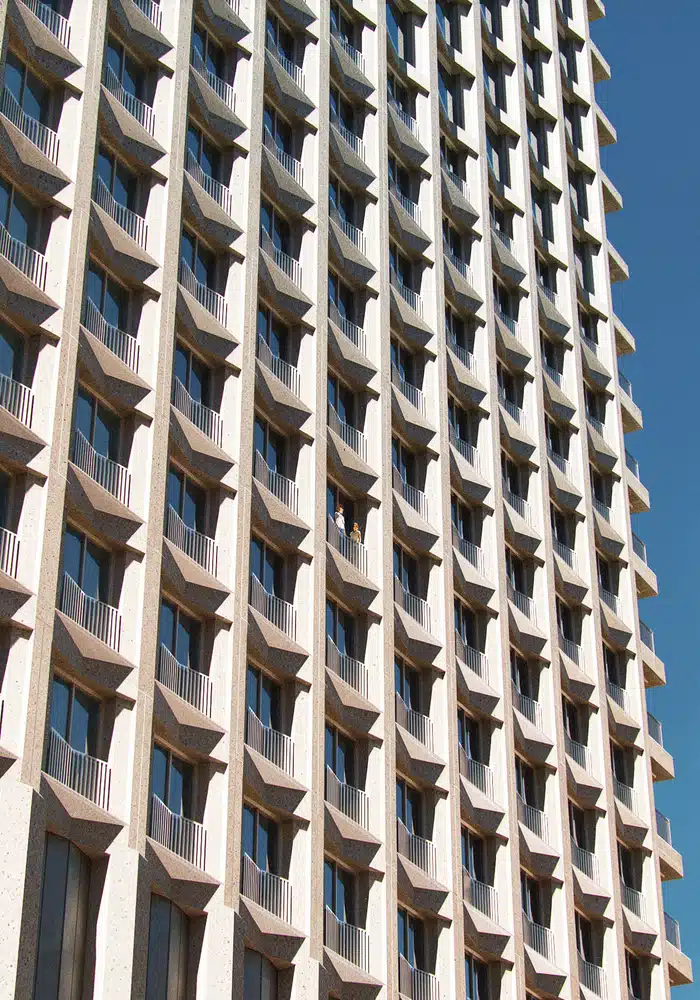
Supertall for All: Proposed Mixed-Income Tower in Manhattan

Supertall for All proposes a 74,000 square meter residential tower on Manhattan’s Gansevoort Square. It aims to deliver 1,000 rental units half affordable, half market rate stacked evenly from base to top. The project responds to New York City’s housing crisis. It repositions the skyscraper as a vehicle for equity, not exclusivity. Developed with SO IL, it answers a design competition by NYCEDC.

Design Concept
The tower uses a single floor plate repeated vertically. Each level holds twelve units. This ensures consistent distribution while allowing subtle façade variations. A two story Sky Garden on the 53rd floor adds shared outdoor space and daylight. This aligns with current research in architectural design. Supertall for All integrates social equity into its spatial layout. It avoids segregated housing tiers seen in older mixed-income buildings.

Materials & Construction
Exact building materials are not specified in early renderings. However, the proposal follows an all electric, low carbon strategy. This matches modern construction standards for dense cities. The slender shape fits the narrow Gansevoort site. It also respects height limits near the High Line, a landmark in New York’s cities network.

Sustainability and Urban Equity
Long term affordability depends on operational efficiency. The all electric system cuts fossil fuel use. This reflects methods in global sustainability frameworks. Supertall for All challenges Manhattan’s luxury tower trend. It ensures income diversity on every floor. Data shows little affordable housing was built in the Meatpacking District recently. Nanne de Ru of Powerhouse Company noted that Manhattan has added skyline since 2008. Yet it has added too little affordable rental housing, especially here.

Conclusion
Can vertical architecture support inclusion instead of displacement? The Supertall for All model tests this in a high pressure real estate market. Explore equitable urban models in the archive. Follow the latest news on the global architecture platform.
Architectural Snapshot: A supertall residential tower in Manhattan integrates 1,000 mixed-income units with equal affordable and market rate distribution from base to crown.
ArchUp Editorial Insight
The Supertall for All proposal reframes New York’s luxury skyline narrative by mandating vertical income integration a formal response to institutional calls for equity. Yet its architectural language remains within familiar aesthetic boundaries, relying on repetition and a mid rise Sky Garden rather than reimagining structural or communal innovation. While commendable for resisting housing segregation, the project risks normalizing supertalls as neutral tools, overlooking their infrastructural and speculative entanglements. Its all electric claim aligns with current sustainability trends, but without material transparency or construction economics, it leans more on ideology than operational proof. Still, embedding affordability into Manhattan’s premium corridor sets a necessary precedent. Whether this model becomes a replicable standard or another symbolic gesture depends on policy more than design.


ArchUp: Technical Analysis of the Proposed “Supernormal for All” Tower in Manhattan
This article provides a technical analysis of the proposed “Supernormal for All” tower as a case study in social skyscraper architecture designed to address the housing crisis through vertical income integration. To enhance archival value, we present the following key technical and design data:
The proposed tower spans a total area of 74,000 square meters in Manhattan’s Gansevoort Square. The design features a single floor plate repeated vertically across all levels, with each floor containing 12 uniformly distributed residential units. The units follow a mixed-income model: 50% (500 units) are designated as affordable rentals, and the remaining 50% (500 units) are market-rate, with uniform distribution from the base to the top of the tower to prevent spatial stratification.
The ecological and structural system adopts a low-carbon approach and relies entirely on electric energy to power all its systems, reducing dependence on fossil fuels. The tower includes a two-story sky garden on the 53rd floor, providing shared green space and enhanced natural light. The facade incorporates subtle variations in depth to create visual diversity while maintaining an efficient, repetitive structure.
In terms of social and planning performance, the tower aims to address the acute shortage of affordable units in the Meatpacking District, an area that has added luxury towers without meeting affordable housing needs. The tower’s slender design maintains compliance with height restrictions near the renowned High Line park. The project is part of a design competition launched by the New York City Economic Development Corporation (NYCEDC), making it a prototype for how vertical architecture can serve as a tool for social equity and sustainability in major cities.
Related Link: Please refer to this article for an analysis of affordable housing policies in a European context:
European Union Unveils Historic Plan to Solve the Affordable Housing Crisis
https://archup.net/eu-housing-plan-and-urban-sustainability/