Meadows Apartments: Princeton’s Residential Achievement Embodying Sustainable Architecture and Smart Economics

Urban Imperative: An Esteemed University’s Answer to the Housing Challenge
Securing affordable housing for graduate students has long been a critical challenge for elite institutions. At Princeton, the response to this urgent demand materialized as a thoughtful campus expansion south, across the serene Lake Carnegie. The goal was not merely to add buildings but to create a fully integrated residential community serving 604 students, presenting a practical model for Sustainable Student Housing. This complex acts as a welcoming gateway to the new Meadows Campus, peacefully embracing its natural surroundings. This type of development is a vital part of contemporary urban planning.
Courtyard Journeys: A Design Celebrating the Environment
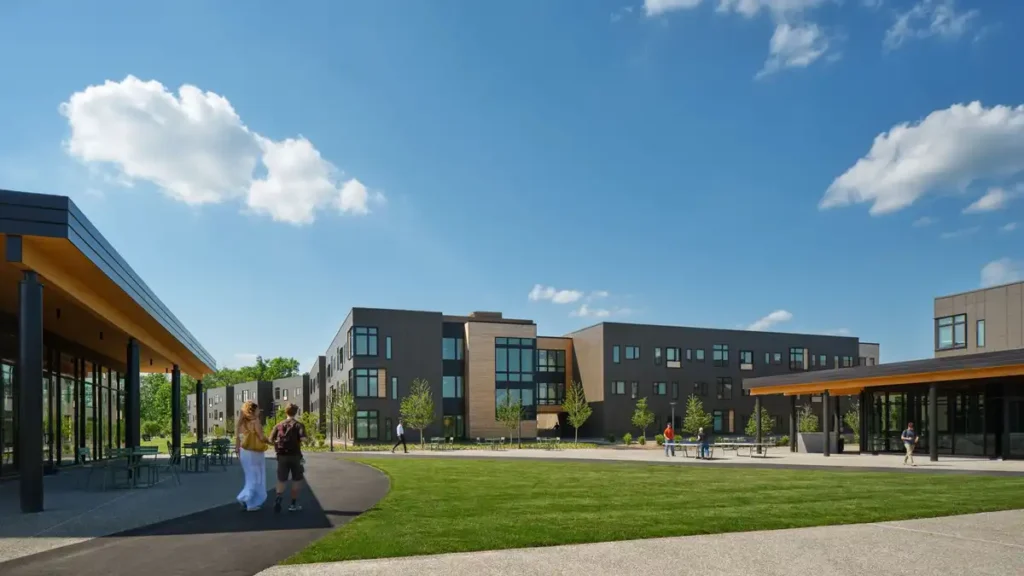
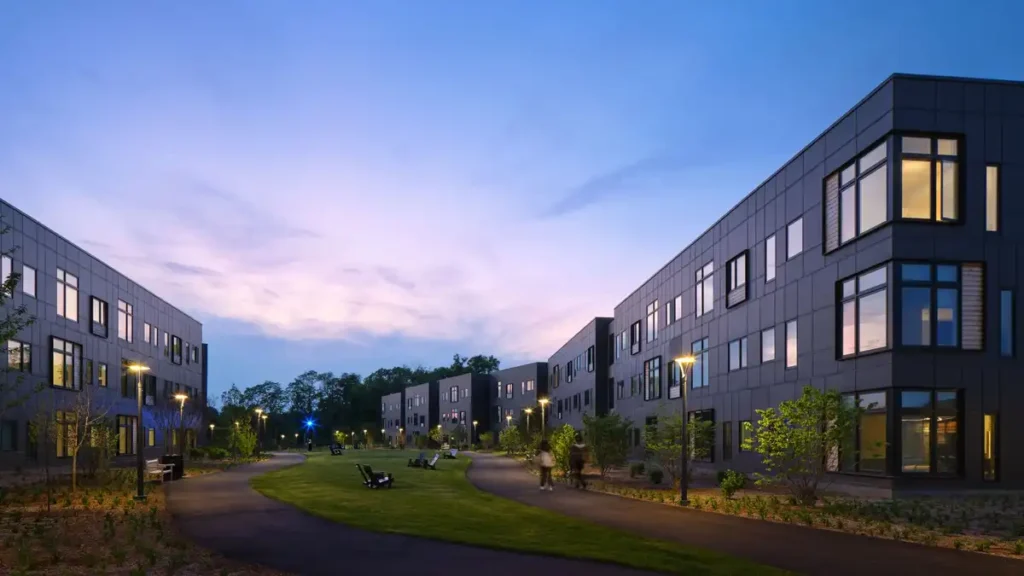
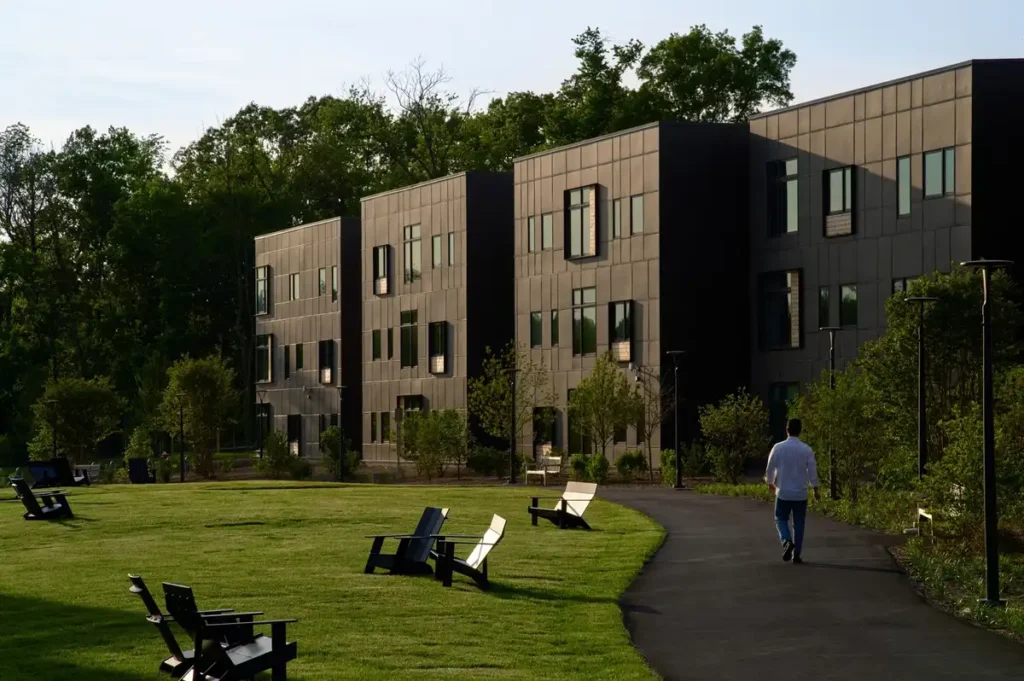
The visitor’s journey begins with an immediate sense of harmony between the architecture and nature. The complex consists of three residential structures, designed in a formation resembling a tiger paw for studied interlock. This configuration not only provides compelling architectural massing but also defines four unique courtyards, each with a distinct character and purpose.
As you wander, the design guides pedestrian flow through intentional passageways called portals. These six pedestrian portals continue Princeton’s long tradition of connecting structures and courtyards, ensuring fluid movement and enhancing opportunities for social interaction. Residents and visitors are naturally drawn through these green courtyards toward the community’s heart, while the pivotal residential wings ensure minimal disruption to the adjacent historic Delaware and Raritan Canal State Park. Sustainable Student Housing here signifies a daily life lived in harmony with this valuable ecological site.
The Heart of the Community: The Center for Social Life and Services
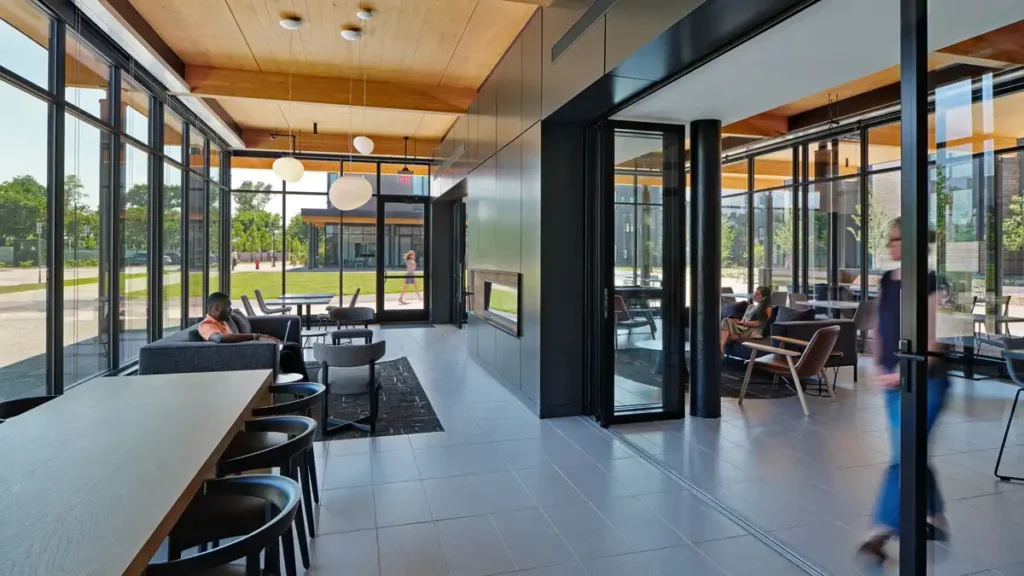
The social nexus of the complex is located in an active plaza at the southern point of the development, where the main courtyards converge. This vital hub offers students a necessary break from the pressures of academic study.
The community center and student café feature the following amenities:
- Lounge and reading areas.
- Dedicated study spaces.
- A children’s play area (serving student families).
- A package center and leasing office.
The residential units were carefully designed to meet student priorities, focused on balancing privacy with opportunities for social connection and affordability. Consequently, the complex offers 13 different unit types, accommodating a wide range of personal preferences and rental rate sensitivities. Every apartment is optimized for comfort and academic focus, with special attention to acoustic control, natural daylight flow, and thermal comfort. Details like these are often included in a project archive for reference.
Performance Excellence: Leading the Way in Sustainable Student Housing
This project represents a significant advancement toward achieving carbon neutrality goals, setting a high benchmark for the university’s future development.
To achieve exceptional environmental performance, the project relied on a package of key materials and technologies:
- High-Performance Envelope: A building enclosure designed for maximum thermal efficiency and insulation, a crucial element in meeting strict sustainability standards.
- Prefabricated Timber Structures: The use of rapidly assembled wood structures helped reduce the overall project cost by 35% compared to other residences. This method shortens the construction period.
- Geothermal Exchange: Utilizing geothermal exchange wells as part of the energy systems to reduce reliance on conventional fuels.
- Low-Embodied Carbon Materials: Selecting building materials with low embodied carbon emissions to support the overall environmental targets. Technical datasheets for these materials are essential.
The project’s commitment to these technologies solidifies its position as one of the largest certified complexes for Sustainable Student Housing, adhering to rigorous environmental performance standards. This integration of efficient design and advanced technology proves that affordable housing can coincide with pioneering environmental performance.
✦ ArchUp Editorial Insight
The Meadows Apartments project presents a visual paradigm of architectural integration
. Low rise, horizontal massing, built with prefabricated timber blocks
, interlocks to define four distinct courtyards. Design
efficiency is evident in the tiger paw configuration. This layout provides optimized views and achieves a rare feat: rigorous compliance with Passive House standards
in a large residential scheme
. Critical analysis assesses the ability of the six pedestrian portals to genuinely foster spontaneous social interaction within this community. Nonetheless, the project is a success. It lowered construction
costs by 35% while achieving top-tier Sustainable Student Housing levels. Project Meadows thus establishes a new benchmark for affordable, high-performance residences.