The Enchanting Architectural Harmony of Toledo

The Enchanting Architectural Harmony of Toledo: A Umayyad Legacy
In the heart of Spain lies an architectural gem known as Toledo or Talilah in Arabic, whose design distinctively sets it apart from other cities. Historians have unearthed inscriptions amid the city’s ruins, describing it as a “strong rock surrounded by water from three directions.” Toledo’s architectural blueprint exemplifies the splendid handling of varying elevations, a characteristic shared with some of the world’s most architecturally acclaimed cities.

The influence of Islamic, specifically Umayyad architecture, is profoundly embedded in Toledo’s fabric. Arabic traces are evident, with places like Bab Sarrah retaining their Arabic names. A visit to Beit Al Wali (Governor’s House) unveils a true embodiment of Arabic architecture amidst Toledo’s landscape. The traditional Arabic courtyard, accompanied by the fragrant aroma of flowers and the soft murmur of water, evokes reminiscence of Damascus.
Explore the architectural grandeur of Toledo, Spain, through our eyes as we traverse its historic lanes. Our journey unveils a blend of cultures reflected in mesmerizing structures, offering a rich narrative for tourists, architects, and history aficionados. Dive into a city where every corner tells a story, and modernity gracefully dances with heritage
The Umayyad civilization’s architectural mastery is a well-discussed topic among the locals, and indeed, their legacy continues to breathe through Toledo’s ancient stones. Arabic inscriptions discovered in one of the old town’s mosques further affirm this enduring influence.

Toledo presents an unparalleled architectural journey, becoming an essential destination for any architect keen on exploring the intersection of cultures and the evolution of architectural styles. While it may lack the theatrical drama often associated with Venice, Toledo’s architectural narrative is rich and diverse, offering a comprehensive story of its own.

As you traverse through Toledo’s quaint streets, every corner tells a tale of its Umayyad past, making it a living canvas that showcases the harmonious blend of cultures and the timeless elegance of Umayyad architectural genius. Each visit to Toledo is not just a tour, but a step back in time, offering a deeply enriching experience that leaves a lasting impression on its beholders.
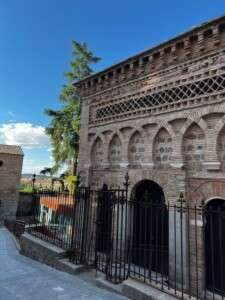
Toledo, often referred to as the “City of Three Cultures” due to its Christian, Muslim, and Jewish heritage, boasts a rich architectural history. The city spans an area of 232.1 square kilometers and is perched on a mountaintop with an elevation of 529 meters. The diverse architectural styles reflect the city’s multifaceted history. The Alcántara Bridge, dating back to Roman times, and the medieval San Martín Bridge are two examples of the city’s architectural prowess. In recent years, Toledo has seen a surge in tourism with over 2.3 million visitors in 2019, according to the Toledo Tourist Board. The city’s compact size and well-preserved historical sites make it a high-density tourist destination.

Architectural Tourism:
Toledo is not just a city but a living museum of architectural marvels that span centuries. Tourists can traverse through time as they walk through the narrow, winding streets, each turn revealing structures resonant with Islamic, Gothic, Mudejar, Renaissance, and Baroque architectural styles. The fusion of these styles gives Toledo a unique aesthetic, appealing to architects and history enthusiasts alike. One of the significant sites is the Toledo Cathedral, a magnificent example of Gothic architecture, and the Alcázar of Toledo, displaying Renaissance to Habsburg style. On a different note, the city’s adaptation to modern tourism while retaining its historical essence is an architectural feat in itself. The seamless integration of modern amenities without disrupting the ancient ambiance is a lesson in adaptive reuse and sustainable tourism, making Toledo a must-visit for anyone with an eye for design and history.
https://archup.net/explorer/