
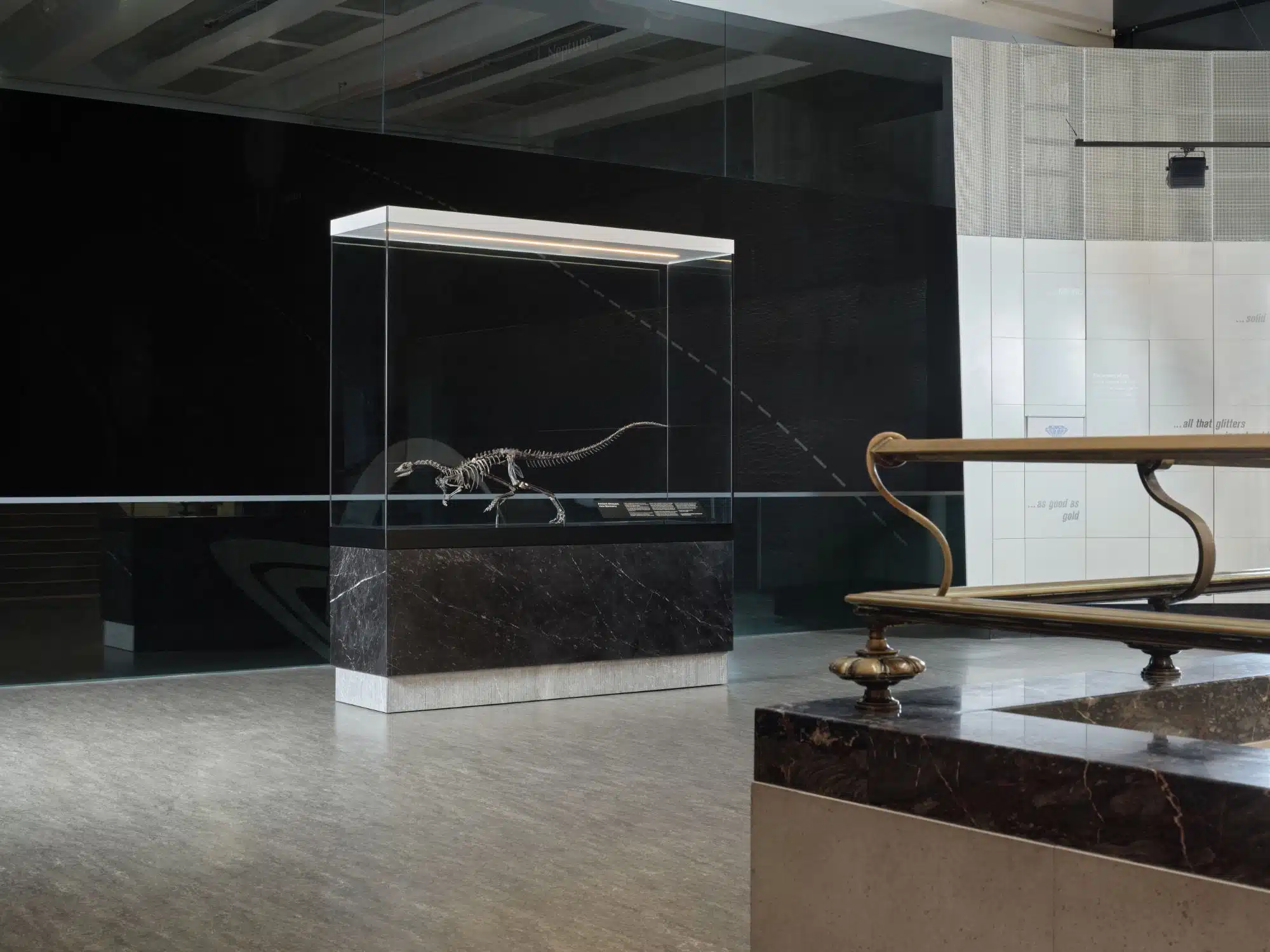
The Enigmacursor Dinosaur Display: A Moment Frozen in Time, Masterfully Highlighted by Architecture

Introduction: More Than Just a Fossil Display
In the heart of the Natural History Museum in London, specifically in the Earth Hall Gallery, lies a new testament to the grandeur of natural history—not just a fossil, but an architectural masterpiece designed to tell this discovery’s story. Ogden Architects’ project for displaying the Enigmacursor Mollyborthwickae dinosaur is a work that transcends the traditional function of a fossil display, becoming an exquisite study in how architecture can be used as a medium to enhance the dialogue between science and the public, between the deep past and the contemporary present.
A Jurassic Dinosaur in a Contemporary Home
The fossil of Enigmacursor Mollyborthwickae, dating back 145 to 150 million years, is the first dinosaur to be formally named by the Museum in over ten years. This unique scientific context demanded a design solution worthy of the specimen’s historical importance. The goal was not merely to place the fossil in a glass box but to design a “place” for it that enhances its presence and respects its value as scientific evidence and a window into the Jurassic world.

Design Philosophy: Architecture as a Narrative Medium
Ogden Architects approached this project as an opportunity to redefine architecture’s role in scientific museums. The designers viewed the display not as a mere display element but as a Spatial Intervention. This philosophy aims to reshape the visitor’s perception of the surrounding space and the fossil itself through meticulous control of light, materials, proportions, and sightlines. It is a shift from “viewing” to “experiencing,” where the architectural design becomes an integral part of the story being told.
Material Analysis: A Dialogue Between Geology and Craftsmanship
The Stone Base: Roots in the Depths of the Earth
The display’s base is made of dark stone with white veining, a choice that is not arbitrary. These veins are a direct visual nod to the Geological Strata that preserved the fossil for millions of years. Structurally, the base was executed with precision Mitred Corners, a technique ensuring exceptional structural integrity and a sense of solidity and permanence. The recessed, line-chiselled skirting adds a touch of visual lightness to the solid mass, preventing it from appearing heavy on the hall’s historic floor.
The Glass Enclosure: Transparency That Creates Presence
Above the stone base rises a Frameless Glass Enclosure. This bold choice serves two main purposes: The first is to provide a complete, unobstructed 360-degree view of the fossil from all angles, encouraging the visitor to walk around it and discover it from every perspective. The second is to create a sense that the fossil is “floating” or “displayed in space,” enhancing its dramatic impact and stripping it of any physical context that might limit its perception as a once-living creature.

The Role of Lighting: Reviving Frozen Motion
Perhaps the most impactful element in the overall experience is the lighting. The system of Concealed Linear Lighting inside the display is not only intended to make the fossil visible. It is specifically designed to highlight the Enigmacursor skeleton in a “running” pose, emphasizing the creature’s anatomical dynamism. This technique transforms the static fossil from a “bone specimen” into a creature that appears to be Suspended in Motion, adding an emotional and dramatic dimension to the scene and stimulating the visitor’s imagination to picture this creature running in its natural environment millions of years ago.
Spatial Integration: Weaving a Narrative Fabric within the Hall
Visual Relationship with Sophie the Stegosaurus
The display was not placed randomly but was carefully positioned on the Earth Hall Mezzanine. This strategic location creates a direct and continuous visual relationship with the famous Sophie the Stegosaurus on the floor below. This visual connection creates a “vertical narrative” linking two distant periods in dinosaur evolution, deepening the visitor’s understanding of diversity and geological time, and turning the visit from viewing separate exhibits to reading a connected chapter in the story of life on Earth.
Full Respect for Historic Architecture
The project is situated within a Grade I Listed Building, meaning any new architectural intervention must be handled with extreme sensitivity towards the original historic fabric. Ogden Architects’ design responded to this challenge through a meticulous study of the hall’s proportions and details. The dimensions and scale of the new display were designed to harmonize with the grandeur and details of the historic hall without imitating or competing with it, instead adding a contemporary and distinct layer that respects the past without replicating it.

Challenge and Response: Engineering in a Sensitive Environment
Designing any new element within a historic, protected building presents a difficult architectural challenge. How can the new element stand out without overpowering? How can it adapt without disguising itself? Ogden Architects’ response was through:
- Clear Contemporaneity: Using an honest contemporary language (like frameless glass and polished stone) that clearly distinguishes the display from its historic backdrop.
- Proportional Scaling: Adjusting the display’s dimensions to suit the massive scale of the hall without overwhelming it or getting lost within it.
- Functional Performance: Ensuring the design meets the highest standards of scientific conservation regarding humidity control and thermal stability inside the case, achieved in an invisible manner.
Conclusion: An Architectural Legacy for a Timeless Scientific Specimen
In conclusion, the Enigmacursor Mollyborthwickae display represents a refined meeting of science and art, of preservation and presentation. It is a model to be emulated in modern Museum Architecture, proving that a small, sensitive architectural intervention can have a significant impact on the public’s experience and perception of scientific heritage. Thanks to this design, Enigmacursor is no longer just another fossil specimen in the Natural History Museum; it has become a prominent architectural landmark, testifying that architecture can be an effective tool for reviving history and enriching cultural and scientific dialogue.

✦ Editorial Vision from ArchUp
The project presents a custom architectural display for the “Enigmacursor Mollyborthwickae” dinosaur fossil within the Earth Hall of London’s Natural History Museum, aiming to create an integrated viewing experience between the artifact and the visitor. The frameless glass solution imposes complete visual transparency; however, this transparency may create challenges in controlling light reflections and glare, which could obscure the clarity of viewing the fossil’s fine details from certain angles. The design relies on concealed linear lighting to highlight the fossil’s dynamism, but this choice places the specimen in a fixed and specific lighting condition, limiting the potential for presenting multiple interpretations of its form under different lighting scenarios. On a positive note, the display’s central location on the mezzanine successfully establishes a direct visual dialogue with other exhibits in the hall, enhancing the narrative interconnectedness of the Museum’s collections.
Brought to you by the ArchUp Editorial Team
Inspiration starts here. Dive deeper into Architecture, Interior Design, Research, Cities, Design, and cutting-edge Projectson ArchUp.


