The House-Garden: Where Architecture Melts into the Embrace of the Coastal Landscape

Design Philosophy: The House as a Gateway to Nature
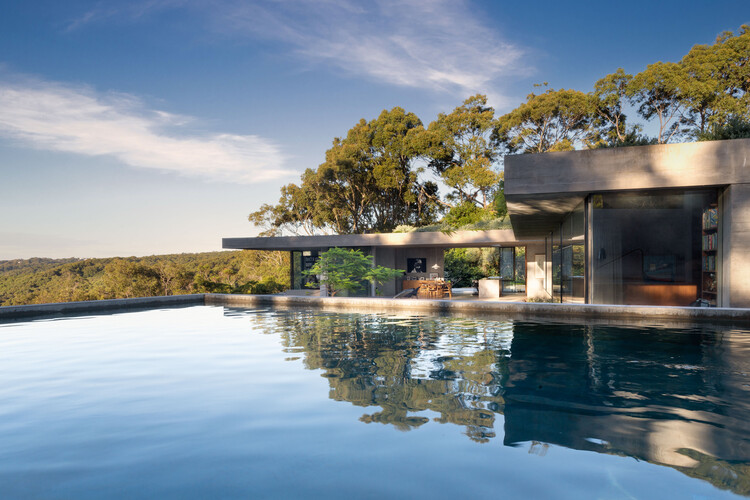
This project does not merely offer a shelter for residence; it proposes a new vision for the relationship between humans and their environment. The primary goal of the design is to make access to the garden and the coastal landscape the ultimate purpose and essence. In other words, “Arrival at the house is, in truth, arrival at a landscape.” Thus, the house becomes a pivotal mass that bookends the garden, just as the headlands do the beach, in a profound architectural metaphor connecting the building to the site’s geology.
Environmental Response: Integration as a Proactive Solution
The design faced climatic challenges and bushfire risks, and instead of taking a defensive stance, it used these challenges to enrich its concept.
· Climatic Stability: Burying half the house in the hillside was an intelligent solution for achieving natural thermal stability, as the earth mass acts as a natural insulator, moderating temperatures throughout the year.
· Bushfire Protection: This integration reduces the surfaces exposed to flames and embers, providing an added layer of safety.
· Enhancing Biodiversity: The house is no longer an alien mass upon the land but has become a part of it, providing additional natural habitats for small plants and animals and enhancing the site’s ecological value.
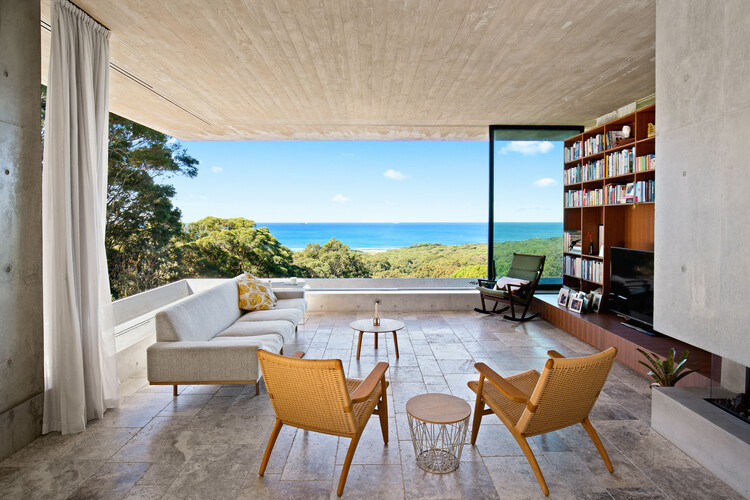
Design Language: Evoking the Geological Spirit of the Coast
The inspiration was not merely a visual metaphor but an attempt to make the house continue the geological story of the place.
· Linear Arc Planning: The house was shaped into a linear arc, inspired by the natural rock formations and coastal geomorphology that form headland buttresses and embayments. This shape not only harmonizes with the topography but also creates a kinetic path that guides the visitor through the landscape.
· Hovering Earthen Platforms: The embodiment of the idea of “earth as a roof” is realized through a series of raised platforms covered with soil and planting. These platforms not only redefine the building’s surface but also act as visual termination points, where each visual axis within the house concludes with a carefully curated landscape view.
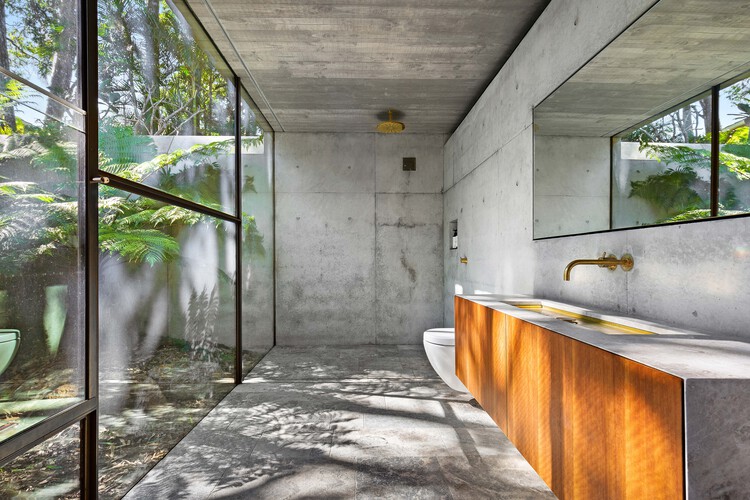
Structural Elements: Where Durability Serves Transparency
To achieve this vision, the design relied on bold structural solutions with a dual purpose.
· Post-Tensioned Concrete Cantilevers: These flying beams are more than just a structural element; they are the vital separator that creates spaces for light and air. By separating the room volumes from the earthen platforms, these cantilevers allow for natural light and cross-ventilation to penetrate every corner of the house, creating a continuous dynamic between inside and outside.
· Robustness of Concrete: The choice of concrete as a primary material was carefully considered. Its durability and ability to endure direct interaction with the harsh natural surroundings (from sea spray and winds) make it the ideal choice. Its raw texture also visually harmonizes with the surrounding rocks, as if it were a natural material extracted from the site itself.
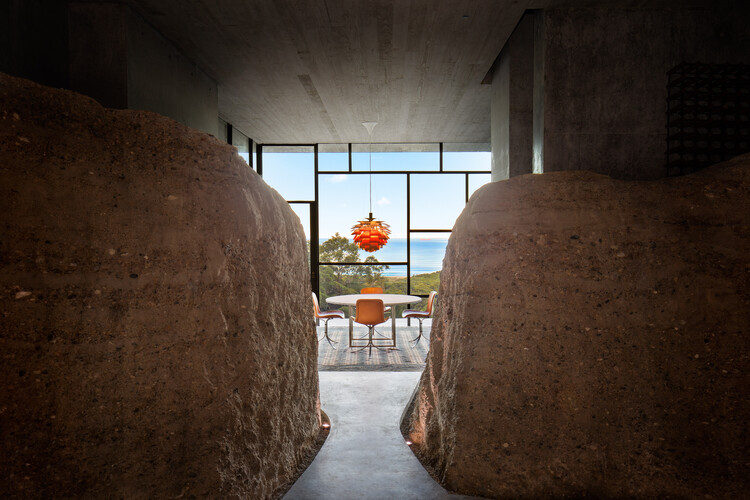
Completing the Cycle: Reviving the Ecosystem
Integration with nature is not complete by making the house a part of it, but by making nature a part of the house. Therefore, the surrounding landscape was meticulously programmed.
· Endemic Species: 15 endemic plant species were thoughtfully planted throughout the site. These plants not only provide visual beauty compatible with the region but also work to attract wildlife, particularly birds, transforming the garden into a vibrant micro-ecosystem.
· Organic Sustainability: The ultimate goal is to allow the natural world to “reclaim” the house. Over time, these plants will grow, climb, and creep over and around the house, allowing the architectural work to eventually dissolve completely into the coastal landscape from which it emerged, completing the cycle of sustainable life.
✦ Archup Editorial Insight
The article summarizes a design vision aimed at making the house a gateway to the coastal landscape and its garden by partially burying and integrating it into the hillside. The design raises questions about the relationship between solid masses and voids; the separation between the room volumes and the earthen platforms by concrete cantilevers may create a state of functional and spatial displacement, potentially weakening the user’s sense of containment and stability within the main spaces. Furthermore, the reliance on a linear arc form may impose constraints on the flexibility of the internal layout and limit possibilities for future expansion or reconfiguration of the spaces. On a positive note, the choice of raw and durable materials like concrete contributes to ensuring the building’s structural integrity and its long-term ability to withstand natural coastal elements.
Brought to you by the ArchUp Editorial Team
Inspiration starts here. Dive deeper into Architecture, Interior Design, Research, Cities, Design, and cutting-edge Projectson ArchUp.