

The Main House in Cunha: An Architectural Dialogue Between Memory and Nature

In the heart of the stunning landscapes of the Serra do Mar valleys, near the Pedra da Macela tourist peak in the Cunha region, the Main House stands as a testament to architectural integration with nature. The site enjoys an exceptional location offering visitors simultaneous views of the sea waves on the horizon, the towering mountain peaks, and the historic landmarks of the coastal city of Paraty, all within a single visual panorama.
An Evolutionary Journey from Simplicity to Integration
The story of this site dates back to 2017, beginning with modest projects focused on improving basic functionalities. The initial phase involved reconfiguring wet areas (bathrooms and kitchens), improving circulation within living spaces, and creating an outdoor “gourmet” area to enjoy the surrounding nature. As site usage increased continuously, new needs emerged, pushing the project to expand.
The work evolved through multiple stages: renovating the caretaker’s house to improve living conditions, creating an independent laundry room to serve the property, building a studio for creativity and work alongside a small chicken coop to complement the local life cycle, culminating in the creation of the new Main House, which fully embodies the philosophy of the site.
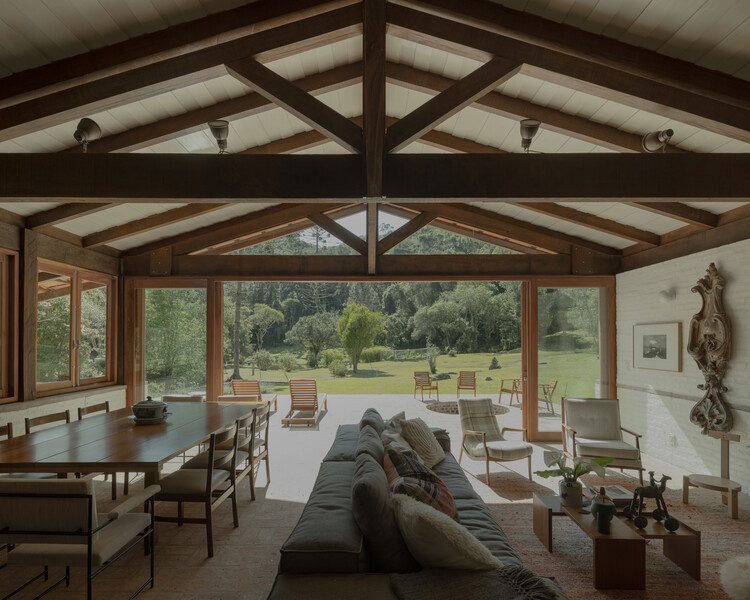
The Regulatory Challenge: An Obstacle Transformed into Inspiration
The site is part of a protected area under strict local environmental legislation due to its proximity to a permanent water stream. This classification prohibits new construction and mandates the preservation of the delicate ecological balance. Instead, the innovative architectural solution was to breathe new life into the existing structures by preserving the original architectural volumes while fully rehabilitating them to suit contemporary uses, turning the constraints of environmental protection into an opportunity to enrich the architectural identity.

Local Materials and Authentic Craftsmanship: A Fabric of the Place
All construction phases were characterized by complete reliance on regional resources and expertise. The building materials served as a definition of local identity: the bricks used were crafted by Cunha’s traditional potters, Zé Tabuinha and Burrico, carrying the imprint of the region’s traditions in their composition. A significant portion of the wooden structures were cut from eucalyptus trees growing on the site itself, under the supervision of local woodworking expert “Leco,” who oversaw their treatment and shaping on-site.
The labor was no less local than the materials; the project was executed by a team of skilled builders and artisans whose contributions in the region span over four decades, carrying generations of inherited knowledge. This harmony between design and craft practice embodies an exceptional approach that respects heritage and builds upon it.

Organic Sustainability and a Creative Outcome
This integration of environmental constraints and local capabilities results in an architecture that is humble yet rich in meaning. The property offers not just spaces for living and working, but tells a genuine story about how challenges can be transformed into sources of creativity, and how architecture can be a bridge between past and present, without neglecting its responsibility towards the environment and the community. It is a tangible model of holistic sustainability that respects spatial memory, reduces the carbon footprint, and enriches the local economy.
✦ ArchUp Editorial Vision
The article delves into the methodology of a renovation project within an environmental protection zone, where new construction is prohibited, necessitating the repurposing of existing structures. The design raises questions about the efficiency of distributing the diverse spaces and functions (main residence, studio, chicken coop) within the original shells, and whether the functional adaptation achieved sufficient autonomy and privacy for each. Furthermore, there remains ambiguity regarding the treatment of the relationship between interior and exterior spaces under the constraints imposed on external modifications, and how optimal natural ventilation and lighting were achieved within the existing structures. On another hand, the challenge related to the long-term performance of local materials against weather elements, despite their aesthetic appeal, is notable. However, the core value of the project lies in its success in transforming regulatory constraints into a stimulating framework for creativity, resulting in a unique architectural fabric that preserves the visual and material memory of the place.
Brought to you by the ArchUp Editorial Team
Inspiration starts here. Dive deeper into Architecture, Interior Design, Research, Cities, Design, and cutting-edge Projectson ArchUp.


