

The Modern Home in Nature’s Embrace: DRN Residence Stands as a Paradigm of Contemporary Tropical Architecture in Ubatuba

The DRN Residence forms a captivating architectural canvas where the contemporary lines of Brazilian design meet the living tapestry of Ubatuba’s rainforest in São Paulo. This project, realized by Pitta Arquitetura, is not merely a dwelling on a plot of land, but a profound architectural dialogue with it. Spanning 250 square meters across two floors, the house presents a modern vision of expansive living that combines the aesthetics of modern design, sustainable comfort, and a complete connection with the natural surroundings.
(The Primary Muse: The Jackfruit Tree)
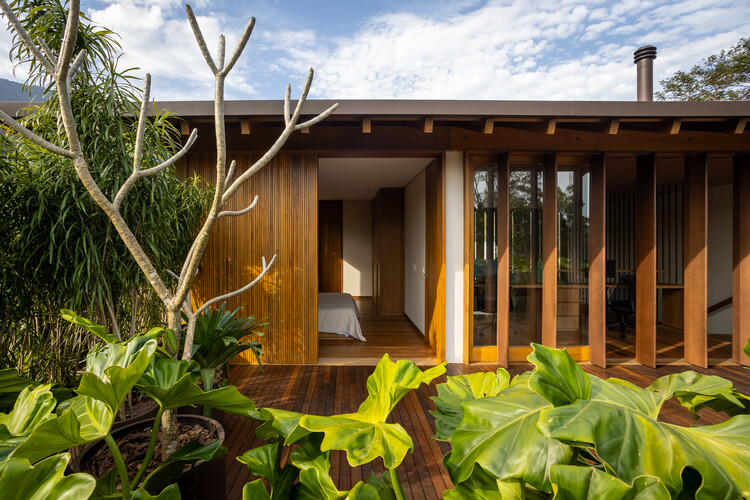
The existing jackfruit tree on the site was not just a natural element; it was the cornerstone of the entire design. This preserved tree formed the focal point around which all design decisions revolved. Architect Thiago B. Pitta explains: “The large tree was our creative starting point. From it, an architecture was born that does not avoid or resist nature, but celebrates it and makes it a fundamental partner in the living experience.” This approach defined the building’s orientation, the placement of openings, and the framing of visual perspectives that create a continuous feeling of being within nature, rather than just viewing it.
(Spatial Planning: Fluidity Between Public and Private)
The architectural program was meticulously distributed to achieve a delicate balance between family social life and privacy, while emphasizing fluid movement between inside and outside.
· Ground Floor: The Heart of Social Life
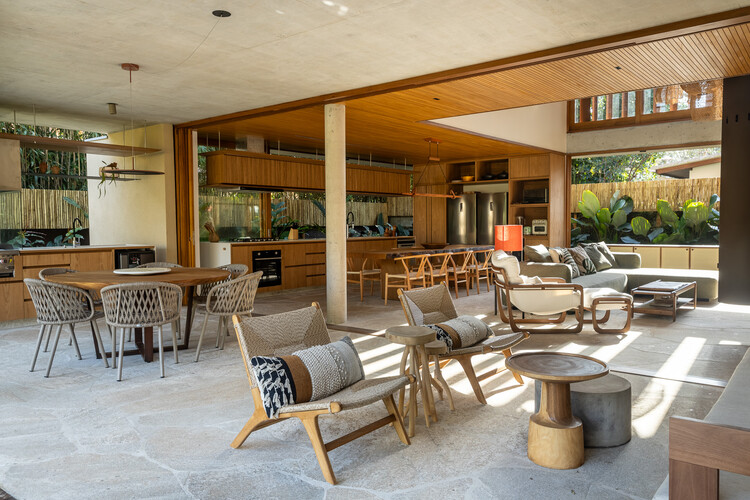
The ground floor reigns as the area for reception and gathering. Here, the social area (seating and living room) fully integrates with the outdoor relaxation area through large glass walls. This level also houses two master suites that open directly onto the green garden, ensuring the bedrooms are connected to nature from the moment of waking.
· Upper Floor: A Realm of Privacy and Tranquility
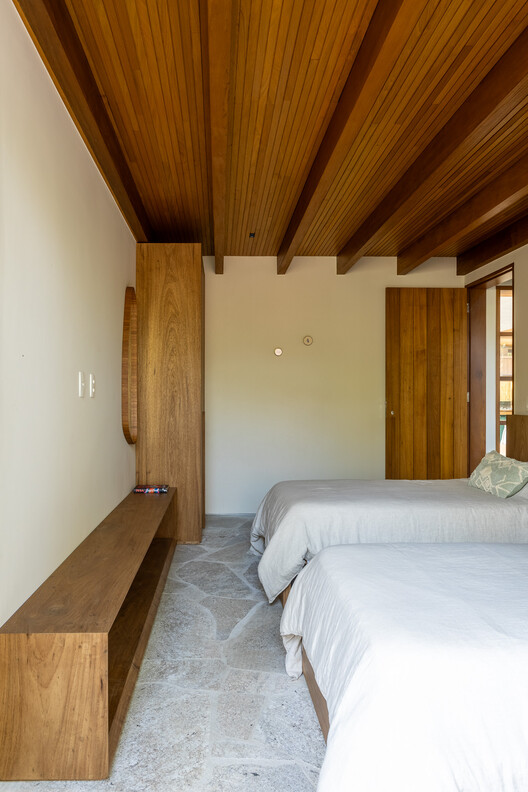
Ascending to the upper floor, one finds two additional suites, each opening onto a private balcony surrounded by a hanging garden, creating a sense of secluded vitality. Also on this level is the office, which extends to incorporate the double-height volume, creating a majestic space that imparts a sense of expansiveness and psychological comfort.
(Sustainable Design Strategies: A Dialogue with the Climate)
The design transcends being a beautiful form to become an intelligent machine for interacting with Ubatuba’s tropical climate.
· Cross-Ventilation: The designers ensured openings were oriented to capture natural breezes, guaranteeing constant air renewal and minimizing reliance on air conditioning.
· Solar Radiation Control: The windows are equipped with movable louvres. These louvres act as an intelligent solar filter, allowing soft natural light to illuminate the spaces without the accompanying direct solar heat, maintaining the building’s coolness.
· Architectural Transparency: The bold use of full-height glass walls in the double-height living room is not merely an aesthetic decision but a tool for achieving spatial continuity, erasing the physical boundaries between the interior of the house and the exterior.
(The Materials of Nature: A Language of Authenticity and Durability)
To enhance the sense of belonging to the place and ensure construction durability, materials were carefully selected to be natural and expressive.
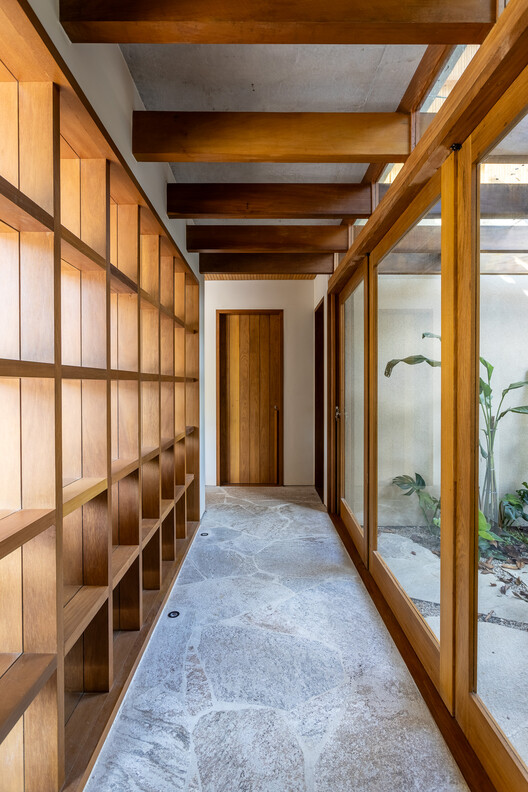
· Natural Stone (Moledo): Moledo stone was used on the façades and parts of the interior décor, imparting an earthy solidity and a visual connection to the place.
· Joinery and Framing: The task of crafting the metal frames and fine woodwork was entrusted to GM Marcenaria, ensuring high quality in the details that touch daily life.
· Lighting Touches: Lighting fixtures made of ceramic and rattan were chosen to add warmth and a touch of traditional craftsmanship, enhancing the warm and welcoming atmosphere within the spaces.
(Landscaping: Design that Employs Nature as an Ally)
The role of the landscaping, designed by Plantare, was not limited to beautification; it was a fundamental functional element of the building’s system.
· Visual and Acoustic Filters: The dense plants and trees act as a natural insulating layer, blocking noise and providing privacy from the outside without resorting to solid walls.
· Creating Microclimates: The selected tropical plants, such as heliconias and banana trees, help regulate the microclimate around the house, slightly increasing humidity and softening the air, creating a comfortable environment around the dwelling.
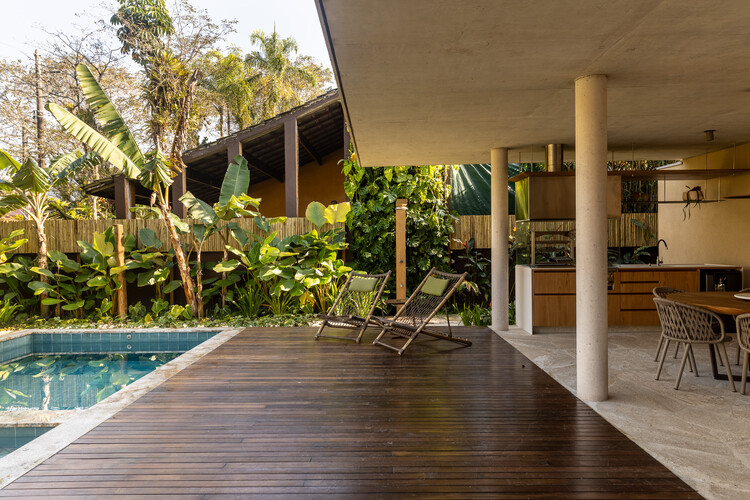
· Outdoor Leisure Area: The wooden deck was designed to be a natural extension of the living area, combining a swimming pool, a relaxing whirlpool spa, and a set of solid wood furniture, all within a framework of tropical plants that enhance a perpetual holiday feeling.
(Conclusion: A Statement of Contemporary Tropical Architecture)
After eight months of meticulous project development and a year and a half of on-site execution, the DRN Residence emerges as a complete statement of contemporary tropical architecture. As Luiza Querido summarizes the project’s vision: “More than a house, this project conveys the idea of tropical well-being, where architecture intelligently adapts to the climate and the mountainous landscape of Ubatuba.” It is a model that demonstrates how aesthetics, comfort, and environmental responsibility can meet in a single, coherent architectural work.
✦ Archup Editorial Insight
The analysis examines a residential project that aspires to total integration with its natural environment through open plans and high visual transparency. It is noted that the intensive reliance on fully glazed transparent façades in a humid tropical climate like Ubatuba’s, while successful in achieving visual connection, increases the thermal heat gain within the spaces due to solar penetration. This places an additional burden on cooling systems to compensate for the lack of thermal insulation in these vast glazed areas. Furthermore, the distribution of the architectural mass and the placement of foundations around the central tree raise a question about the impact of structural intervention on the soil’s root system and the delicate biodiversity that previously existed on the site, which goes beyond preserving the tree as a single symbolic element. However, the design solution’s ability to formulate dynamic and continuous visual and sensory relationships between the house’s occupants and the surrounding natural landscape remains a fundamental strength in enriching the daily living experience.
Brought to you by the ArchUp Editorial Team
Inspiration starts here. Dive deeper into Architecture, Interior Design, Research, Cities, Design, and cutting-edge Projectson ArchUp.


