Global Architectural Projects to Watch in 2026

The year 2025 witnessed the passing of architectural icons such as Frank Gehry, Robert A.M. Stern, and Ricardo Scofidio, the designer behind New York’s High Line.
The year was also marked by the influence of U.S. President Donald Trump on architecture, from his preference for classical styles and rejection of strict structuralism, to the demolition of the White House East Wing, disputes with the design team of the State Dining Room, and the removal of architecture from recognized professional certifications.
Amid these debates, the American Institute of Architects (AIA) awarded its Gold Medal for the first time in a decade to a non-American architect, the Japanese Shigeru Ban. Meanwhile, Chinese architect Liu Jiakun won the Pritzker Prize for his austere academic and cultural buildings.
Here are 11 architectural projects worldwide expected to make headlines in 2026 as reported by CNN:
Sagrada Família
After nearly 144 years of construction, the Sagrada Família is approaching completion. This year, the final Jesus Christ Tower, standing at approximately 172 meters, is expected to be finished.

The lengthy construction is due to the complex design and intricate decorative details, blending Gothic and Art Nouveau styles with nature-inspired forms. Financial constraints, bureaucratic hurdles, and the COVID-19 pandemic also contributed to the extended timeline.
520 Fifth Avenue
520 Fifth Avenue marks a shift in New York’s skyscraper aesthetic, favoring larger, more monumental towers inspired by American architectural heritage.

The tower reaches approximately 305 meters, with terracotta arches that recall the city’s classic skyscrapers, signaling a growing appreciation for New York’s architectural history.
Winter Olympic Village
The 465,000-square-meter Olympic Village will host thousands of athletes during the 2026 Winter Games, before being converted into low-cost student housing for 1,700 beds, with recreational, fitness, and event facilities.

The project also revitalized the city through the renovation of two historic buildings previously part of an old railway yard.
Guggenheim Museum
The Guggenheim Abu Dhabi is one of the last major projects by Frank Gehry, featuring curved forms and angular shapes inspired by traditional Middle Eastern courtyards and wind towers (barjeel).

Project managers hope it will achieve a “Bilbao effect” by attracting attention, tourism, and investment to Saadiyat Island. The opening date in 2026 remains tentative.
F Tower
The F Tower will become the tallest new building in Africa at 421 meters, designed by Lebanese-Ivorian architect Pierre Fakhoury, with 64 floors surpassing the current record holder by almost 30 meters.

The slanted glass facades draw inspiration from African masks, symbolizing both the city’s history and its architectural ambitions.
Shanghai Grand Opera House
Located on the riverbank, the Shanghai Grand Opera House features clean, low white roofs that rise seamlessly from the ground. Its iconic spiral staircase leads visitors to a large rooftop plaza open to the public.

The opera house will host three performance halls at opening, including a main hall for 2,000 spectators, combining Western and Chinese operatic traditions.
Barack Obama Presidential Center
The Obama Presidential Center covers about 80,940 square meters, anchored by a 69-meter marble tower nicknamed “Obamalisk,” symbolizing upward movement from the grassroots.

The tower’s four faces feature hands meeting together and words from Obama’s speech commemorating the 50th anniversary of the Selma to Montgomery march, reflecting civil rights achievements.
The center includes gardens, wetlands, performance halls, and a branch of the Chicago Public Library.
Central Bank of Iraq
The new headquarters marks a posthumous realization of Zaha Hadid’s vision in Baghdad, her only completed project in her home country.
Standing at 170 meters, the building’s expanding structural facade resembles a funnel-shaped bottle, reflecting Iraq’s turbulent banking history.

Lucas Museum of Narrative Art
The Lucas Museum, honoring George Lucas, resembles a spaceship landing on Earth, with curved, floating forms.

Its permanent collection includes over 40,000 works of art, focusing on visual storytelling, making it the most significant museum in the U.S. by a Chinese architect.
Melbourne Metro Tunnel
The Melbourne Metro Tunnel represents the largest rail network overhaul in 40 years, spanning 9 kilometers of twin tunnels up to 39 meters deep, with five new underground stations, at a cost of $8.9 billion USD.
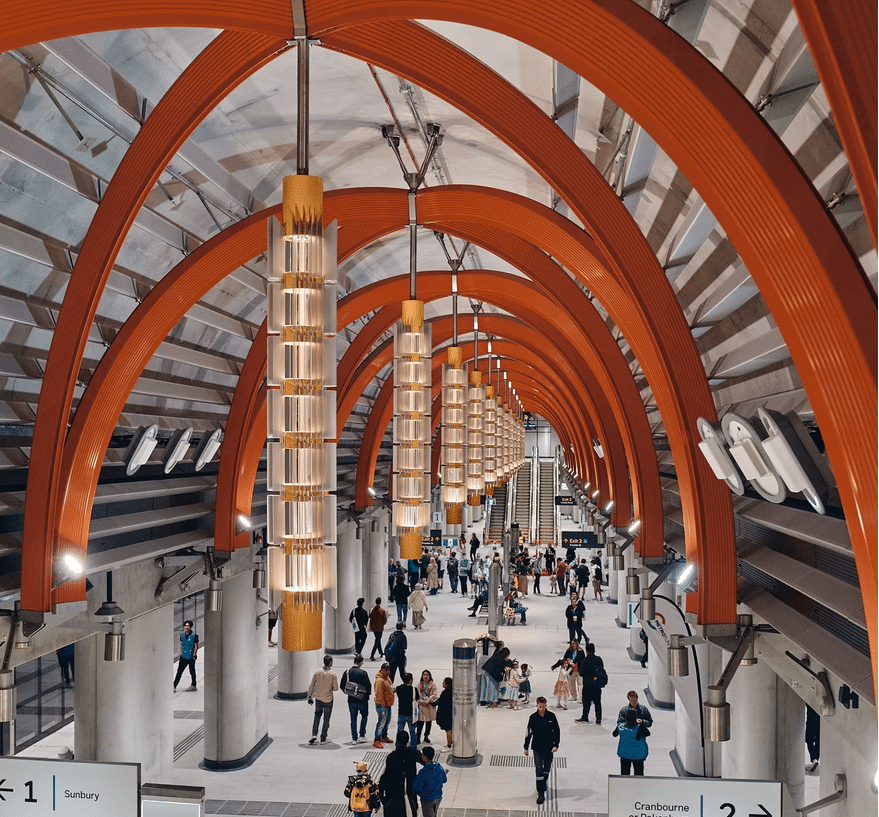
After partial opening, it will add 1,000 new weekly services and fully integrate into the expanded network. Stations near the surface feature wide entrances and glass roofs, while deep stations have a cave-like character.
OPPO R&D Center
The OPPO R&D Center consists of ten buildings, including seven with serviced apartments accommodating 6,000 employees.
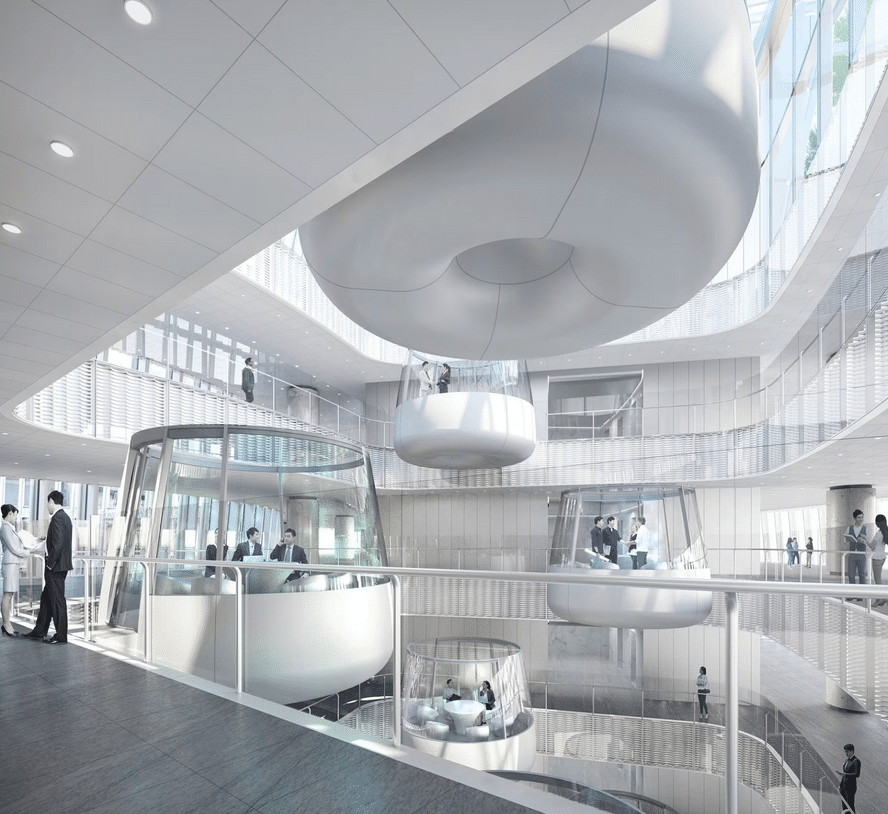
The design features interconnected circular structures and cutting-edge architectural solutions by Kon Pedersen Fox and Bjarke Ingels, representing a vision of future-oriented workplace and living environments.
✦ ArchUp Editorial Insight
The global architectural landscape in 2025–2026 underscores the continued influence of Contemporary and Postmodern design paradigms, juxtaposed with heritage-inspired and culturally resonant projects. Landmark completions—from Barcelona’s Sagrada Família with its Gothic-Art Nouveau fusion, to Gehry’s Guggenheim Abu Dhabi and Hadid’s Central Bank of Iraq—demonstrate innovative Material Expression and sculptural Spatial Dynamics, while balancing local context and symbolic narratives. However, these ambitious undertakings invite reflection on Functional Resilience and Contextual Relevance, as ultra-tall towers, mega-museums, and integrated urban infrastructures challenge environmental, social, and operational capacities. Yet, the diversity of typologies—from the F Tower in Abidjan to Melbourne’s Metro Tunnel and OPPO R&D Center—signals an architectural ambition committed to urban transformation, global identity, and the creation of adaptable, culturally embedded urban experiences.