Schieblocks: A Second Reconstruction Narrating Rotterdam’s Architectural History

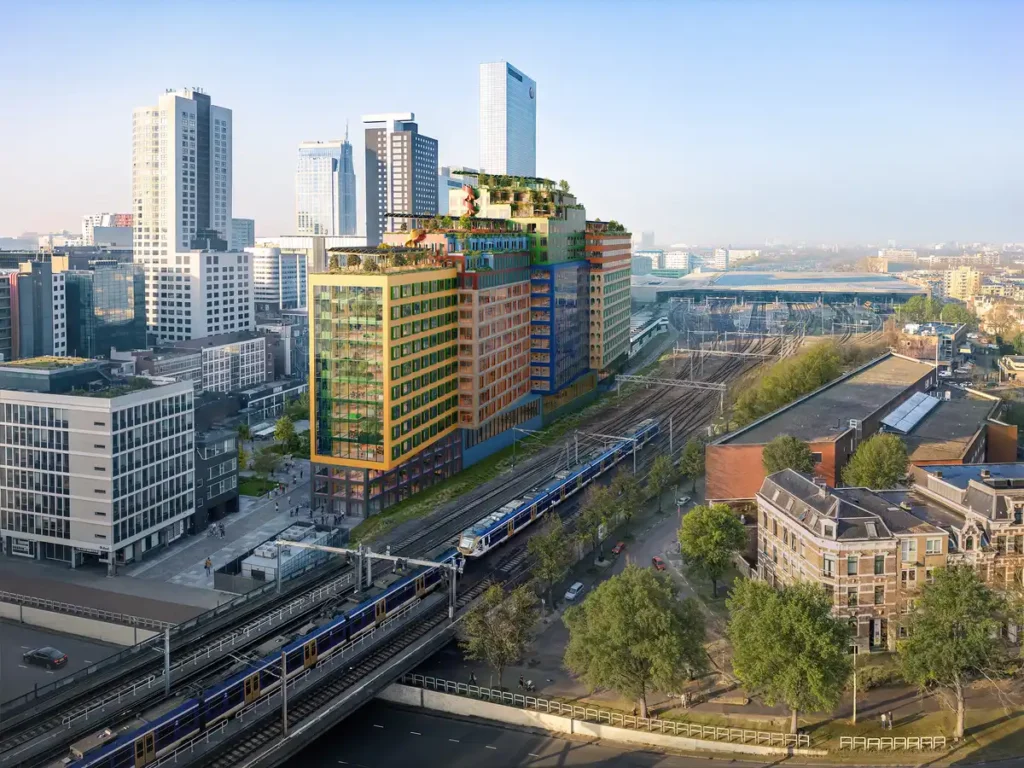
The Schieblocks building is immense. It stands 61 meters tall and stretches nearly 150 meters in length. The structure occupies a narrow strip of land right beside the railway line in Rotterdam. This location holds historical significance. It is part of the Schiekadeblok district, which is an emblem of the city’s post war Reconstruction period. The project aimed for more than just an office building. Its goal was to execute Vertical Densification in Rotterdam, building higher while simultaneously preserving the area’s existing character.
: A Mosaic of Colorful Blocks
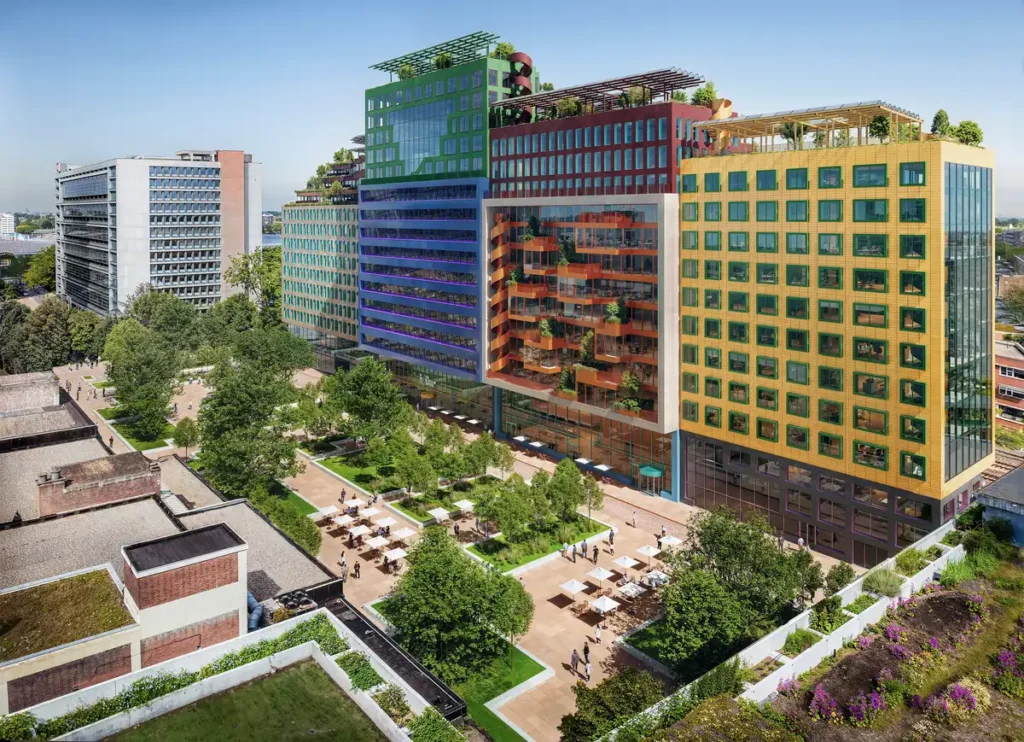
Upon approaching the building, the visitor recognizes that the massive 47,000 square meter volume has been intentionally deconstructed. The design is divided into 11 distinct, stacked blocks, mitigating the structure’s dominance and giving it a human scale. Each block functions as a canvas, borrowing elements from Rotterdam’s architectural history.
The passerby observes the building as a pictorial book about the city. One section displays projecting windows inspired by the historic Citrusveiling building. These features blend with a touch of bright yellow taken from the Luftsingel bridge. Elsewhere, a reference to the distinctive sandstone of the City Hall building is visible. Windows engraved with the number 010 (the city’s dialling code) form an octagonal shape. This detail is inspired by the nearby Hofplein 19 building. This deliberate decomposition and reassembly successfully integrate Vertical Densification in Rotterdam into the neighbourhood’s fabric.
: Life Thriving from Base to Summit
The Schieblocks experience starts at the bottom. The ground-level plinth features maximum transparency. This design merges interior and exterior life. This layer serves as the public interaction point. Here, residents and visitors can use the bike café, visit the bakery, or browse the concept store. From the plinth, the ascent paths lead toward the summit.
A highly intriguing architectural detail sits at the western entrance: the Wokkelbar (Spiral Bar). An existing, functional car ramp belongs to an adjacent historical monument. This ramp could not be removed. Therefore, the designers incorporated it into the architectural fabric. The glass-encased ramp became the central feature of a new bar. This successfully turned a structural constraint into a unique spatial characteristic.
Ascending higher, the public interaction loop finishes on the top floors. Visitors can find a restaurant or a two story event space here. This area overlooks the city. It transforms the building’s summit from private offices into a public viewing platform.
: Environmental Integration and Smart Materials
The project extends beyond aesthetic considerations, relying on technologies and materials aimed at reducing the building’s environmental footprint a crucial requirement for Vertical Densification in Rotterdam projects.
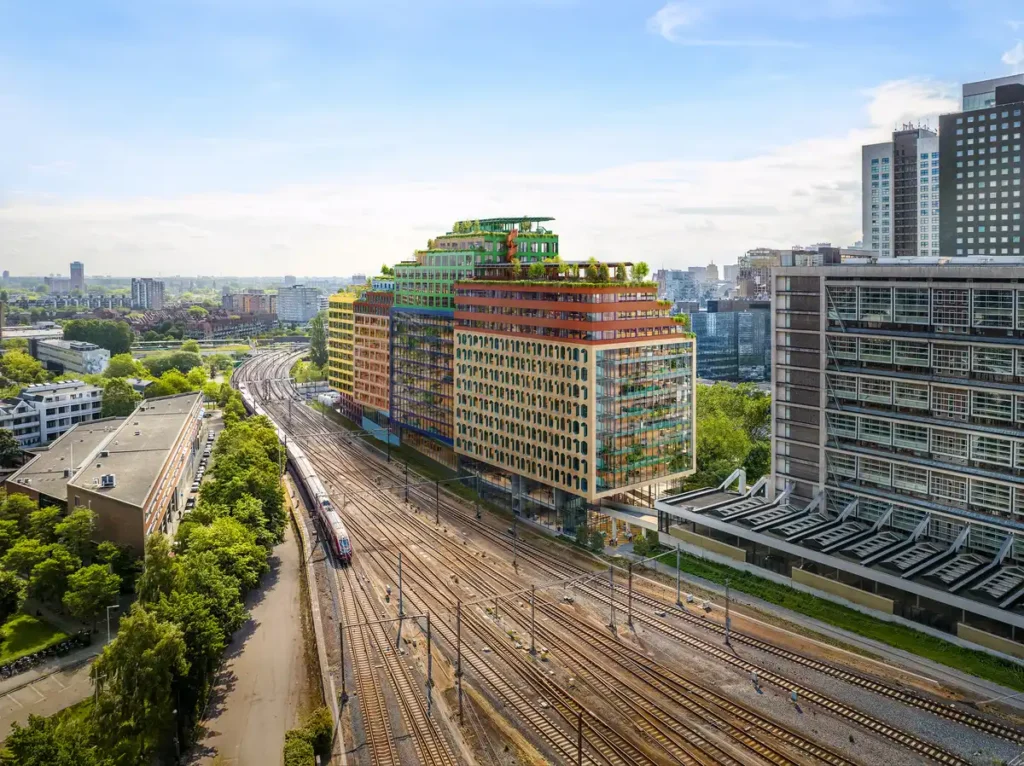
To ensure harmony with the surrounding environment, some upper blocks are angled according to the sun’s path, preventing shadows from being cast on adjacent residential buildings. The entire roof is also a green landscape, designed to serve two primary functions:
- Water Retention: To facilitate stormwater management.
- Promenade: To provide a continuous walkway across the different roof levels.
Summary of Sustainable Construction Techniques:
- 18% of the blocks (2 out of 11) have façades constructed with bricks made from recycled material, aiming to reduce embodied carbon.
- 27% of the façades (3 façades) on the south side utilize Building Integrated Photovoltaic (BIPV) panels to generate power and reduce operational carbon emissions.
- Extensive green roofs and a pergola supporting additional solar panels for extra energy generation.
With this methodology, Schieblocks is more than an administrative building; it is a profound architectural study on how to integrate the city’s visual memory with the demands of Vertical Densification in Rotterdam, presenting a model for coexisting large architectural volumes within a historical urban setting.
Architecture professionals can follow ArchUp’s events section for verified updates on exhibitions, conferences, competitions, and results.

✦ ArchUp Editorial Insight
The Schieblocks project offers a model for Vertical Densification in Rotterdam by transforming a massive office volume into a mosaic of 11 colourful blocks, drawing their hues and details from the city’s architectural memory. This visual deconstruction is a skillful strategy to integrate the new volume (47,000 square meters) within the historic fabric of the Schiekadeblok. The critical analysis questions whether this superficial play with visual metaphors is sufficient to offset the immense urban pressure. The project, through the integration of sustainable technologies and the use of recycled materials, registers a positive value in environmental commitment. The overall merit of the development lies in establishing public interactive spaces, such as the Wokkelbar and accessible green roofs, ensuring continuity of dialogue between the new structure and city life.