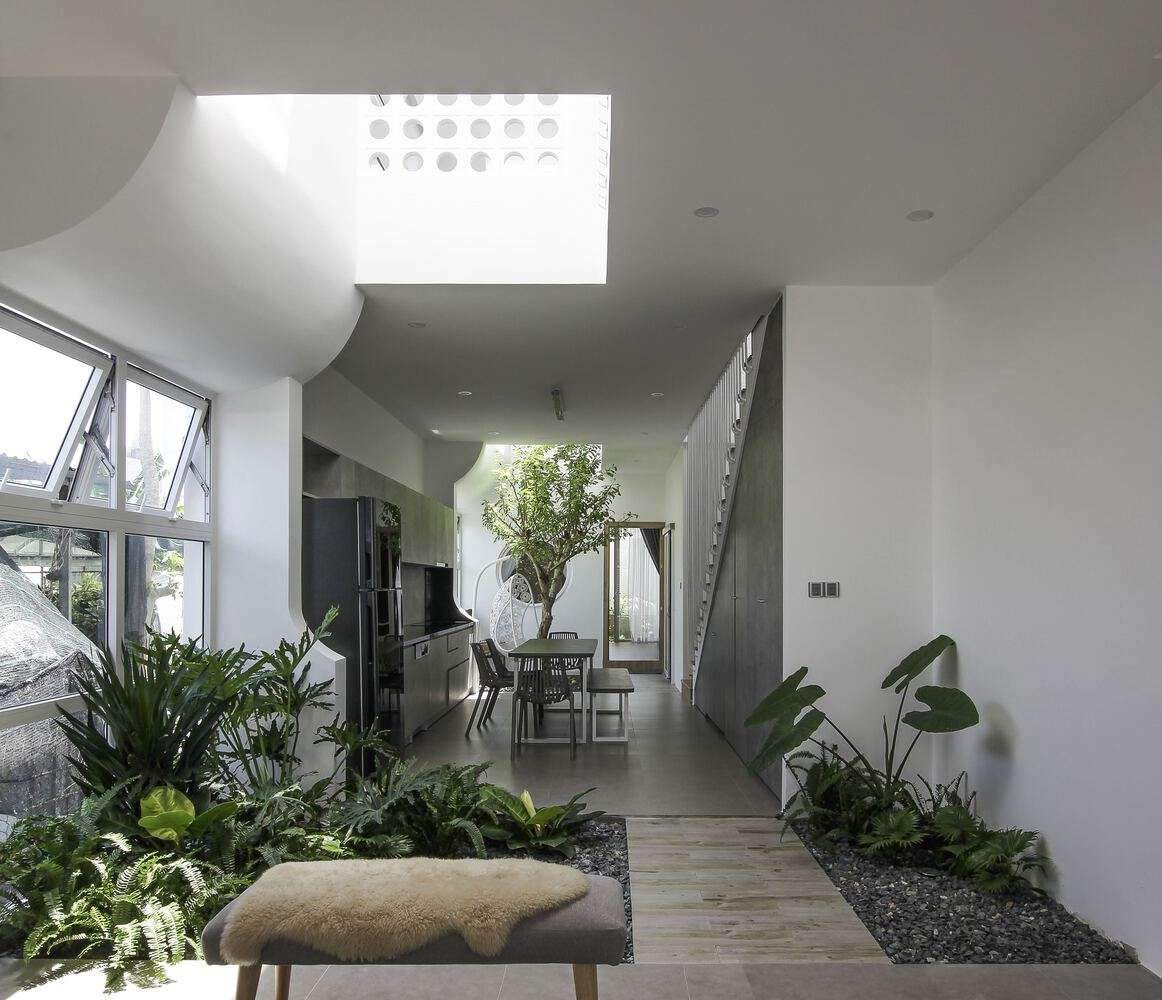
Villa Omah Prana explores a courtyard-centered residential model in Payangan

Located in the highland area of Payangan, Bali, Villa Omah Prana is an architectural project that links the landscape, structure and human activities. The residence, designed by Alexis Dornier, is an example of how a small footprint can create a spatial system with the main characteristics of openness, circulation and light. The project is a contribution to the continuous dialogue in architecture about tropical living, climate responsiveness and building culture.


Project Information
| Project Name | Villa Omah Prana |
| Location | Payangan, Bali |
| Typology | Residential, Rental |
| Total Size | 475 m² |
| Status | Completed 2022 |
| Architectural Design | Alexis Dornier |
| Construction | 2019 |
| Photo Credit | KIE |
| Landscape | N/A |
| Interior | BARES, AD |
Spatial Logic and Architectural Strategy
The residence is organized using a courtyard strategy designed by the architect. A circular movement path connects all living spaces, sleeping areas, and public places while still being visually linked to the central open space. This allows good air circulation, sun control, and the different levels of privacy to coexist. It also shows the way tropical projects are still utilizing the former through design when it comes to climate rather than through technical systems.


Building Materials and Construction Technique
The use of wood, masonry and a combination of structural elements that are made visible gives the residence by the architect a solid and at the same time a very dynamic feel. The said materials are linked to the weather and the craftsmanship of the Indonesian island of Bali. The accent on inviting surfaces and warm colours actually demonstrates how building materials can create a mood without too much decoration. The construction that was finished in 2019 has quite a lot of attention to detail in regard to the carpentry, the shading and the durability to withstand the tropical conditions.


Experience and Interior Concepts
The collaboration of BARES and AD in the interior corresponds with the architecture by accentuating transparency and unimpeded mobility. The architects have made the spaces to be perceived as if they are not far away from the courtyard, the sky and the other trees that are close by. The artistic layout of the interior can serve both the need for a quiet retreat and for a social gathering, thus demonstrating that it is the interactions between the interior and architectural decisions that create the living environment. This integration is of great concern to the designers in terms of comfort, rhythm of spaces and their sequencing.
Contextual Relevance
The topography of Payangan is quite uneven but it has a lot of greenery. The house has been designed in such a way that the land is a part of it, not a rival. As a result, the structure is very calm and shows that it is possible for buildings to be small yet have a strong spatial identity. The project has a say in the matter concerning tropical regions’ residential architecture that can be developed through the sensitivity to the surrounding and the weather.


Architectural Insights
Villa Omah Prana has raised significant concerns for architects. What are the possibilities for dense living in small sites? What impact does the climate have on plan geometry and material selection? For how long can a residence be both for live-in owners and rental guests, without losing unity? The design adopts these issues and offers a foundation for future practices. It also contributes to the realization of the architectural research by the characteristics of courtyard typologies in humid areas.


Contribution to Typology and Future Relevance
The venture indicates that residential design in tropical areas can focus on simplicity, environmental logic, and spatial continuity. It further validates that smaller dwellings can be considered the testing ground for new architectural ideas. For the architects dealing with climate-responsive houses and the organisation of spaces, the villa is a very evident reference
✦ ArchUp Editorial Insight
Villa Omah Prana, a residential model driven by a courtyard, demonstrates a soothing tropical environment defined by timber and stone, along with shaded circulation. The images depict a circular spatial movement complemented by soft daylight, exposed structure, and plants, thereby emphasizing the building’s intention of climate control. At the same time, the arrangement gives rise to the question of how far the small footprint can go in balancing retreat, rental use, and long-term adaptability, especially when the program lines remain so visually permeable. However, the project still represents a clear case of spatial continuity and climate-responsive planning, illustrating how the combination of courtyard geometry and material restraint can shape future design strategies in humid climates.


Conclusion
Villa Omah Prana is an example of how architecture can bring together climate, material, and human activities into one consistent environment. It not only provides insights for current practices but also contributes to the discussions about the living models, the relationship with the landscape, and the construction culture in Bali and beyond that are taking place. The ArchUp archive allows you to uncover various studies related to buildings and tropical residential design.


Explore the Latest Architecture Exhibitions & Conferences
ArchUp offers daily updates on top global architectural exhibitions, design conferences, and professional art and design forums.
Follow key architecture competitions, check official results, and stay informed through the latest architectural news worldwide.
ArchUp is your encyclopedic hub for discovering events and design-driven opportunities across the globe.
Brought to you by the ArchUp Editorial Team
Inspiration starts here. Dive deeper into Architecture, Interior Design, Research, Cities, Design, and cutting-edge projects on ArchUp.