

Curved Office Tower Completes in Hong Kong’s Wanchai District

A 21 storey office tower has opened in Hong Kong’s Wanchai district. The building features a curved facade that expands at upper levels to maximize leasable space while maintaining street level ventilation. Located at 369 Hennessy Road near Causeway Bay MTR station, it delivers approximately 25,000 to 100,000 square feet of Grade-A office space. The site sits in one of the city’s densest commercial corridors.

Design Approach and Structural Strategy
The architectural design employs a non-prescriptive approach to Hong Kong’s planning regulations. This results in progressively larger floor plates at higher elevations. Global Design Principal Cary Lau describes the podium treatment: A double layer façade featuring lights, shadows and textures of materials is presented at podium levels to this prime corner. The layered facade system addresses the narrow plot constraints. It creates visual depth at the street corner adjacent to Tin Lok Lane.
The ascending curved profile responds directly to site limitations. The narrow footprint required strategic spatial planning to accommodate functional building requirements. Lower levels feature smaller floor areas where street access and pedestrian circulation take priority. Upper floors expand outward to meet commercial space demands.

Materials and Interior Configuration
Beige fins form the primary material language. They extend from exterior entrance walls into interior lobbies to establish spatial continuity. An arched ceiling at the entrance allows natural light penetration to ground level. The lift lobby maintains the fin detailing with white ceiling planes. The material palette prioritizes neutral tones across public circulation zones.
The double-layer facade at podium levels incorporates texture variations and shadow play. Specific material specifications beyond the fin system remain undocumented in available project details. The construction methodology for achieving the curved profile is not detailed in project documentation.

Environmental Performance Claims
The tower reportedly incorporates energy efficiency measures and environmental management systems. No third-party sustainability certifications such as LEED or BEAM Plus are mentioned in project materials. The design claims to allow more ventilation at urban street level through smaller lower floor plates. This represents a passive environmental strategy. Quantified ventilation improvements are not provided.
The relationship between floor plate configuration and actual energy performance outcomes remains unverified. Post-occupancy data is not available. Green building features are referenced generically without specification of systems, performance targets, or monitoring protocols.

Urban Context
The tower sits near Grade A office buildings and major transit infrastructure. It contributes to Wanchai’s ongoing commercial densification. The building’s relationship to Tin Lok Lane positions it within the district’s characteristic urban fabric. This narrow service street is typical of Hong Kong’s mix of contemporary towers and legacy street patterns.
✦ ArchUp Editorial Insight
This piece chronicles a commercial tower in one of Asia’s most inflated real estate markets, where every square meter commands premium rates and architectural rhetoric often compensates for spatial constraints. The curved facade strategy presented as innovative planning negotiation is fundamentally an economic maneuver to extract maximum rentable area from restrictive zoning envelopes. The text correctly avoids celebrating this as design genius.
The beige fin motif receives disproportionate attention given its decorative rather than structural role, while substantive questions about thermal performance in Hong Kong’s subtropical climate remain unaddressed. The double-layer facade claim lacks technical specificity that would distinguish it from standard curtain wall assembly with applied ornamentation.
Credit is due for explicitly noting the absence of sustainability certification, a rare admission in promotional architectural writing. The ventilation assertion at street level deserves empirical validation, not speculative repetition. Wanchai’s urban density will absorb this tower as it has hundreds before it functional, profitable, architecturally unremarkable. Whether this project merits documentation beyond real estate transaction records remains an open question for future assessments of early 21st century commercial vernacular.

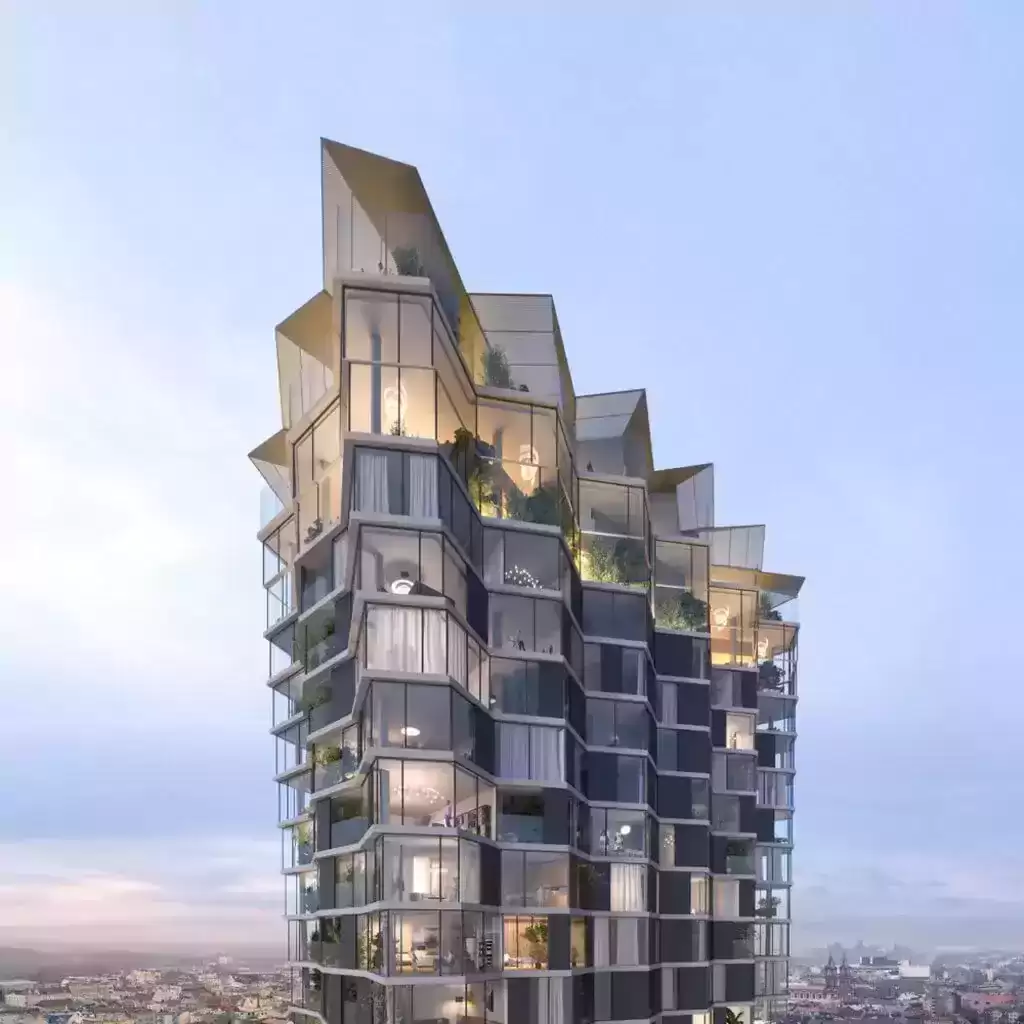


ArchUp: Structural & Economic Analysis of the Wan Chai Office Tower in Hong Kong
This article examines the office tower at 369 Hennessy Road as a case study in urban intensification and high-value real estate development. To enhance its archival value, we present the following key technical and economic data:
The tower features a curved façade with vertical expansion, where floor areas increase from 450 m² at ground level to 650 m² on the 21st floor, representing a 1.5% expansion per floor, taking advantage of non-mandatory local zoning regulations. The building stands 95 meters tall with a reinforced concrete structure designed to withstand wind speeds up to 250 km/h, and incorporates a 1.2-meter-deep double-skin façade for thermal control.
The interior design is characterized by vertical wooden fins that extend from the exterior façade into internal lobbies, alongside flexible floor plates that accommodate leasable spaces ranging from 2,300-9,300 m² (25,000-100,000 ft²). The building maintains 4.5-meter-wide street-level ventilation openings to enhance urban air circulation, despite lacking formal sustainability certifications (LEED/HK-BEAM).
In terms of economic context, the tower is situated in an area with an average rental rate of $120/ft²/year and an estimated market value of $450 million. The curved design yields a 15% increase in leasable area compared to a rectilinear design, achieving a site utilization efficiency of FAR 15 (Floor Area Ratio). The location is served by the Causeway Bay MTR station, 150 meters away, with views overlooking Victoria Harbour.
Related Link: Please refer to this article for a comparison of real estate development strategies in dense urban centers:
The Economics of Real Estate Development in Major Cities: Between Density and Market Value
https://archup.net/kylie-jenners-real-estate-journey-from-dark-mansions-to-a-palm-springs-oasis/