Yijia Building of Tongji University / TJad Atelier L+ – A Masterpiece of Modern Campus Architecture

The Yijia Building at Tongji University’s Jiading Campus, designed by TJad Atelier L+, stands as a revolutionary architectural landmark that redefines student activity centers. Combining innovative spatial design, sustainable engineering, and cultural vitality, this building has become a hub for creativity and social interaction. In this in-depth exploration, we’ll analyze its design philosophy, structural innovations, and environmental impact, showcasing why it’s a benchmark for future academic architecture.
Design Concept: A Vertical Campus Wander
Bridging Functionality and Aesthetics
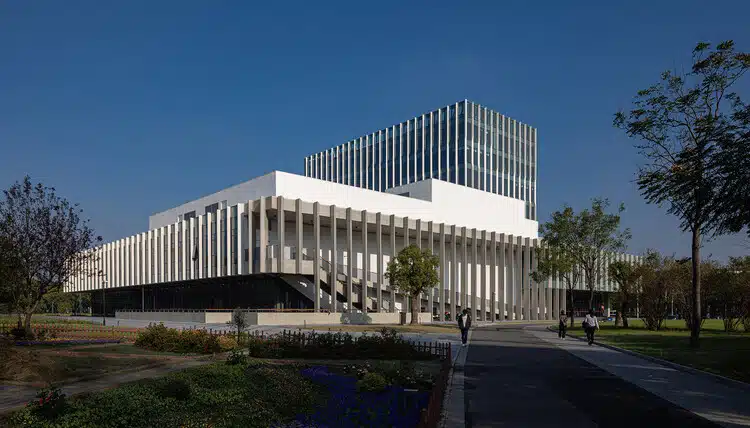
The Yijia Building was conceived as a “vertical campus wander”, seamlessly connecting ground-level plazas with rooftop gardens through multi-dimensional staircases, ramps, and pathways. Inspired by traditional Chinese garden design, the structure offers a continuously shifting spatial experience, where every turn reveals new perspectives.
Strategic Location & Cultural Anchor
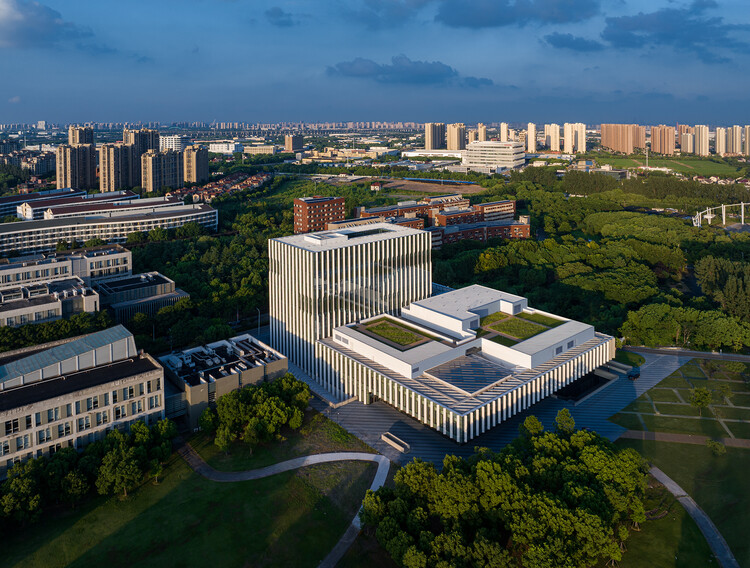
Positioned at the southeastern edge of the Jiading Campus, the building serves as a cultural anchor, bridging academic and residential zones while overlooking a serene lakeside lawn. Its two-story podium and nine-story tower create a striking landmark along the campus’s southern entrance axis, harmonizing with the nearby library.

Architectural Highlights
1. Fluid, Multi-Functional Spaces
The Yijia Building is designed as a “boundless composite functional space”, where students and faculty can:
- Socialize in open lounges
- Study in quiet corners
- Observe campus life from elevated walkways
- Engage in spontaneous interactions
The interior’s dynamic circulation encourages exploration, with wood-clad staircases and concrete columns adding warmth and texture.
2. Contrasting Exterior & Interior
- Exterior: A monolithic, stone-like volume with modular units exudes strength and simplicity.
- Interior: A rich, layered environment with natural light, ventilation, and organic materials.
3. Sustainable & Earthquake-Resilient Engineering
- Floating Seismic Isolation System: A 2-meter-high insulation layer between the foundation and underground floors enhances earthquake resistance.
- Prefabricated Concrete Components: 40.5% of structural elements use precast concrete, reducing construction waste.
- Thermal Chimney Effect: The atrium and stack ventilation maximize natural airflow, cutting energy use.
- Carbon Reduction: The building’s lifecycle emissions were reduced by 7% (equivalent to planting 250,000 trees).


Innovative Structural Systems
| Feature | Description |
|---|---|
| Hybrid Steel-Concrete Frame | Combines ribbed steel beams and concrete columns for durability. |
| Integrated MEP Systems | Lighting, sprinklers, and HVAC are embedded for efficiency. |
| Dynamic Facade Openings | Large-scale operable windows enhance natural ventilation in transitional seasons. |
Spatial Experience: Light, Wind, and Nature
Walking through the Yijia Building feels like a journey through a living ecosystem:
- Light & Shadow: Sunlight filters through stairwells, creating ever-changing patterns.
- Wind Flow: Strategically placed voids allow breezes to circulate freely.
- Green Integration: Rooftop gardens and lakeside views blur the line between indoors and outdoors.

Why the Yijia Building Matters
- Cultural Revival: Transforms the Jiading Campus into a vibrant social hub.
- Sustainability Benchmark: Sets new standards for low-carbon academic architecture.
- Modular Prefab Innovation: Demonstrates the potential of prefabricated construction in large-scale projects.
Conclusion: A Model for Future Campuses
The Yijia Building is more than a student center—it’s a “spatial container of light and wind” that fosters community, sustainability, and design excellence. By merging traditional Chinese spatial principles with cutting-edge engineering, TJad Atelier L+ has created a timeless academic landmark.
Catch up on the latest projects, trends, and bold ideas in the world of “architectural” content on ArchUp.