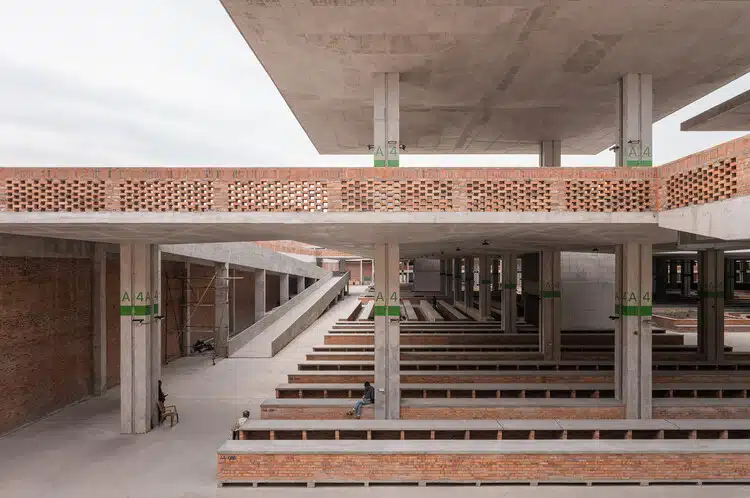
THINK TANK Architecture’s Zando Market Overhaul in Kinshasa Wins Holcim Award

THINK TANK architecture’s redevelopment plan for the Zando Central Market in Kinshasa, Democratic Republic of the Congo, has earned a 2025 Holcim Foundation Award for the Middle East and Africa region. The project addresses the market’s severe overcrowding and infrastructural challenges by introducing a climate responsive design that utilizes local resources and accommodates both formal and informal economic activities. This is a significant news for the global news.
A Climate Responsive Civic Hub
The Zando Central Market, originally designed for 3,500 traders, now supports over 20,000 vendors. The new architectural design re envisions the market as a vital piece of civic infrastructure. The design employs open concrete structures combined with locally produced terracotta bricks. This approach minimizes the need for imported materials and systems. The patterned brick facades, drawing inspiration from Congolese textiles, act as moucharabieh screens, providing essential ventilation and shade. “Mushroom” shaped concrete slabs are a nod to the historic market structure and enhance natural air circulation through stack ventilation, a key feature of this sustainable architecture.

Local Materials and Economic Empowerment
A key aspect of the project is its reliance on locally sourced materials, particularly concrete and terracotta bricks. This decision reactivated three local brick factories, boosting the local economy and preserving traditional skills. The use of locally sourced clay results in natural variations in color and texture, giving the buildings a timeless quality that blends with the local aesthetic. This approach to construction strengthens local industries instead of depending on foreign imports. The project serves as an important case study for future developments in the region.
Accommodating the Informal Economy
The design acknowledges the reality of informal markets in African cities. The plan preserves open and accessible areas to accommodate vendors who operate outside the formal structure. For instance, a wide inner street between the main structures and the open market allows smaller vendors to rent minimal spaces. The rooftop terraces are also designed to be open for informal market activities. This inclusive approach to urban planning ensures that the market continues to serve the entire community.

A Collaborative and Socially Responsible Approach
The architects developed the project through extensive collaboration with local authorities, vendors, and other stakeholders. THINK TANK architecture acted as a “reservoir of ideas,” combining international expertise with local knowledge and craftsmanship. This collaborative process was essential for a project of this scale, especially since the architects were not on site during the construction phase. The project highlights the social responsibility of architects in creating spaces that are not only functional but also culturally and economically inclusive. The success of this project could be a topic for a future editorial. The project’s success is a significant announcement for the future of architecture in the region.

✦ ArchUp Editorial Insight
The project is the outcome of a system operating under severe economic and logistical constraints. An informal market economy, far exceeding the site’s formal capacity, produced a non negotiable demand for spatial porosity. The decision to source all primary building materials from within a 60km radius, reactivating dormant factories, was a direct response to this economic reality, not an aesthetic choice.
The architects’ remote location during construction created a high risk environment.The architects managed this risk through two key decisions: producing hyper-detailed pedagogical documents and simultaneously designing for a high tolerance of craftsmanship error.This acceptance of imperfection is a systemic feature, not a design philosophy.
The resulting structure defined by its repeatable concrete forms, varied local brickwork, and integration of informal commercial spaces is the logical output of prioritizing local economic activation and remote oversight risk mitigation over standardized industrial perfection. It demonstrates how a project’s form is predetermined by its supply chain and management structure.