Ultra-Slim 262 Fifth Avenue Skyscraper Redefines Manhattan’s Residential Skyline


A new pencil-thin residential tower at 262 Fifth Avenue nears completion in Manhattan’s NoMad district. The 860-foot building rises approximately 54 stories, claiming the title of the tallest all-residential structure on Fifth Avenue.
A Pencil Tower With a Razor-Thin Footprint
The skyscraper’s defining feature is its remarkably slender profile. Its footprint measures just over 2,200 square feet. This creates an extraordinary height-to-width ratio that emphasizes pure verticality. Therefore, the tower ranks among the thinnest towers in New York City. The design pushes the centralized mechanical core to one side. This engineering decision eliminates interior columns entirely. Residents consequently enjoy uninterrupted panoramic views across Manhattan’s dense urban fabric.
Only 26 Residences Across 54 Stories
Unlike typical high-rise developments, this project contains only 26 homes. The residences include full-floor simplex units and larger duplex layouts. Each unit prioritizes natural light, privacy, and spatial flexibility. Moreover, the interior design comes from Danish firm Norm Architects, marking their first New York project. Pricing reportedly starts at approximately $7.5 million, reflecting the ultra-luxury segment of Manhattan’s residential market.
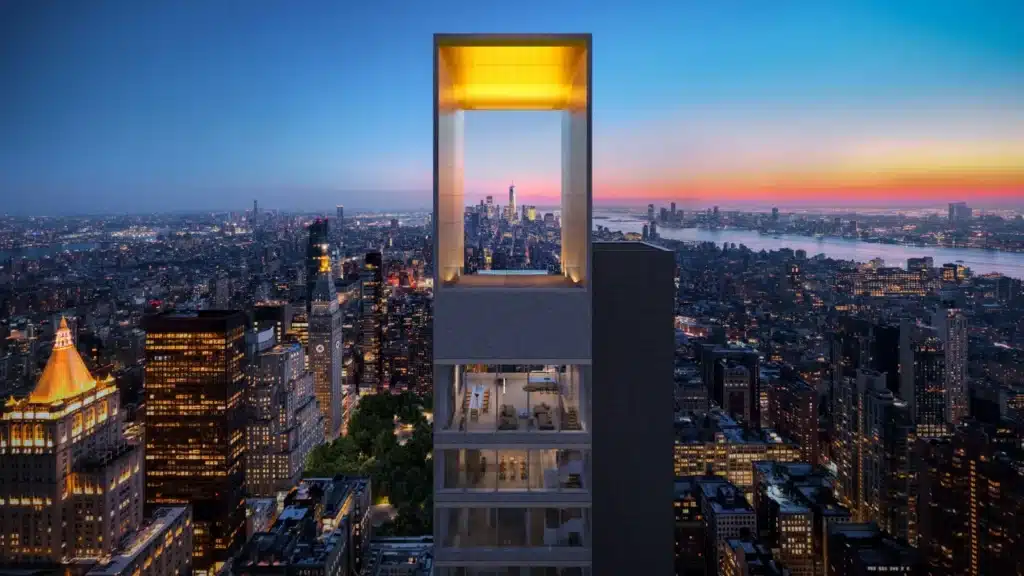
The rooftop crown features a large rectangular opening for an observation deck. Image © Hayes Davidson
Rooftop Amenities and Heritage Integration
The architecture extends beyond private residences into shared amenity spaces. A rooftop terrace features an infinity pool with observation-level views rivaling the nearby Empire State Building. Additional facilities include wellness spaces, a fitness center, and communal terraces. Meanwhile, the base of the tower incorporates a historic 12-story facade from a prewar structure previously on the site. This approach blends old and new elements, adding contextual depth to the construction.
A Decade-Long Evolution
The project has changed significantly since its inception. Initial 2016 proposals envisioned a taller mixed-use tower exceeding 900 feet. However, subsequent revisions refined the concept into its current residential-only form at 860 feet. The Moscow-based firm Meganom led the design, with SLCE Architects serving as architect of record. According to recent news coverage, private showings will commence in 2026. The tower targets a global clientele seeking privacy and iconic skyline views in one of the world’s most competitive cities.
As urban planning in Manhattan continues evolving, 262 Fifth Avenue demonstrates how extreme slenderness can deliver density without overwhelming its surroundings. The project also raises ongoing questions about sustainability and accessibility in ultra-luxury residential development.
A Quick Architectural Snapshot
Rising 860 feet on a 2,200-square-foot footprint, 262 Fifth Avenue delivers just 26 residences within one of Manhattan’s thinnest towers. The project merges a historic base facade with a contemporary pencil-tower form, offering column-free interiors and rooftop amenities at the edge of the NoMad skyline.
✦ ArchUp Editorial Insight
The pencil tower typology emerges from a simple equation: maximum height on minimum land. Manhattan’s zoning laws reward verticality, while Fifth Avenue’s prestige commands premium pricing per square foot. Developers therefore extract value upward when horizontal expansion proves impossible.
The 26-unit model reveals another calculation. Fewer residences mean fewer shared walls and exclusive floor plates. This scarcity drives prices higher than conventional luxury towers can achieve. The ultra-wealthy buyer seeks separation from neighbors, not community amenities.
Historic facade preservation at the base serves dual purposes. It satisfies landmark considerations while providing marketing differentiation. The old becomes a selling point for the new.
This project is the logical outcome of constrained land availability, zoning incentives favoring height over bulk, and a global capital flow seeking trophy assets in gateway cities.