A 90-Year-Old Vase Becomes a Walk-In Room on Copenhagen’s Harborfront

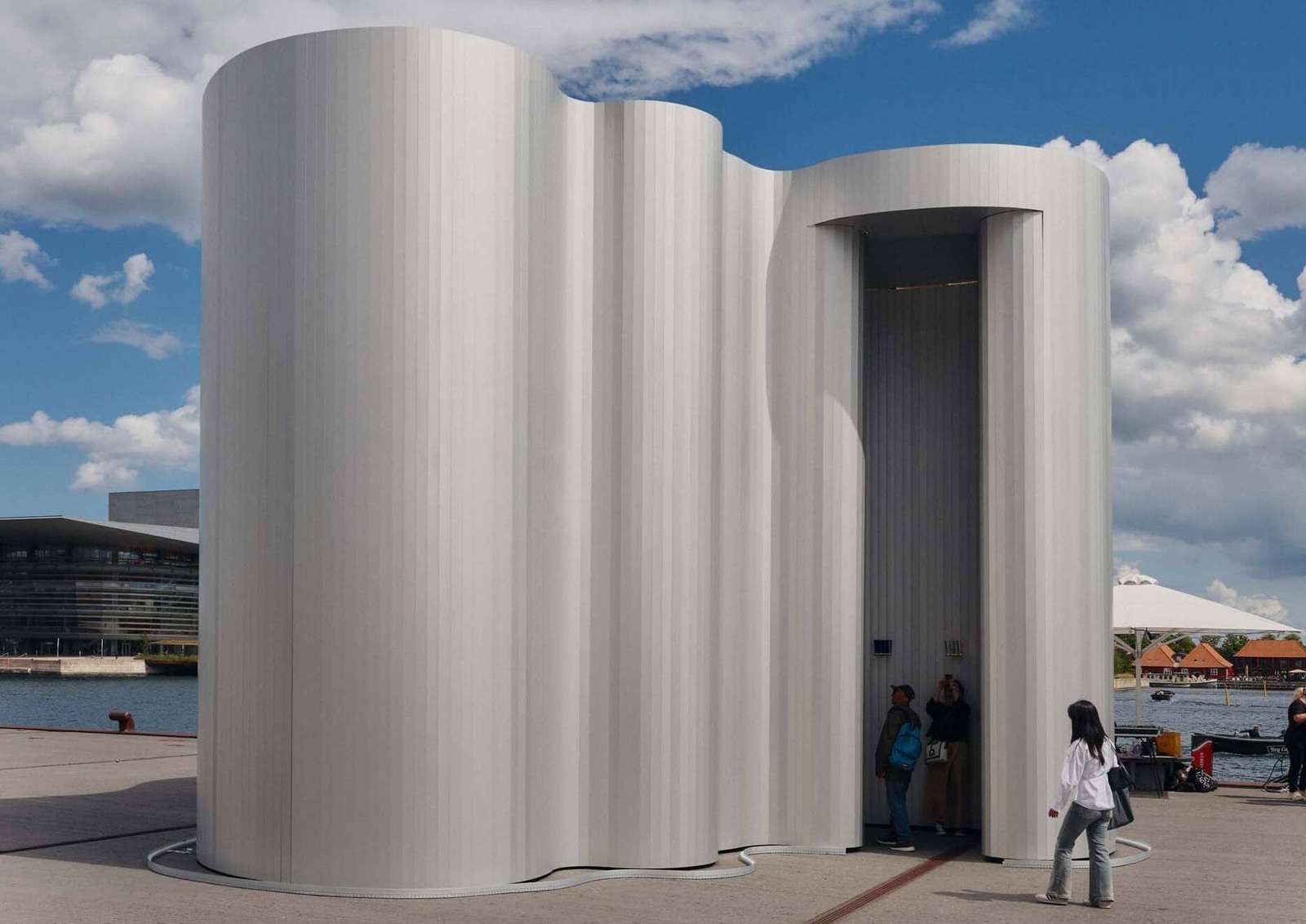
For three days in June 2025, a pale, rippling aluminum wall rose 23 feet above Copenhagen’s harborfront at Ofelia Plads. It was not a wall in any conventional sense. It was the outline of the Aalto vase a small glass object first designed in 1936 scaled up until a person could walk inside it. The move raises a precise architectural question: what happens to an object when the body enters it rather than holds it?
The pavilion took its occasion from the vase’s 90th anniversary. Finnish glassmaker Iittala, which has produced the vase continuously since 1936, commissioned the project. A Copenhagen-based studio designed it. Norwegian aluminum company Hydro supplied both the metal and the engineering required to hold a 23-foot wave upright without visible structural support. The structure appeared at the annual design festival 3daysofdesign, running from June 10 to 12, then came apart for reassembly in another city.
From Object to Room: How the Vase’s Profile Encloses Space
A vase belongs to the world of held objects. You turn it, set it down, see it from a distance. Scaling the Aalto vase to room size reverses that relationship entirely. At 23 feet, the form offers no elevation to read from the outside. It reveals itself only from within, only in movement, and only partially. The object that once sat in the hand becomes the enclosure that contains the body.
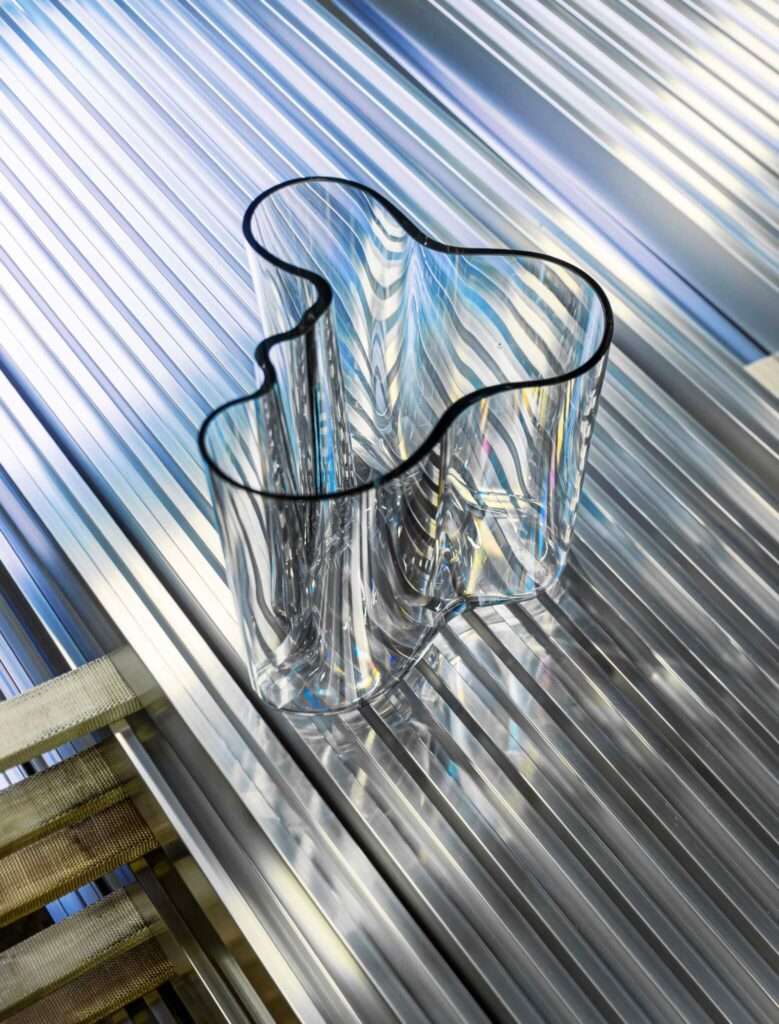
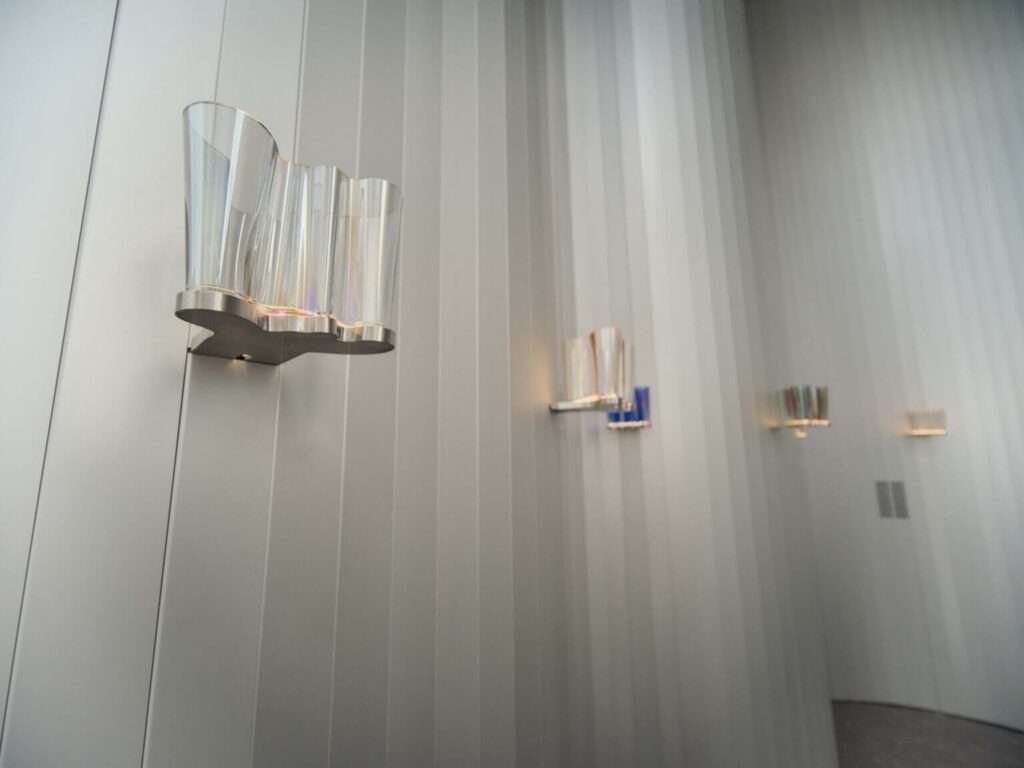
The inversion reached its clearest point at the pavilion’s center. There, a new limited-edition anniversary set of Aalto City Vases six colors named for Helsinki, Tokyo, Amsterdam, Copenhagen, New York, and Berlin stood on display inside the giant version of themselves. The handheld object sat within the room it had become. The circularity was deliberate and spatially precise.
Aluminum, Low-Carbon Material, and the Logic of a Seamless Enclosure
What allowed the form to enclose so completely was the absence of any visible joint. Hydro shaped its low-carbon aluminum produced using 100 percent renewable energy, with a carbon footprint of 4.0 kg of CO₂ per kilogram of aluminum, less than one third of the global average into sections and clamped them edge to edge. The result was one continuous surface with no corners, no joints, and no right angles. The wall wrapped rather than met.
The choice of aluminum served the form’s demands. The vase’s organic, flowing outline needed to reach architectural scale without reading as heavy. A heavier material would have thickened the undulations and lost the lightness that defines the original object. The aluminum held the profile thin enough to preserve that quality at room scale.
The structure also addressed sustainability as a material condition rather than a secondary claim. Hydro’s REDUXA aluminum met a specific carbon threshold, and the pavilion’s ability to disassemble and travel meant the embodied energy of its production could be amortized across multiple exhibitions rather than spent on a single event.
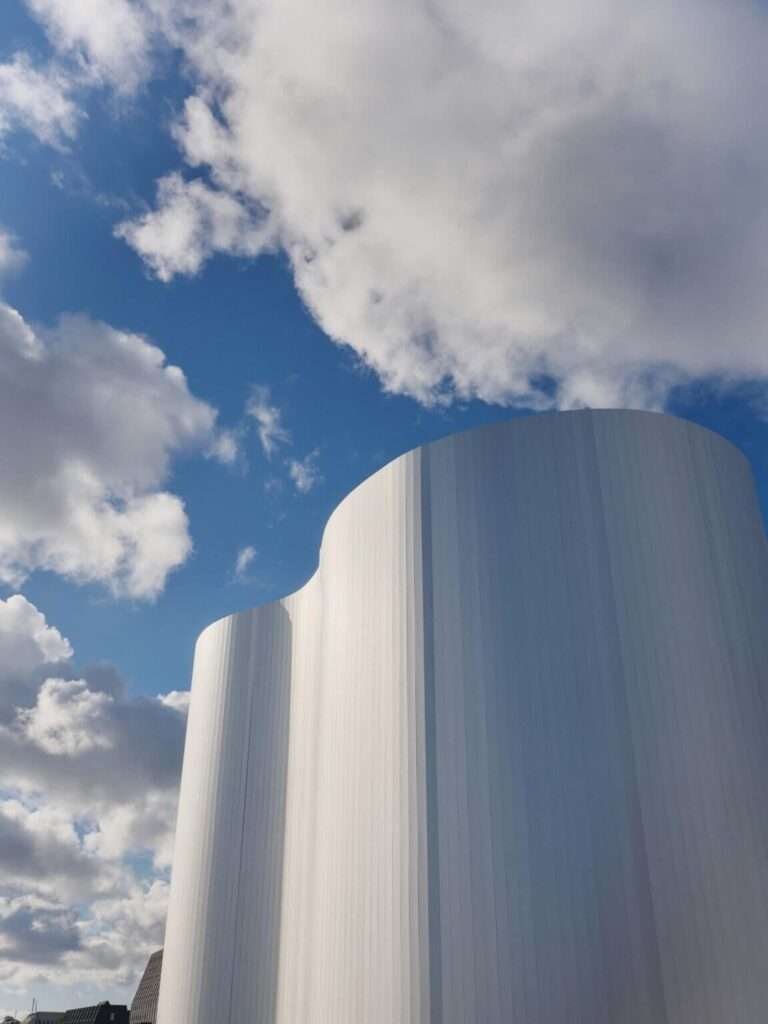
The original vase works through transmitted light. Glass lets daylight pass through its body, and the color shifts as the light angle changes. The pavilion worked in the opposite direction. Its opaque aluminum walls received light rather than transmitted it. The team positioned lighting along the floor and within the wall’s folds, so light raked across the surface rather than moved through it. The undulations caught the light on their forward faces and dropped into shadow at their recesses. In opacity, the waves read harder and more structural than they do in clear glass.
This reversal was not incidental. The designer whose name the vase carries whose surname, Aalto, means “wave” in Finnish spent his career bending modernism’s hard, rectilinear forms into curves that felt human and organic. The pavilion inherited that formal logic but translated it through an entirely different material behavior.
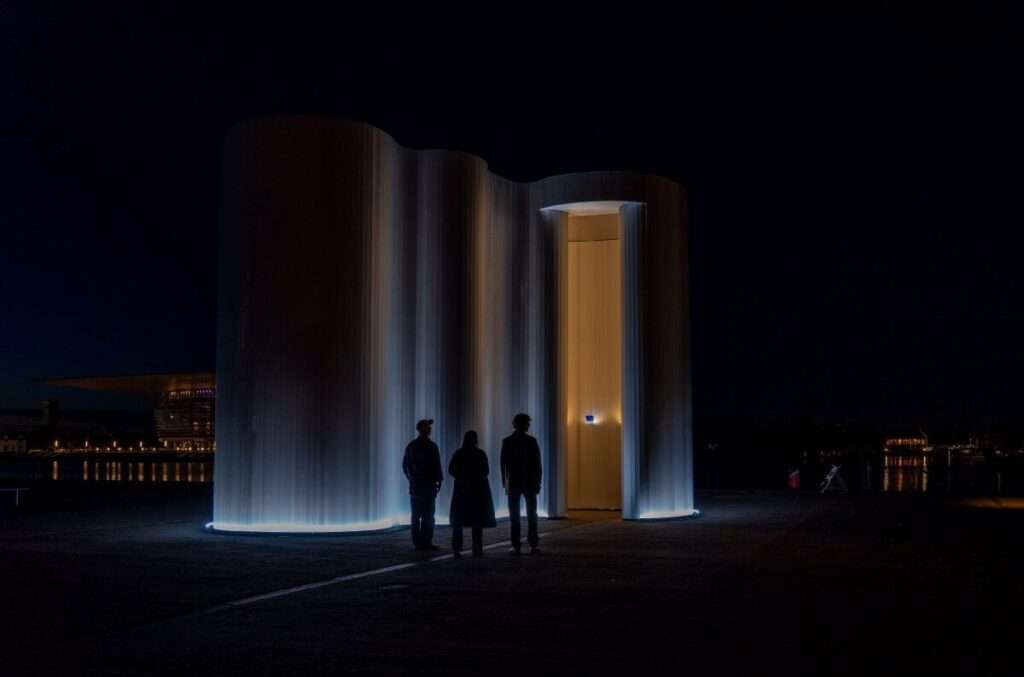
Inside, the design prioritized atmosphere over conventional display. A skylight drew daylight down the curved walls and allowed the light to shift through the hours of the day. The team treated this shifting light as a central spatial element rather than a background condition. A soundscape moved through the volume alongside it. Together, these elements framed the interior as an experience of the form itself not a gallery space that happened to have an unusual shape.
Spatial Logic and the Scale Shift from Object to Enclosure
The pavilion’s architectural argument rests on a single, disciplined move: the scalar translation of a domestic object into a navigable enclosure. This is not a metaphor. The team transferred the vase’s actual profile to a structural aluminum system and resolved the technical problem of holding a non-rectilinear, continuously curving wall upright without visible bracing. The seamless surface was a structural and perceptual decision simultaneously one continuous skin that reads as object rather than building. What the project leaves open is the question of interiority. The vase’s original spatial logic is defined by containment it holds liquid, it does not direct movement. Scaled up, it offers enclosure but no circulation hierarchy, no sequence, no threshold beyond entry. The single seam that opens as a doorway is the project’s only spatial articulation. That restraint is consistent with the pavilion’s brief, but it also marks the boundary of what a translated object can achieve as urban architecture.
✦ ArchUp Editorial Insight
The Aalto 90 Pavilion makes a clear architectural argument: scale a recognized object precisely enough, resolve its surface without seams or corners, and the form generates spatial meaning on its own terms. The skylight, the raking light, the soundscape these are not decorations. They are the project’s interior program. The design treats the enclosure itself as the experience, and at that scale, the vase’s curve carries enough spatial force to justify the move. The counter-argument is harder to dismiss. A pavilion that lasts three days and travels by disassembly is a sophisticated piece of design communication, not a spatial proposition with urban permanence. Its real function is brand extension at exhibition scale. The aluminum’s low-carbon credentials matter, but they do not change the fundamental logic: this is a product launch dressed in architectural language, and architecture criticism should name that honestly alongside its genuine spatial achievements.
Project Team: Design: Tableau CPH (Copenhagen). Material engineering and aluminum supply: Hydro (Norway). Commissioner: Iittala (Finland). Creative direction: Janni Vepsäläinen (Iittala Creative Director). Location: Ofelia Plads, Copenhagen, Denmark.
Project Notes: The pavilion debuted at 3daysofdesign, Copenhagen, June 10–12, 2026, marking the 90th anniversary of the Aalto vase. The structure uses Hydro REDUXA low-carbon aluminum produced with 100 percent renewable energy, rated at a maximum of 4.0 kg CO₂ per kg aluminum. The pavilion is designed to disassemble and travel for reassembly in additional cities. Client: Iittala. Developer: Not specified in source.