Desert Observatory Integrates Scientific Research and Public Stargazing

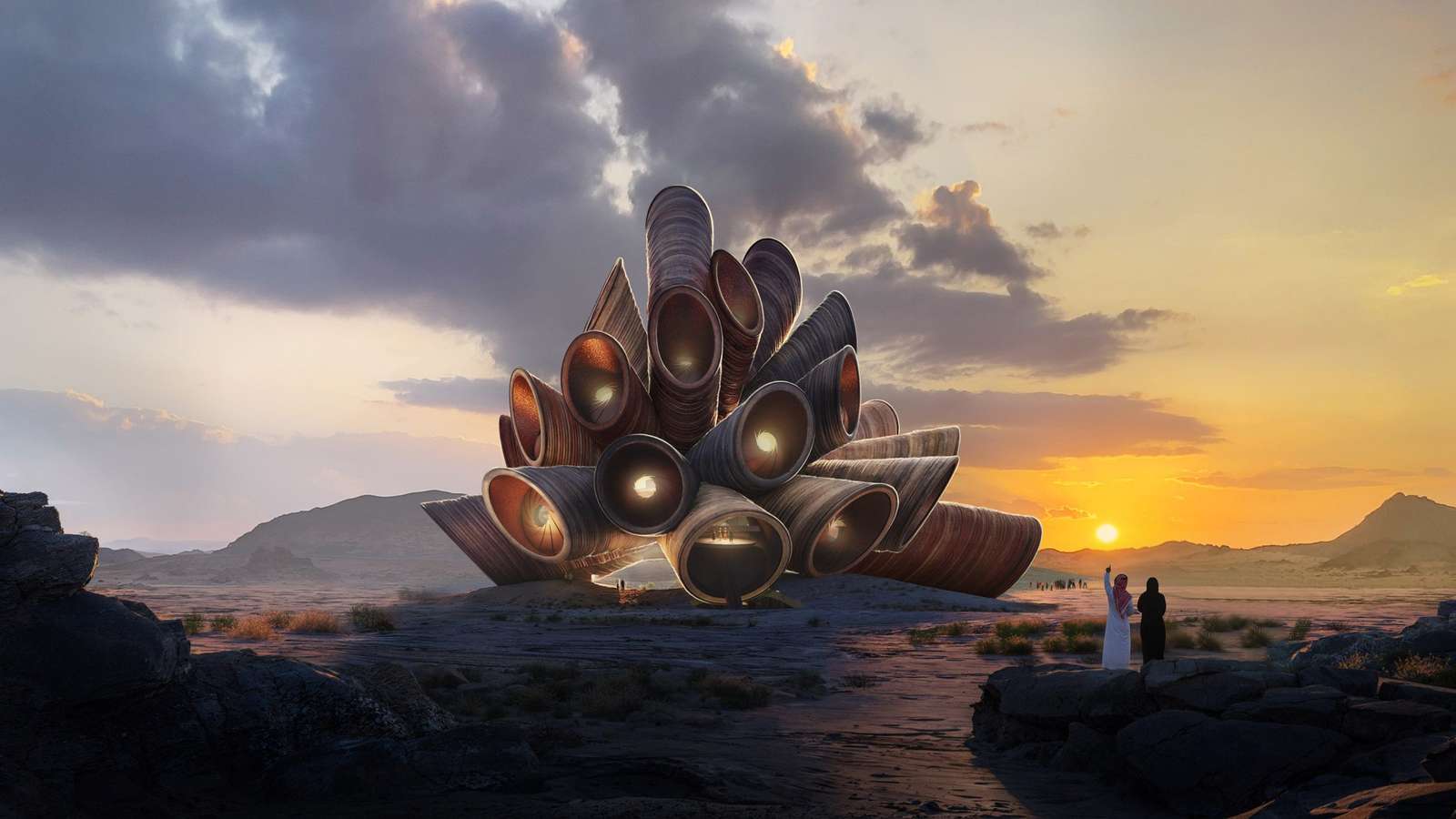
A new visitor and research center near the AlUla UNESCO World Heritage Site in Saudi Arabia redefines the traditional observatory as an immersive public gateway to the cosmos. The project utilizes the region’s exceptional atmospheric clarity to support both advanced scientific inquiry and experiential learning for visitors. The intervention establishes a permanent celestial outpost that remains deeply rooted in the geological character of the surrounding desert landscape.
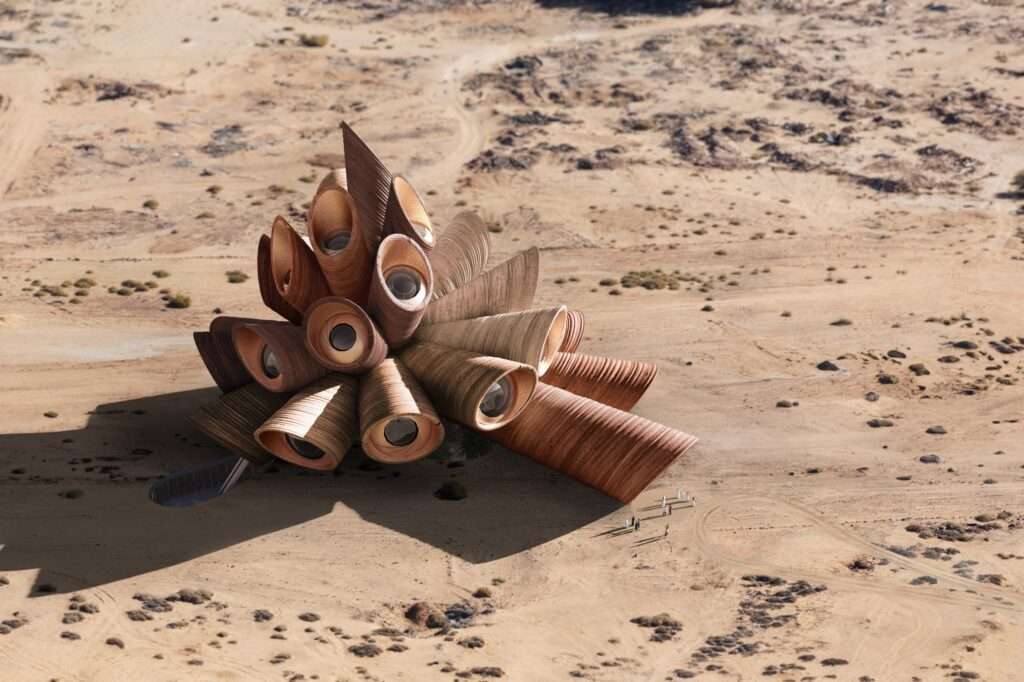
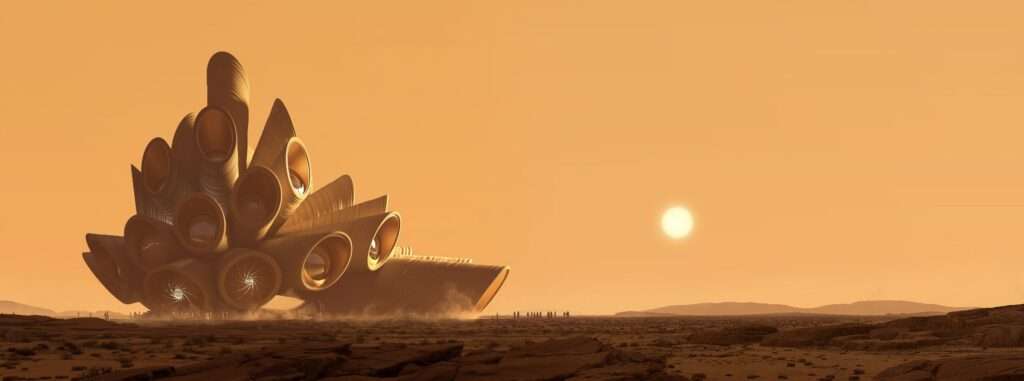
The scheme comprises a cluster of interlocking, tubular volumes constructed from textured stone. These vertical elements terminate in expansive glazed apertures, orienting views toward the night sky and the vast desert horizon. By stacking these forms, the design creates a multi-level architecture that balances technical requirements with a tactile, earthly materiality.
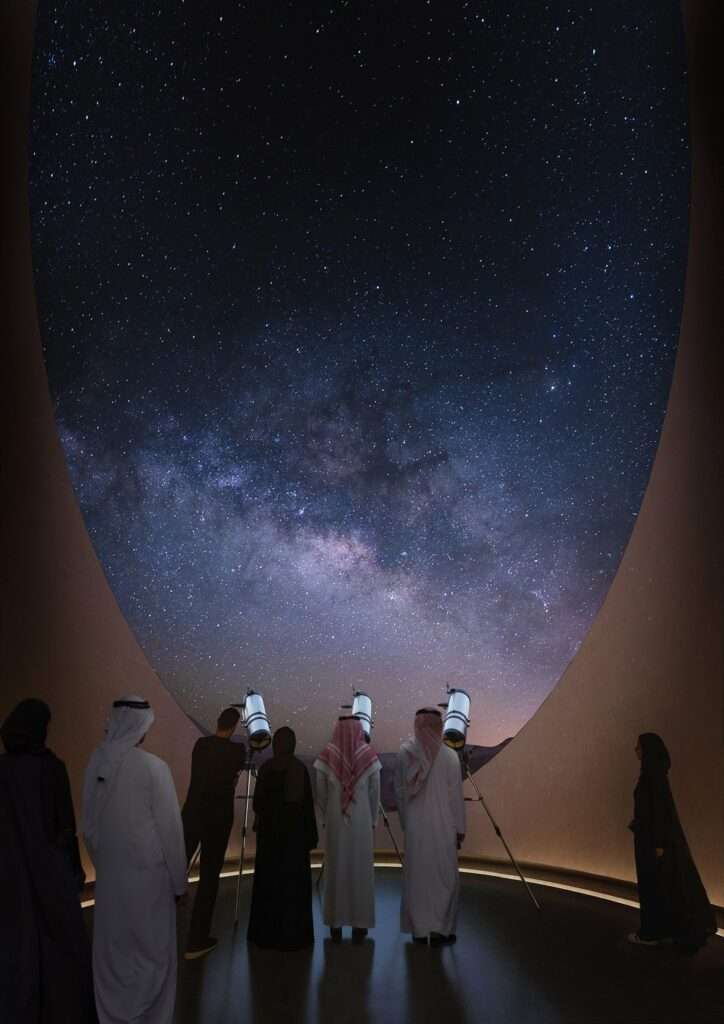
Inside, the program facilitates a range of activities by housing a planetarium, a dedicated research base for scientists, and a restaurant. The interior reorganization prioritizes curiosity, placing scientific work in closer proximity to the public realm than typical remote outposts. This programmatic intelligence ensures that the facility functions as an educational hub rather than a sterile laboratory.
Geological Integration and Geometric Logic
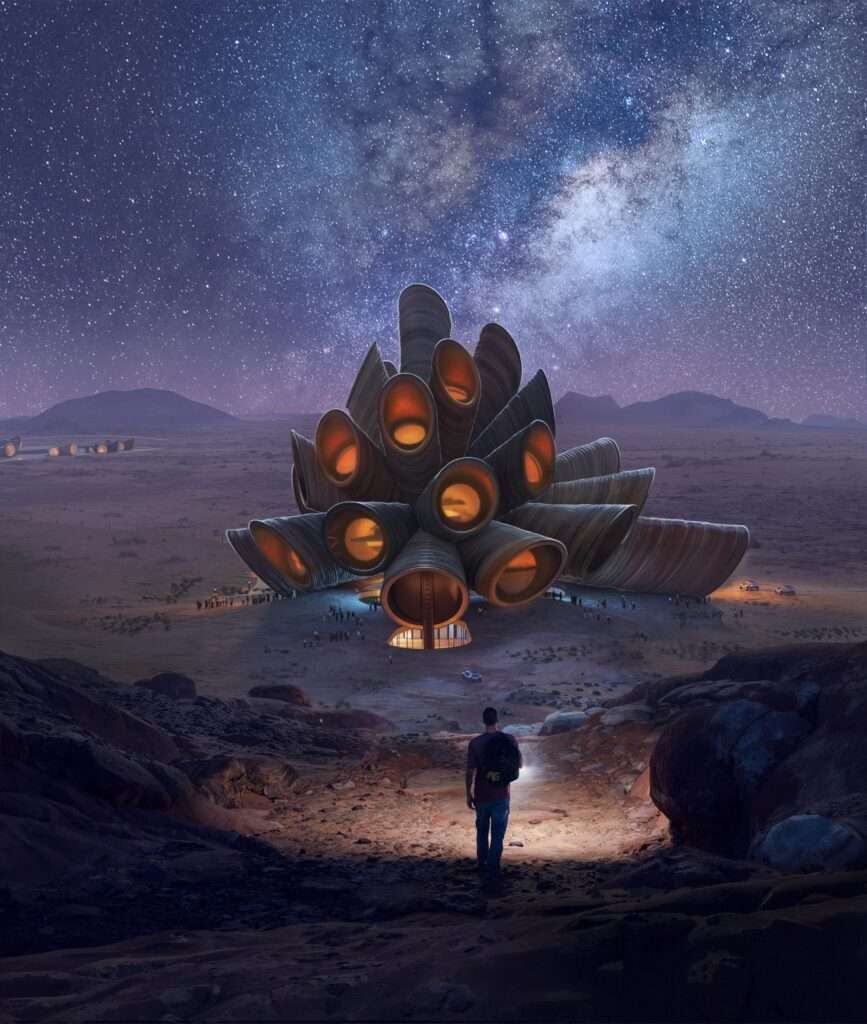
The team drew inspiration from the spiraling geometries found in both celestial systems and the natural world. This conceptual framework manifests in the arrangement of three primary telescope-like formations. These structures appear to grow out of the terrain, maintaining a heavy, rooted presence while directing the visitor’s focus upward toward the solar system.
The construction utilizes local material cues, mimicking the stratification and hue of the nearby mountains. This material choice provides thermal mass, which assists in managing the extreme temperature fluctuations of the desert environment. At the summit, a rooftop observation deck serves as an open-air extension of the interior galleries, offering unobstructed views of the stars.
“Space observatories are often remote, sterile places – technical outposts that feel distant from the public. We saw an opportunity to dissolve those barriers and create a place where visitors can step inside the wonder of the cosmos.”
Expansion of the Regional Masterplan
This observatory serves as a cornerstone for a larger masterplan intended to transform the site into a premier destination for astronomy. Future phases include the installation of several powerful telescopes and the construction of onsite accommodation. Plans also feature a stargazing lodge and remote pods, which will allow visitors to experience the night sky in total isolation from the central hub.
The project aligns with a broader regional strategy to integrate heritage, sustainability, and specialized tourism. By focusing on the unique darkness of the AlUla desert, the intervention secures a niche within the global network of scientific research facilities. Meanwhile, the tactile stone envelope ensures the building remains an asset to the landscape even during daylight hours.
Circulation Hierarchy and Programmatic Intelligence
The project demonstrates a sophisticated reading of the observatory typology by rejecting the hermetic enclosure usually associated with scientific outposts. Instead, the design utilizes a vertical circulation hierarchy that guides the visitor through a sequence of increasingly specialized zones. The interlocking tubular forms serve as both structural support and spatial containers, allowing for a clear separation between the public restaurant and the technical research areas. By employing a spiraling geometric logic, the scheme creates a sense of rhythmic movement that mirrors the rotation of the heavens. The choice of textured stone grounds the high-tech program, ensuring that the facility functions as a geological extension of the site rather than a foreign object placed upon it.
Project Team: Heatherwick Studio and executive partner Stuart Wood. Location: AlUla, Saudi Arabia.
Project Notes: The team recently unveiled the design as part of a wider masterplan including scientific telescopes and visitor accommodation. Visualisations belong to Heatherwick Studio.
✦ ArchUp Editorial Insight
The proposal reimagines the observatory as a tactile, geological event, moving away from the hermetic machinery of traditional science to create a public threshold in AlUla. By utilizing stacked, textured stone cylinders, the architecture successfully domesticates cosmic observation, grounding celestial curiosity within a specific desert stratification. This strategy effectively replaces scientific distance with a grounded, experiential journey through spiraling, telescope-like volumes. However, this romanticization of the desert landscape risks masking the project’s role as a tool for high-end territorial branding and tourism. While the design celebrates “dissolving barriers,” the resulting construction remains an curated enclave within a broader masterplan of exclusive pods and lodges. This aestheticization of the night sky may ultimately prioritize the spectacle of observation over the rigorous, isolated environment essential for authentic scientific inquiry.