The Great Repositioning: Architecture and the Valuation of Skill in 2026

As we conclude the first quarter of 2026, the global architectural landscape is defined by a state of profound repositioning. It is an era that defies simple labels; it is not quite a traditional recession, nor is it a mindless boom. Instead, it is a period where the world is reordering itself with a velocity that exceeds our institutional capacity to adapt. For the professional architect, this moment is particularly acute, as they stand at the volatile intersection of global economics, sophisticated technology, and the physical reality of the built environment. The fundamental question of the year is no longer about who possesses the most advanced tools, but rather who understands the nature of the transformation itself.
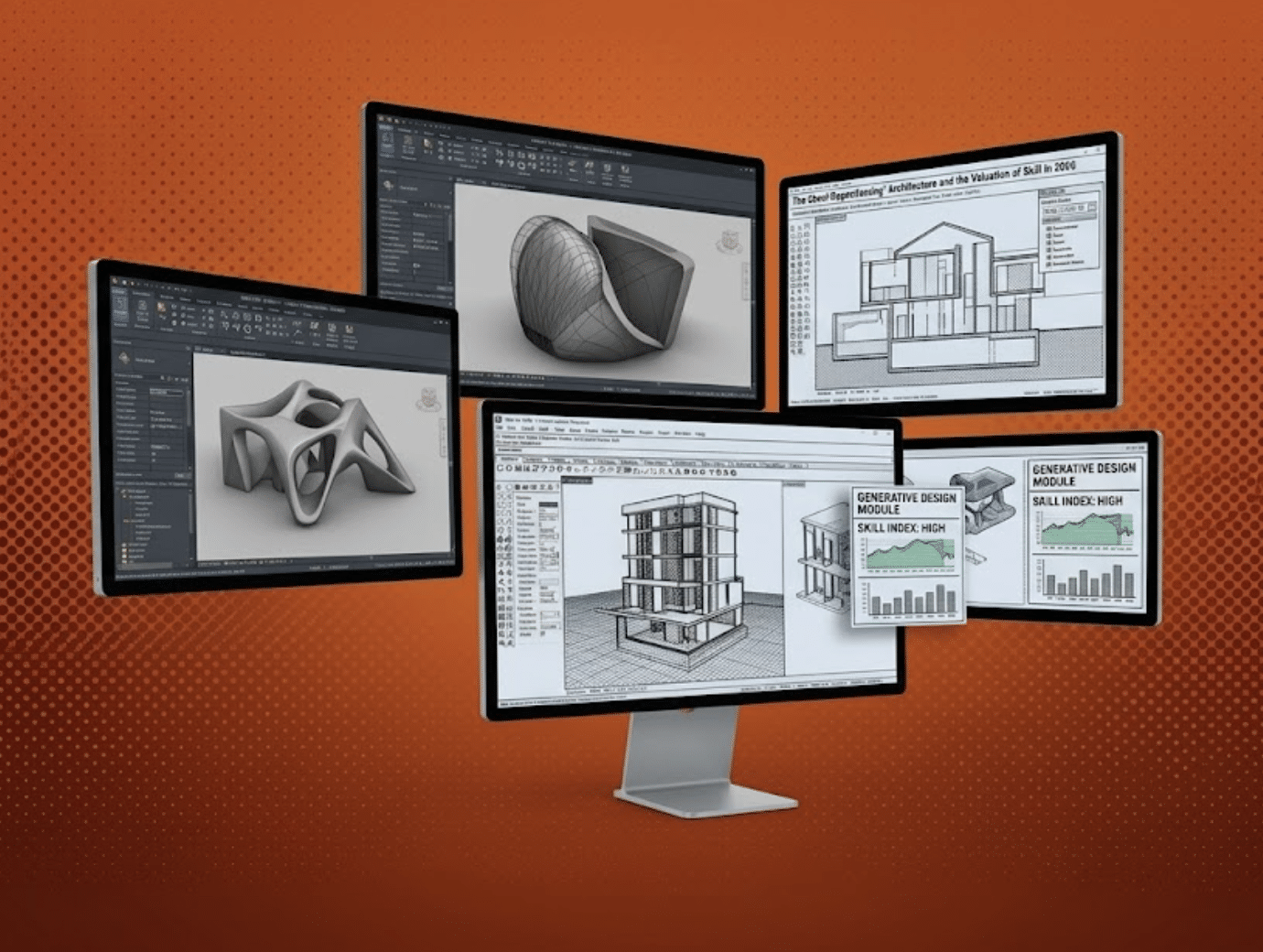
To grasp the depth of this shift, one must consider the trajectory of an architect who entered the profession two decades ago. For those who graduated in 2005 or 2006, their professional identity was forged through the mastery of a specific digital liturgy. Proficiency in AutoCAD, SketchUp, and Photoshop was not merely an asset; it was the very language of the trade. Mastery required years of iterative practice, and professional survival was inextricably tied to the speed and precision of one’s hands. As we navigate the early months of 2026, that twenty year accumulation of skill is facing a confrontation with a twenty second generative cycle. This is the central crisis of the contemporary practitioner, where skills that once defined a career have been liquidated into a series of automated prompts.
The shock we are experiencing is not merely a technological one; it is fundamentally economic. Artificial intelligence has not arrived simply to change how we work, but to radically reprice the work itself. Services that were once sold as high value offerings, such as the drafting of detailed plans, the creation of hyper realistic renderings, and the orchestration of complex presentations, are now faster, cheaper, and in many instances, nearly free. This is the moment of architectural devaluation, where the market price of technical proficiency has collapsed because the knowledge required to produce it is no longer scarce. When a skill becomes abundant, its economic leverage vanishes, leaving many traditional firms in a state of existential vertigo.
This pressure is clearly visible in the fluctuating fortunes of the software giants that have long anchored the industry. Companies like Adobe, Autodesk, and Trimble, which built their empires on the monopoly of specialized tools and recurring subscription models, are facing unprecedented scrutiny. Financial reports from early 2026 suggest a significant contraction in traditional SaaS margins as users begin to gravitate toward integrated, AI driven environments that bypass the need for traditional intermediary software. While Autodesk remains a pillar of the engineering world, it is being forced to redefine its role from a provider of drafting tools to a coordinator of generative design. The user is no longer paying for the privilege of using the tool; they are demanding the immediate delivery of the result. This shift from tool to outcome is putting immense strain on every corporation that historically sold the bridge between a concept and its physical manifestation.
In this new reality, the monopoly of knowledge has effectively dissolved. For over a century, the architect was the gatekeeper of a specialized body of information. That rarity allowed for a specific pricing structure. Today, that information is abundant and accessible, and as any student of Architectural Research knows, abundance is the enemy of high margins. This technological shock is occurring against a backdrop of severe global economic strain. With global debt hovering at 348 trillion dollars, capital is no longer cheap, and investors are increasingly intolerant of the traditional, slow moving architectural workflows. The industry is being forced to reconcile with a harsh market that is both more ruthless and more transparent than ever before.
“The shift is not anecdotal; it is already visible in the financial posture of the tools themselves. In 2023–2024, companies like Autodesk reported that more than 95 percent of their revenue now comes from subscriptions, a model built on locking long-term dependency rather than one-time mastery. At the same time, generative AI tools have entered the market with near-zero marginal cost, collapsing the perceived value of production-based skills almost instantly. This is the real inflection point: not a decline in demand, but a structural inversion where tools are no longer scarce assets but ubiquitous utilities. In such a landscape, the architect who remains defined by software proficiency is inevitably competing in a race toward commodification.”
The impact of this repositioning is manifesting across three distinct layers of the industry. In the design layer, we see a hyper acceleration of production and a significant decrease in the cost of visual output, which in turn increases competition among smaller firms. In the execution layer, which remains anchored in the physical world of Construction, the impact of AI has been slower but is gaining ground through automated logistics and site management. Finally, in the market layer, clients have become more sophisticated and their expectations for speed and precision have reached an all time high. Every new entry in the News cycle seems to reinforce the idea that the traditional, labor intensive model of the architectural office is becoming a historical relic.
However, this is not a forecast of professional extinction; it is a forecast of professional sorting. We are witnessing the emergence of two distinct types of architects. On one side, there is the architect who remains dependent on the tool, the one whose value is tied to their proficiency in a specific program. This category of practitioner is under immediate threat because their primary output can now be replicated by a machine in seconds. On the other side, there is the architect who leads the idea. This professional uses the tool but is not defined by it. They understand the broader context, they possess the authority of intent, and they are the ones who ultimately make the critical decisions. This strategic architect is becoming more essential than ever before, precisely because the technical work has become so trivial.
The software companies themselves are not disappearing, but they are undergoing a radical metamorphosis. They are moving away from selling isolated programs and toward building integrated ecosystems. The product is no longer a software license; it is a work environment that combines data, simulation, and execution in a single flow. This mirrors the broader economic trend where value is migrating from the “how” to the “why.” In a world where anyone can generate a plan, the person who understands why that plan is the correct solution for a specific community or a specific climate is the only one who can still command a premium. This is why the future of Sustainability in the built environment will be driven by those who can synthesize complex environmental data into human centric solutions.
As we look at the major Projects currently being developed in high growth regions, such as those documented in the national archives of Saudipedia, it is clear that the scale of modern ambition requires a new kind of architectural leadership. The complexity of managing a giga project in 2026 requires more than just drafting skills; it requires an architect who acts as a conductor of a vast, automated orchestra. The role is shifting from a producer of drawings to a curator of systems. This transition is evident in the winners of recent global Competitions, where the successful proposals are those that demonstrate a deep understanding of urban systems and social resilience rather than just formal gymnastics.
The architect of today must make a decisive choice between resisting the change or redefining themselves. Resistance leads to a steady decline in competitiveness and a gradual exit from the market. Redefinition, however, requires a difficult pivot. It demands that the architect stop focusing on the mastery of the interface and start focusing on the mastery of the strategy. It requires a deep understanding of the economy, the social dynamics of our Cities, and the long term impact of every Design decision. The twenty year accumulation of skill is not lost; it simply needs to be repurposed as a foundation for a more elevated form of practice.
Ultimately, what we are witnessing in 2026 is the end of one era of Architecture and the beginning of another. The tools that once took a generation to master can now be condensed into a moment of digital generation. But the idea, the vision, and the human responsibility of building a world that matters still require a human mind. The real differentiator is no longer who knows the software, but who knows what to do with the result. In a world that is being reshaped with unprecedented speed, the ultimate winner is not the one with the most powerful machine, but the one who understands the game before the rules change once again.
✦ ArchUp Editorial Insight
The “Great Repositioning” of 2026 is a clinical symptom of the economic liquidation of traditional technical skills due to the abundance of generative knowledge. Data layering reveals a significant contraction in traditional SaaS margins and a market shift from “renting tools” to “buying immediate results.” This systemic pressure generates an institutional decision framework that dissolves the architect’s monopoly as the gatekeeper of specialized information, transitioning the role from a producer of drawings to a curator of complex systems.
Consequently, the architectural outcome is the result of a sharp professional sorting; tool-dependent practice becomes a devalued commodity, while “Idea-Led Architecture” emerges as a high-premium strategic service anchored in fiduciary responsibility and social resilience. In 2026 cities, built massing represents the final transition from the “how” to the “why” of construction. The labor-intensive office model is finalized as a historical relic, replaced by algorithmic infrastructure where twenty years of accumulated skill are repurposed as strategic prompts for sovereign decision-making.