The Infected City: When a Landmark Building Hijacks the Identity of Its Urban Host

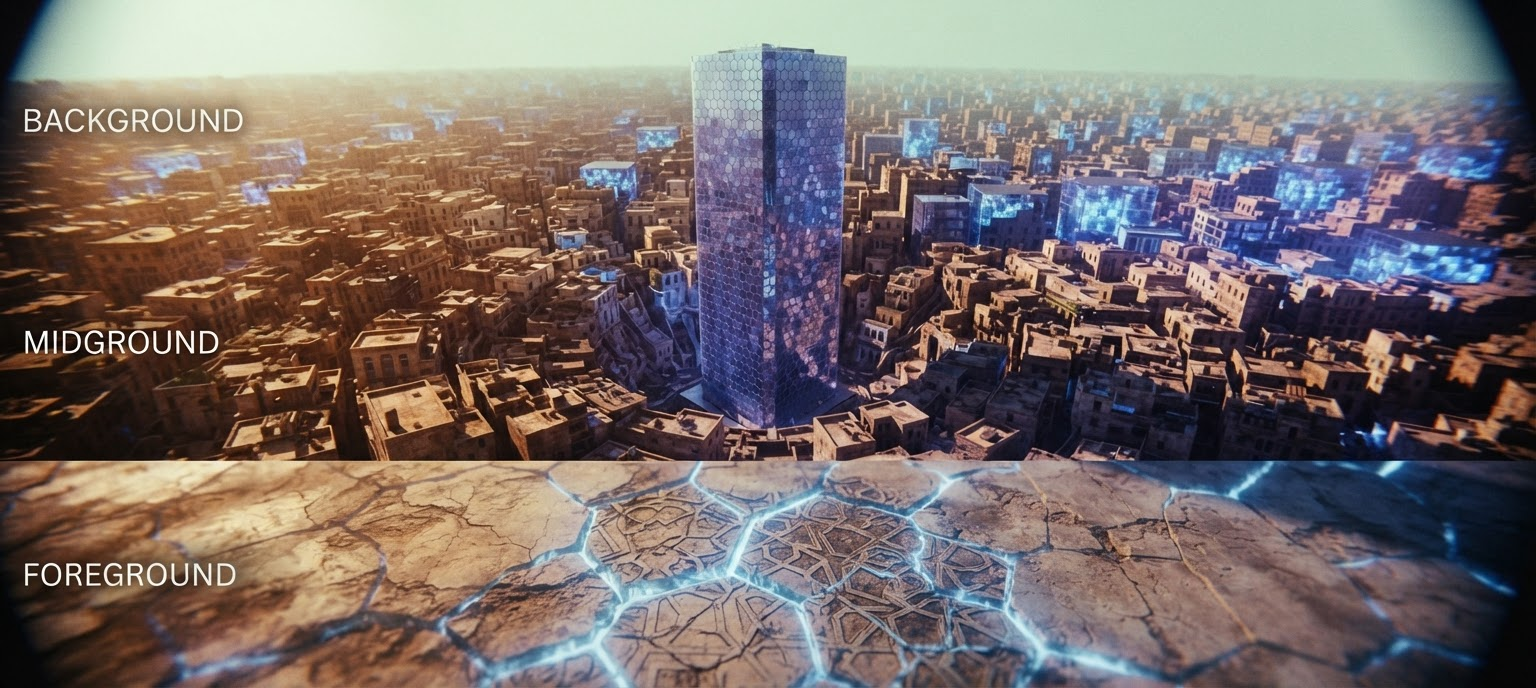
When the “Bilbao Effect” becomes a structural infection that reorganizes the city’s urban DNA
In entomology laboratories, researchers observe a phenomenon that appears to be a visual trick: a small larva transforms overnight into a shimmering blue jewel, not because anything was painted on its surface, but because a microscopic virus invaded its cells and completely reorganized their internal structure. The virus does not add color from the outside; it re-engineers the host from within until the body itself becomes a source of light. Now consider what happened to the Spanish city of Bilbao a quarter century ago: the Guggenheim Museum was not added to the city as a new piece of furniture on an old sidewalk. It reorganized transit networks, land prices, tourism flows, and even the identity of entire neighborhoods, until the whole city seemed to iridesce in the color of a single building. The parallel is not a passing poetic metaphor but a deep mechanical analogy that warrants a new critical lens for reading the transformations of contemporary cities.
Hijacking from Within: When the Intruder Reorganizes the Host’s Structure
To understand what happens to a city when a landmark building invades it, we must first understand what happens to a cell when an iridovirus invades it. According to research led by Williams in his comprehensive study of the natural invertebrate hosts of iridoviruses, these viruses do not operate as surface invaders that contaminate the host’s outer shell. They penetrate the cytoplasm and force the cell to produce enormous quantities of uniformly sized viral particles that self-assemble into paracrystalline lattice arrays. This crystalline lattice is what generates the iridescent color through Bragg-type light diffraction, much as DVDs produce their colors from regular microscopic grooves rather than chemical pigments.
Now pull this mechanism into the urban landscape. When the city of Bilbao — a declining industrial center in the Basque Country — decided to host a branch of the Guggenheim Museum designed by Frank Gehry, the building was not merely a formal addition to an existing urban fabric. The building reorganized the city’s internal structure: metro lines extended, airports expanded, hotels multiplied, and abandoned industrial districts transformed into cultural hubs. The city was not painted a new color; its urban DNA was re-engineered. The landmark building here resembles a virus that does not color the host from the outside but reprograms its entire productive machinery.
Smith observed as early as the 1950s, in his pioneering study on the morphology and crystallization of insect cytoplasmic viruses, that iridoviruses are among the most productive viruses in the insect world, with viral particles capable of comprising a remarkable fraction of the host’s body mass. By the same analogy, a single landmark building can command a disproportionate share of a city’s budget, media attention, and planning capacity, until it nearly overwhelms everything else. The question this parallel raises is not aesthetic but existential: does the city still control its landmark building, or has the building come to control the city?
Structural Color and Pigmentary Color: Why Painted Façades Cannot Change a Neighborhood’s Identity
One of the most compelling distinctions in iridovirus research is the fundamental difference between pigmentary color and structural color. As Just and Essbauer demonstrated in their characterization of an iridescent virus isolated from the two-spotted cricket, the blue-violet hue that coats the infected host does not result from any chemical pigment. It is a purely structural color arising from the regular physical arrangement of viral particles within the cell. Change the spacing between particles, and the color shifts: smaller particles produce blue and violet, larger particles produce green and orange, exactly as optical theory predicts — a finding later confirmed by Douch and Poupa’s observations based on citizen science data in Australia.
This distinction carries a critical lesson for architectural criticism. Most buildings in our Arab cities rely on “pigmentary color”: exterior paints, colored cladding panels, massive billboards, or even dazzling nighttime lighting. This color is superficial, washable, peelable, and changeable, and it does not touch the deep structure of the place. Al-Muizz li-Din Allah al-Fatimi Street in Cairo, for example, carries a stable historical “pigmentary color”: its limestone and Fatimid carvings grant it a visual identity that does not shift with changes in lighting or season.
Buildings that produce a genuine transformation in a city’s identity, by contrast, operate through a “structural color” mechanism: their impact does not come from the shape of their façade but from their reorganization of the economic, social, and political network of relations within the city. Egypt’s New Administrative Capital, regardless of our critical assessment of it, does not derive its impact from the colors of its buildings but from its complete reorganization of the urban network of relations: the relocation of ministries, the rerouting of transit corridors, the shifting of real estate centers of gravity. It is urban “structural color” par excellence, even if we disagree about its success or failure.
Adaptation or Distortion: When the Virus Saves the Host and When It Kills It
The central question posed by the biological research is one of adaptive function: does the iridescent color change benefit the infected host, benefit the virus at the host’s expense, or is it merely a functionless byproduct? The answer, as Williams and Hernández conclude in their study on the costs of cannibalism in the presence of an iridescent viral pathogen, is not simple. The virus renders the infected host lethargic and unable to defend itself, increasing the likelihood of predation by conspecifics or stinging by parasitoid wasps that in turn transmit the virus to new hosts. In laboratory trials, cannibalism among infected larvae transmitted lethal infection to roughly ninety-two percent of the consuming larvae. The iridescent color here may serve as an “honest signal” informing predators that this host carries a rich viral payload.
The urban translation of this question is sharp and direct: does the “architectural virus” — the landmark building that reprograms the city — adapt the host city and rescue it from decline, or does it drain its resources and kill its original fabric? Bilbao is the textbook case of successful adaptation: the museum saved a dying industrial city and transformed it into a global tourist destination, and the structural infection here was medicine, not poison. But the failed cases are more numerous than we think. Museums and landmark projects in Gulf and Arab cities have consumed billions without producing any real transformation in the city’s economic or social structure, and in some cases have siphoned resources from existing neighborhoods in desperate need of them. The landmark building here resembles a virus that drains the host to death without achieving any successful spread.
More troubling still is what Adamo and colleagues revealed about the “viral aphrodisiac” in Texas field crickets, where the virus suppresses normal sickness behavior and maintains the infected host’s sexual activity to ensure viral transmission through mating. In urban terms, this resembles those projects that keep the city in a state of media euphoria and visual spectacle while its infrastructure corrodes from within. The city appears alive and glittering from the outside, but is in fact sick and depleted.
Pattern Infection: When the Glass Façade Spreads Through Historic Neighborhoods Like an Epidemic
Iridovirus does not transmit easily through ordinary ingestion, as Carter demonstrated in his classic study on the mode of transmission of Tipula iridescent virus. Infection requires an open wound, a direct breach of the physical barrier. But once that breach occurs, the virus spreads through the population with remarkable speed. Marina and colleagues showed in their experiment on mosquito populations that host density plays a decisive role in transmission dynamics: the higher the density, the faster the infection accelerates.
In the Arab architectural landscape, we see the same mechanism repeating with remarkable precision. The tinted glass façade or cladding panel does not spread through a historic neighborhood via “ordinary ingestion” — that is, through the gradual natural evolution of the local architectural style — but requires an “open wound”: a new commercial building erected on the ruins of an old house, or a residential tower planted in the heart of a working-class quarter. Once this intruder building appears, the visual infection begins to spread: neighbors imitate the new façade within a few years, then imitation accelerates as urban density increases, until the “color” of the entire neighborhood shifts from warm stone to cold glass. Cairo witnessed this infection clearly over the past two decades, as the façades of entire districts transformed from local limestone and marble to imported cladding panels, not because individual owners made that decision independently, but because the visual infection spread through the same mechanism of social imitation by which a virus spreads through dense populations.
The Luminous Body and the Dead Body: Is Iridescence a Vital Sign or a Harbinger of Collapse?
Perhaps the most troubling aspect of iridovirus research is the gray zone between life and death. The infected host does not die immediately; it remains alive longer than usual, moving slowly, shimmering with iridescent colors. As López and colleagues observed in their study on parasitoid-mediated viral transmission, wasps attack infected larvae at roughly twice the rate they attack healthy ones, because the infected host has become a target that is simultaneously easy and enticing. The iridescent color here is not a sign of health but a sign that the body no longer belongs to itself.
How many Arab cities do we see today glittering with glass towers and illuminated façades while their infrastructure collapses from within? Urban iridescence — that gleam captured by drone cameras and social media feeds — may in some cases signal that the city has lost control of its developmental trajectory, and that external forces such as real estate speculation, short-term foreign investment, and superficial beautification policies have hijacked its internal structure and reorganized it to serve purposes unrelated to its original inhabitants. The city shines, but its shine is the shine of an infected body, not a healthy one.
Conversely, as Fenton and colleagues noted in their study on parasite-induced warning coloration in nematodes, some forms of parasitic coloration may be aposematic: the vivid color tells predators that this host is toxic and unfit for consumption. In urban terms, we can read some forms of failed “urban iridescence” as warning signals to planners and policymakers: this landmark project did not succeed, do not repeat it. The problem is that these warning signals are rarely read in time.
Toward an Urban Diagnosis: Reading the City as a Living Body Susceptible to Infection
What iridovirus research ultimately offers us is not merely an entertaining literary analogy but a genuine analytical framework that can be deployed in urban criticism. As Doucet and Meadows concluded in their study on the functional perspectives of iridescence, structural colors in nature serve multiple overlapping roles: attraction, warning, camouflage, and signaling. Architecture, in turn, produces urban “structural colors” that serve similarly complex roles.
The city is a living body susceptible to infection, and landmark buildings are structural viruses that reorganize its urban DNA. Some of these viruses are beneficial — like vaccines that stimulate immunity and renew vitality — and some are lethal. The task before architects and urban planners is not to prevent infection, an impossibility in a connected world, but to develop an urban immune system capable of distinguishing the beneficial virus from the harmful one, and of containing visual infection before it transforms from an isolated phenomenon into an epidemic that reshapes the identity of the entire city without the consent of its inhabitants.
✦ ArchUp Editorial Insight
The deployment of singular monumental architecture is rarely an autonomous design initiative; it is the structural instrument of municipal debt financing, global capital capture, and speculative land revaluation. Faced with deindustrialization or fiscal constraints, municipal governance frameworks systematically shift from distributive infrastructure maintenance toward risk-leveraged flagship developments engineered to accelerate real estate turnover. The resulting architectural spectacle—whether a sculptural cultural institution or cloned curtain-wall typologies—operates as a financialized anchor rather than a civic catalyst. This mechanism reallocates public subsidies and zoning concessions toward high-yield transit corridors and tourist enclaves, inevitably draining capital from surrounding civic networks. The visual iridescence of the landmark is neither an aesthetic triumph nor an arbitrary distortion; it is the direct spatial consequence of an urban economic model that subordinates systemic neighborhood resilience to short-term asset liquidity.
References
Williams, T. “Natural Invertebrate Hosts of Iridoviruses (Iridoviridae).” Neotropical Entomology, 2008.
Just, F.T., Essbauer, S.S. “Characterization of an Iridescent Virus Isolated from Gryllus bimaculatus.” Journal of Invertebrate Pathology, 2001.
Douch, J.K., Poupa, A.M. “Citizen Science Data Opens Multiple Avenues for Iridovirus Research and Prompts First Detection of Invertebrate Iridescent Virus 31 in Australia.” Journal of Invertebrate Pathology, 2021.
Smith, K.M. “The Morphology and Crystallization of Insect Cytoplasmic Viruses.” Virology, 1958.
Carter, J.B. “The Mode of Transmission of Tipula Iridescent Virus.” Journal of Invertebrate Pathology, 1973.
Williams, T., Hernández, O. “Costs of Cannibalism in the Presence of an Iridovirus Pathogen of Spodoptera frugiperda.” Ecological Entomology, 2006.
López, M., Rojas, J.C., Vandame, R., Williams, T. “Parasitoid-Mediated Transmission of an Iridescent Virus.” Journal of Invertebrate Pathology, 2002.
Marina, C.F., Fernández-Salas, I., Ibarra, J.E., Arredondo-Jiménez, J.I., Valle, J., Williams, T. “Transmission Dynamics of an Iridescent Virus in an Experimental Mosquito Population: The Role of Host Density.” Ecological Entomology, 2005.
Adamo, S.A., Kovalko, I., Easy, R.H., Stoltz, D. “A Viral Aphrodisiac in the Cricket Gryllus texensis.” Journal of Experimental Biology, 2014.
Fenton, A., Magoolagan, L., Kennedy, Z., Spencer, K.A. “Parasite-Induced Warning Coloration: A Novel Form of Host Manipulation.” Animal Behaviour, 2011.
Doucet, S.M., Meadows, M.G. “Iridescence: A Functional Perspective.” Journal of the Royal Society Interface, 2009.