Façades Electrically Dead… Alive at the Nanoscale

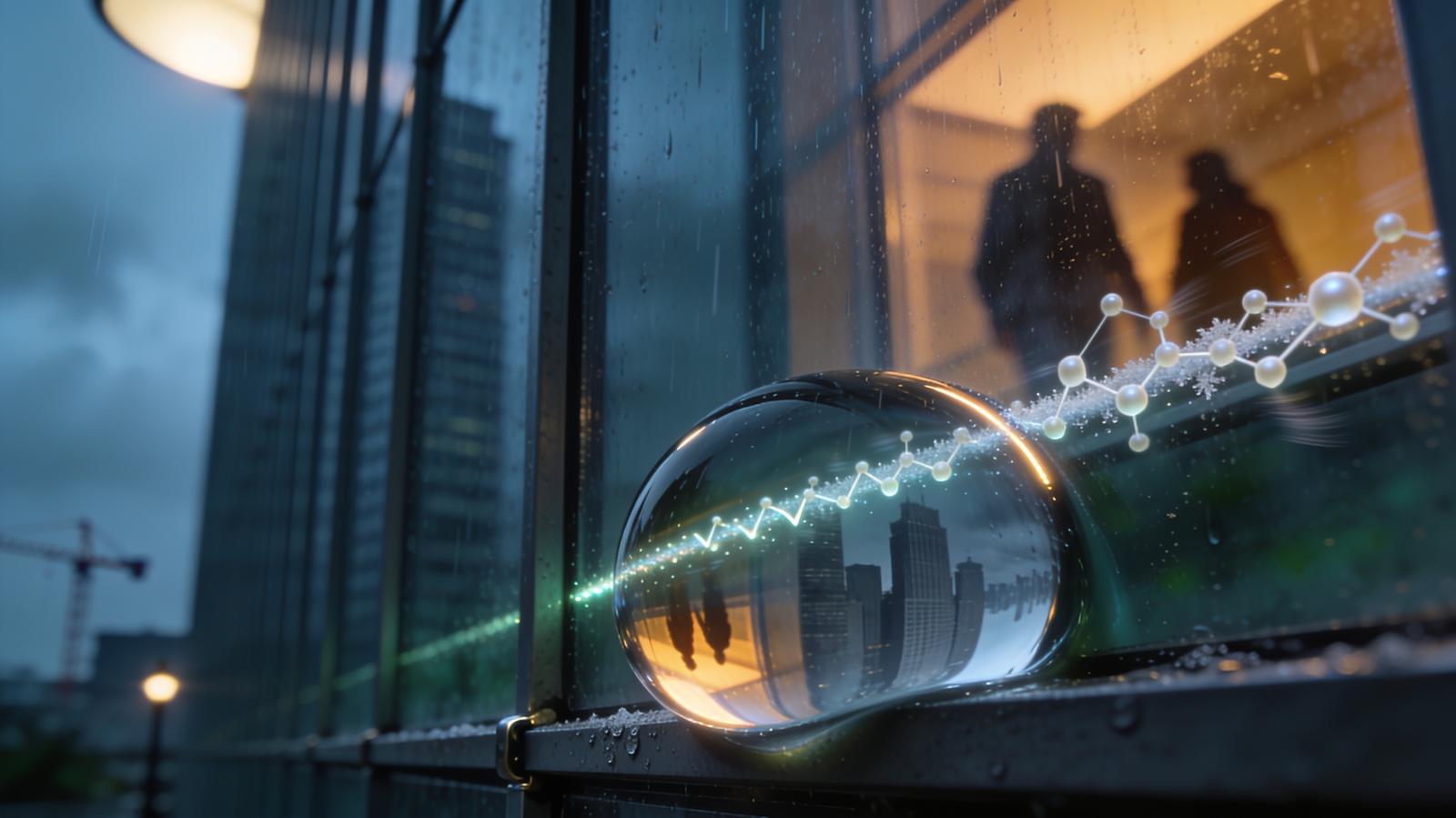
What the physics of confined water reveals about the water-repellent layers we wrap our towers in and assume to be still
When an engineer runs a hand across a glass panel treated with a water-repellent coating, the surface feels cold, dry, and silent; a surface whose job, the engineer assumes, was finished the moment the raindrops slid away. Yet a research paper published in 2020 in the journal Nano Letters by Sayantan Mondal and Biman Bagchi poses a question that unsettles this reassurance at its roots: is the water layer clinging to a hydrophobic surface truly “dead”? The answer, as the paper’s own title summarizes it, is an explicit paradox: this layer is electrically dead, but dynamically alive. Its molecules cannot respond to any electric field perpendicular to the surface, and at the same time they rotate, slide, and swap positions within fractions of a trillionth of a second. The façade we see as static is, at the molecular level, a stage in perpetual motion.
When Eighty Collapses to Two
The story began two years earlier, in the laboratory of Laura Fumagalli and her colleagues, who published in the journal Science a notable experiment: they confined water between two atomically smooth walls, one of graphene and the other of hexagonal boron nitride, and used a technique known as scanning dielectric microscopy to measure what is called the dielectric constant in the direction perpendicular to the surface. The dielectric constant, in plain terms, measures a material’s capacity to “absorb” an electric field and dampen it by rearranging its molecules; free water has an exceptional value of roughly eighty, which is why it dissolves salts so effectively. What the team found is that this value collapses to only about two when the water layer is no thicker than a nanometer or two, and it recovers its natural value only once the slit widens beyond a hundred nanometers.
The team explained its results with a simple model that imagines, near each wall, a thin layer about 7.5 angstroms thick, equivalent to the diameter of two or three water molecules, in which the capacity for polarization all but vanishes. They gave it a name borrowed from the world of solid-state capacitors: the “electrically dead layer.” The architectural irony here is that the thickness in question is far smaller than the thinnest coating any façade contractor could apply to a tower’s glass, and yet it suffices to turn the behavior of water upside down.
The Series-Capacitor Rule: The Thinnest Layer Governs the Whole Surface
Why does a layer this thin dictate the behavior of the entire water film? Here Mondal and Bagchi offer the most elegant explanation in the paper. When the dielectric response is measured across a slab of water, the system does not behave as an arithmetic average of its layers but as a chain of capacitors in series, where the reciprocal of each layer’s dielectric constant is summed rather than the value itself. Mathematically, this means the layer with the weakest response seizes a disproportionate share of the overall result. Two “dead” molecular layers near the walls are enough to determine the capacitance of the whole film, however thick the “living” water between them may be.
Envelope engineers know this logic well, if in another form; in a multilayer thermal insulation system, the weakest link determines the wall’s performance, not the thickest layer. What the two researchers did was generalize this rule to cover confinement in flat slabs, nanoscale cylinders, and graphene spheres, demonstrating that the inverse-addition rule is the key to understanding how a handful of molecular shells control the electrical screening of the entire system.
Why the Molecules Refuse to Turn
Molecular dynamics simulations reveal what actually happens inside that thin layer. At a hydrophobic surface such as graphene, water molecules sacrifice part of their hydrogen-bond network and compensate for the loss by aligning so that their hydrogen bonds lie flat, parallel to the surface, with their dipole moment resting in the plane of the wall rather than perpendicular to it. The result is a robust planar network of bonds that a perpendicular electric field cannot flip collectively. Studies conducted by Dominik Marx’s team and by the team of Iman Ahmadabadi and Ali Hassanali showed that this bias creates a sharp contrast: the response parallel to the surface swells until it exceeds the bulk value, in what physicists call “superpermittivity,” while the perpendicular response oscillates violently, passes through zero, and even turns negative near the wall.
Douglas Bonthuis, Stephan Gekle, and Roland Netz had earlier established the mathematical framework for extracting these dielectric profiles from the distribution of bound charges, and they reached a conclusion that concerns anyone working with submerged surfaces: what electrochemists call the “Stern layer,” the layer adjacent to the electrode, can be understood to a large extent as a natural consequence of pure water’s behavior at the interface rather than an effect of ions.
But the picture is not a matter of complete consensus. In 2021, Julián Olivieri, James Hynes, and Damien Laage published a careful analysis arguing that “ice-like” alignment is not the principal cause. According to their calculations, the orientational restriction of the first layer contributes a modest drop in the dielectric constant of roughly ten units, while the larger share, about fifty-two units, comes from long-range dipole correlations combined with the excluded-volume effect of the low-dielectric wall material, which displaces water from a region where it would have contributed positively had it been free. This means the dielectric perturbation extends over several nanometers, and the simple binary picture of “bulk water plus a dead layer” is a misleading simplification. More importantly, from an architectural standpoint, this interpretation suggests that the dielectric response of confined water could be tuned by choosing the dielectric properties of the confining material itself; in other words, the material we build with has a say in how the water touching it behaves.
Picoseconds of Life on the Surface
Here lies the point Mondal and Bagchi emphasized: a diminished static response does not mean the water is frozen. In their simulations of water confined between graphene sheets, inside carbon nanotubes, and within graphene spheres, they tracked residence times, diffusion coefficients, free-energy profiles, and the rotational trajectories of individual molecules. The results showed that a molecule remains in the electrically dead layer for a finite time ranging from a few picoseconds to a few tens of them, longer than it spends in the interior layers because free-energy barriers delay its escape perpendicular to the surface, but exchange between layers is continuous and nothing is trapped.
Indeed, transport parallel to the surface is faster than in bulk water, which Ahmadabadi’s team attributed to the collective motion of intact hydrogen-bonded clusters sliding across the surface like ice floes across a lake, while the slow component of the residence time in the first layer reaches about 18 to 19 picoseconds compared with 4 in bulk water. Rotation slows by a factor of only about two, as Guillaume Stirnemann and colleagues showed, and more than that: a minority of “dangling” hydrogen bonds pointing toward the hydrophobic surface rotate faster than bulk water, jumping between partners in 1.6 picoseconds rather than 3.3.
Nor is this purely theoretical talk. Cho-Shuen Hsieh, Mischa Bonn, and their colleagues used ultrafast vibrational spectroscopy driven by femtosecond pulses to measure the reorientation of these dangling bonds at the air–water surface, the archetype of the extended hydrophobic interface, and found dynamics roughly three times faster than in bulk water. Huib Bakker’s team confirmed that water at these interfaces is more strongly hydrogen-bonded and more ordered, but this order is an equilibrium state of a molecular population in constant exchange, not a rigid ice film. This picture accords with what decades of research on biomolecular hydration have accumulated, as summarized by Aoife Fogarty and Damien Laage: water in contact with hydrophobic and mixed surfaces is only two or three times slower than bulk water and remains mobile on the picosecond scale. And as Shekhar Garde and Mark Schlossman observed, this layering extends about one nanometer into the liquid without the surface drying out or what lies upon it freezing.
The Question of Aging: Questions We Must Dare to Ask
None of these papers deals with building façades, and none of them studied the silicone or fluorocarbon coatings sprayed onto tower glass and metal cladding panels. But what they reveal about the behavior of water at hydrophobic surfaces imposes on the architect a question never asked before: when we wrap a façade in a water-repellent nanolayer and watch the droplets slide off, we assume we have ended the surface’s relationship with rain; what if what we left behind is an invisible layer of water, incapable of electrical response yet in perpetual molecular turmoil?
This opens the door to a hypothesis that materials scientists should test rather than architects assume: we attribute the deterioration of glass façade coatings after a decade or a decade and a half to ultraviolet radiation and thermal cycling. Could the hidden dynamic activity of this moist layer, with its rapid lateral sliding and continuous exchange, play a role in stressing the interface between the coating and what lies beneath it? The current research does not answer, and we may not answer on its behalf. But it dismantles the implicit assumption on which our specifications were built: that a water-repellent surface is an inert surface.
The Third State of Insulation, and the Building Skin as Organism
Architectural design treats waterproofing as a decisive binary: either the surface insulates or it does not. What this research implicitly proposes is a third, more ambiguous state: a surface electrically inert but mechanically unstill. And if the same research indicates that this layer governs at once the weakness of electrical screening and the speed of water transport through hydrophobic nanopores, and that it controls the water-mediated forces between surfaces and the barriers to dehydration, then façade detailing in tall buildings, where wind contends with thin films of water on glass, will one day need to be designed with the awareness that what happens in the first nanometer of the surface is not zero.
There is something beyond the technical, too. The phrase Mondal and Bagchi coined, “the term ‘dead layer’ is a misnomer,” serves as a lens for reading our cities. How many glass towers appear from the sidewalk as closed, silent masses, dead façades unresponsive to their surroundings, while their interiors teem with the movement of people, air, energy, and heat, exchanging constantly with their environment at scales the passing eye cannot see? Confined water teaches us that apparent inertness in one direction may conceal sweeping vitality in the others, and that the difference between “dead” and “alive” depends, first and foremost, on the question we choose to ask of the surface.
✦ ArchUp Editorial Insight
The interest of this article lies less in the physics than in what the physics exposes about how façade knowledge is produced. Building envelopes are specified through a binary logic of pass or fail because warranties, insurers, and procurement contracts require outcomes that can be litigated, and a coating that “repels water” is a legally legible claim in a way that a picosecond-scale molecular exchange is not. Accelerated weathering standards test ultraviolet exposure and thermal cycling because these are the variables that manufacturers, testing laboratories, and ten-to-fifteen-year guarantee horizons were built around; what falls outside the test protocol falls outside the failure narrative. The article’s speculative leap from confined-water research to coating delamination is therefore not a scientific finding but a symptom of a structural gap: an industry whose durability claims are organized around contractual time and standardized instruments, not around the interfacial behavior of the material it sells. Closing that gap would require rewriting the standards, not the coatings.
References
Mondal, Sayantan, and Biman Bagchi. “Water Layer at Hydrophobic Surface: Electrically Dead but Dynamically Alive?” Nano Letters, 2020.
Fumagalli, Laura, Ali Esfandiar, Rene Fabregas, et al. “Anomalously Low Dielectric Constant of Confined Water.” Science, 2018.
Bonthuis, Douwe Jan, Stephan Gekle, and Roland R. Netz. “Dielectric Profile of Interfacial Water and Its Effect on Double-Layer Capacitance.” Physical Review Letters, 2011.
Ruiz-Barragan, Sergi, Daniel Muñoz-Santiburcio, Sebastian Körning, and Dominik Marx. “Quantifying Anisotropic Dielectric Response Properties of Nanoconfined Water within Graphene Slit Pores.” Physical Chemistry Chemical Physics, 2020.
Ahmadabadi, Iman, Ali Esfandiar, Ali Hassanali, and Mohammad Reza Ejtehadi. “Structural and Dynamical Fingerprints of the Anomalous Dielectric Properties of Water under Confinement.” Physical Review Materials, 2021.
Olivieri, Jean-François, James T. Hynes, and Damien Laage. “Confined Water’s Dielectric Constant Reduction Is Due to the Surrounding Low Dielectric Media and Not to Interfacial Molecular Ordering.” The Journal of Physical Chemistry Letters, 2021.
Stirnemann, Guillaume, Peter J. Rossky, James T. Hynes, and Damien Laage. “Water Reorientation, Hydrogen-Bond Dynamics and 2D-IR Spectroscopy Next to an Extended Hydrophobic Surface.” Faraday Discussions, 2010.
Hsieh, Cho-Shuen, R. Kramer Campen, Ana C. Vila Verde, Peter Bolhuis, Han-Kwang Nienhuys, and Mischa Bonn. “Ultrafast Reorientation of Dangling OH Groups at the Air-Water Interface Using Femtosecond Vibrational Spectroscopy.” Physical Review Letters, 2011.
Strazdaite, Simona, Jan Versluis, and Huib J. Bakker. “Water Orientation at Hydrophobic Interfaces.” The Journal of Chemical Physics, 2015.
Fogarty, Aoife C., Elise Duboué-Dijon, Fabio Sterpone, James T. Hynes, and Damien Laage. “Biomolecular Hydration Dynamics: A Jump Model Perspective.” Chemical Society Reviews, 2013.
Garde, Shekhar, and Mark L. Schlossman. “Water at Functional Interfaces.” MRS Bulletin, 2014.