The Walls That Tell Horror Stories

How the Architect Borrows the Novelist’s Tools to Design Fear, Deliberately or Not
We design hospitals to reassure patients, schools to stimulate curiosity, and homes to offer warmth. Yet no one openly admits that, for centuries, we have also designed places for a single purpose: to frighten whoever enters them. From the stone cells of the Bastille to modern deportation corridors, from military bunkers to airport terminals at midnight, there exists a parallel history of architecture that has not yet been clearly written: the history of built space as a narrator of terror. The irony is that the discipline offering us the tools to understand this history is not architecture itself, but narrative theory — a field that has spent decades studying how novels, films, and folk tales frighten us, only to discover, almost by accident, that the same mechanisms function when translated into stone, concrete, and light.
Researchers who spent years dissecting the mechanics of literary fear — from Noël Carroll, who distinguished between “art-horror” and “art-dread,” to Clotilde Landais, who analyzed how suspense collapses when a horror novel is mistranslated, to field studies that measured heart rates inside haunted houses — produced, without intending to, a complete vocabulary for understanding how the human body senses threat within an enclosed space. When this vocabulary is projected onto architecture, an unsettling truth emerges: some of the most “effective” buildings in history were not effective because they were sturdy or functional, but because they were, quite simply, well-crafted horror stories.
When the Wall Becomes a Monster: The Architectural Difference Between Horror and Dread
In narrative theory, there exists a foundational distinction inherited from the novelist Ann Radcliffe and later refined with greater precision by Noël Carroll: horror centers on a concrete, visible, repulsive entity — a monster with describable features — while dread has a source that is vague, absent, and undefined, producing anxiety and foreboding without pointing to anything specific. Researcher Kairi Jets, in her analysis of novels such as We Need to Talk About Kevin and Confessions, as well as Haruki Murakami’s nonfiction work Underground about the Tokyo sarin gas attack, demonstrates that dread depends less on genre than on narrative structure: suspended questions left unanswered, blurred boundaries between reality and subjectivity, and a threat that touches the reader’s entire worldview.
This distinction applies literally to carceral architecture. The traditional prison, with its visible bars and mute stone walls, is an architecture of “horror”: the danger is material, specific, a shape that can be drawn. But the modern deportation center, with its sterile bureaucratic corridors, neutral signage, and numbered doors, is an architecture of “dread”: there is no monster to see, yet a profound sense persists that the system itself — invisible, non-negotiable — is the threat. What Jets calls “social dread,” the fear arising from the collapse of human relationships and institutions, finds its most precise architectural embodiment in spaces that make you feel the entire bureaucratic apparatus is swallowing you without ever showing you its face.
The Interrogative Structure as Corridor: How Narrative Tools Translate into Design Decisions
Narrative scholars, chief among them Yvonne Leffler, identified three recurring devices for constructing fear in text: a question-and-answer structure that keeps the reader suspended without resolution, a special depiction of the adversary or threat source, and an emotive narrative technique that oscillates between “identifying reading” — empathizing with a character through a restricted point of view — and “anticipatory reading,” in which hints and atmosphere lead the reader to expect an impending bad outcome. When these tools are projected onto architectural design, a complete dictionary of concrete decisions emerges.
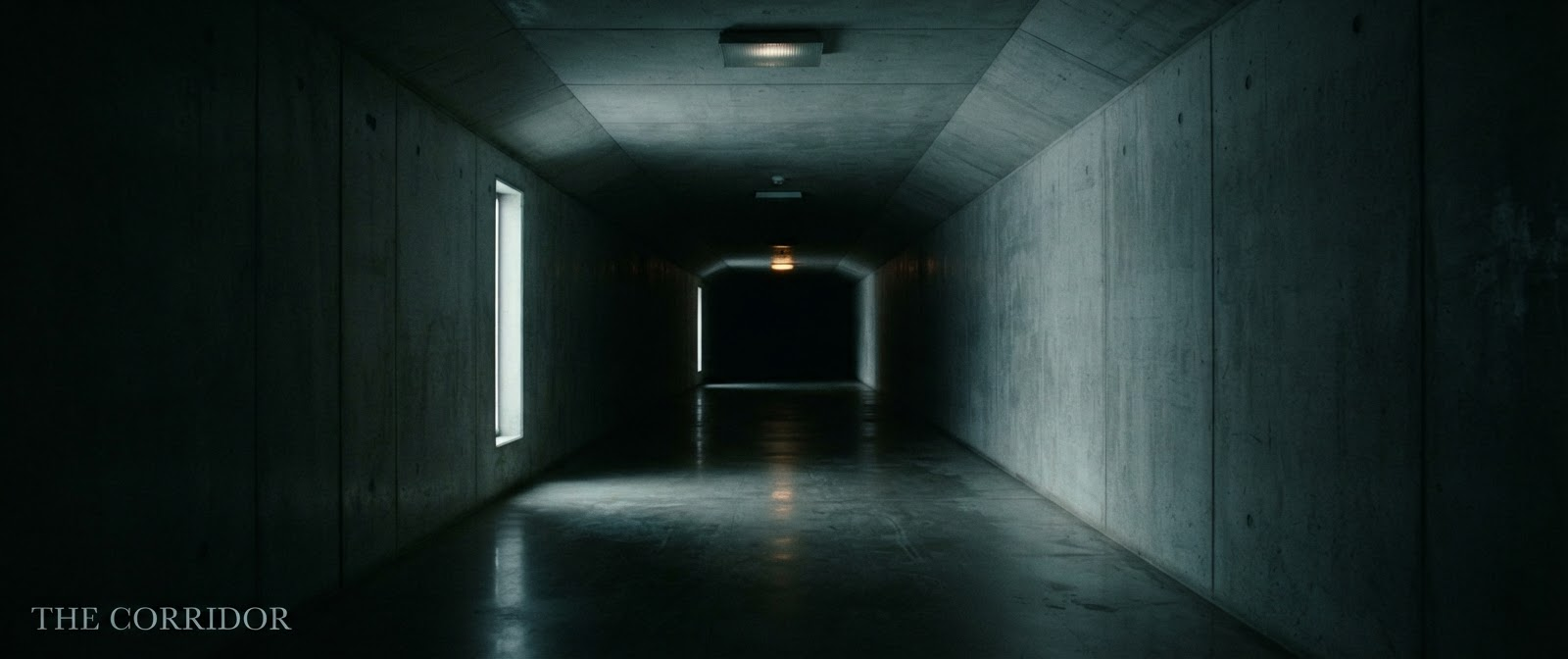
The interrogative structure becomes a corridor whose end you cannot see, or an intersection whose destination is unknown. Identifying reading — the restriction of the observer’s viewpoint — becomes narrow windows, obstructed sightlines, and ceilings that shift height abruptly, making the body feel it no longer controls its own space. Anticipatory reading, which relies on cues and atmosphere rather than events themselves, finds its architectural expression in incomplete lighting, muffled sounds from an invisible source, and sudden transitions from expansive space to confined space. Landais’s studies on the translation of novels by Stephen King and Jack Ketchum showed that breaking the original sentence rhythm — speeding it up or slowing it down without justification — entirely kills the effect of narrative pursuit; the architect faces the identical equation when shortening or lengthening a corridor: spatial rhythm, exactly like linguistic rhythm, is what generates tension or dissipates it.
Carceral Architecture: When Fear Becomes a Systematic Instrument of Power
From the Bastille to Guantánamo, an entire category of buildings has been designed not merely to serve the function of confinement, but to produce systematic fear as an instrument of power. Here, architectural research intersects with what sociologist David Altheide described as the “discourse of fear” in media: the idea that fear is frequently deployed as a “resource” for dramatizing reality rather than as a “topic” subjected to critical examination. Altheide analyzed a full decade of coverage in the Arizona Republic and found that the word “fear” doubled in headline frequency, migrating across subjects as a tool for framing complex issues as simple morality plays. Carceral architecture performs the identical operation spatially: the thick wall, the heavy metal door, the absence of any visual cue about what lies around the corner — these are not merely instruments of physical confinement, but messages engineered to tell the body: here, you possess nothing, not even knowledge of what comes next.
Liminal Spaces: Biological Anxiety Without Narrative Intent
Yet not all architectural fear is deliberate. An entire category of places — late-night airport terminals, long hotel corridors, empty office floors after hours — produces biologically documented anxiety without any designer intending to create that feeling. These are “liminal spaces,” the precise architectural translation of ambiguous dread: no monster, no defined adversary, only a profound sense that a place is “out of place” — neither truly for passage nor truly for dwelling. These spaces share their essence with narrative dread: the threat lies not in a tangible element, but in the suspension of time and place itself, and in the violation of our intuitive expectation of what an inhabited place should look like.
The fundamental difference here is the absence of intent. The novelist who deploys dread does so with full awareness of the tools being used. But the twentieth-century architect, designing airports and offices according to a logic of pure functional efficiency, accidentally produced an emotional structure closer to art-horror, without any aesthetic or narrative calculation. This raises an uncomfortable question: how much of our “neutral” architecture actually frightens its occupants, not because of poor design, but because of the complete absence of any thought given to design as narrative in the first place?
The Pleasure of Architectural Fear: The Sweet Spot Between Arousal and Chaos
If fear is this pervasive, why do we sometimes seek it out voluntarily? A field study conducted at a Danish haunted house, in which one hundred and ten visitors were fitted with heart-rate monitors and filmed at three jump-scare moments, found that self-reported fear correlated linearly with mean heart rate and large-scale fluctuations, but enjoyment followed an inverted-U curve: people enjoy fear most when it is intense enough to engage them but not so chaotic as to strip away all sense of control. This “sweet spot” is precisely what the temporary architecture of haunted houses pursues, and it also explains why we enjoy visiting an abandoned prison converted into a museum while we could not endure a single day inside a functioning one. Researcher Paul Bloom adds an important qualification: this inverted pattern characterizes nearly every human pleasure — from coffee to a hug — so intensity alone does not explain why we specifically seek out fear; the attraction of fear itself remains a genuine puzzle, akin to what David Hume once called the “unaccountable pleasure” of tragedy.
Individual differences also play a decisive role in who enjoys this architecture and who flees it: lower empathy and lower innate fearfulness predict greater enjoyment of explicit horror, sensation seekers tend to appreciate these spaces more, and enjoyment declines with age after adolescence. This means a single building can be a genuine horror experience for one visitor and an enjoyable aesthetic experience for another — a fact that should concern any architect designing a museum or memorial intended for a broad and varied public.
The Ethical Question: Does the Architect Have the Right to Design Fear as Beauty?
Here the matter reaches its most sensitive threshold. Brazilian researchers studied what they termed “art-fear”: fictional narratives that produce aesthetic fear without real risk, grounded in Edmund Burke’s theory of the sublime and Aristotle’s defense of art’s sensory dimension. The idea is that imagination allows us to “double” ourselves and picture our own death, and this same imaginative movement is what binds us to fictional characters in frightening stories. But what happens when this logic is applied to a Holocaust museum or a memorial to victims of a real war?
Here, the crucial distinction that protects literary “art-fear” collapses. In fiction, the reader knows no real danger threatens them. But in a Holocaust museum, the architectural terror — narrow corridors, low ceilings, dim lighting, recorded sounds — is built upon a real tragedy that happened to real human beings. Does the architect have the right to use the same tools that generate “suspense” in a horror novel to construct a memorial experience about genocide? The answer adopted by most serious architectural institutions is: yes, but only on the condition that fear is converted from “pleasure” into “responsibility” — that the place be designed not to stimulate a sensation of excitement and suspense, but to create an honest space for grief, remembrance, and ethical confrontation with history. The distinction is subtle but decisive: between a design that exploits the tools of horror for cheap emotional impact, and a design that borrows the same tools in service of a deeper historical truth.
Are We Designing Cities That Frighten Their Own Residents Without Realizing It?
If the same narrative tools that make We Need to Talk About Kevin terrifying — sustained ambiguity, conflicting points of view, and a threat to the reader’s entire worldview — are genuinely present in the design of our tunnels, our elevated bridges, and our empty nighttime urban centers, then the question this research poses to architects is not theoretical but thoroughly practical: how many of our contemporary cities, with their glass towers standing empty after nine in the evening, their labyrinthine underground passages, and their flickering lighting, function silently as narrative machines of dread — not because anyone intended it, but because no one ever considered spatial narrative when the first plan was drawn? Understanding the architecture of fear, then, is not an academic luxury but a necessary critical tool for any architect who wants to know precisely which story every wall they raise is telling.
✦ ArchUp Editorial Insight
The dread produced by airport terminals, deportation centers, and vacant office floors is not a design failure but a procurement outcome. Fire-egress codes standardize corridor width and lighting uniformity to minimize liability, not to shape perception. Facilities-management contracts optimize for energy cost and maintenance cycles, producing timed lighting that leaves circulation zones dim after hours. Security and immigration policy dictate signage, queuing sequence, and sightline control in detention architecture, with the architect executing a risk-mitigation brief rather than a spatial narrative. Real-estate financing cycles leave speculative floors unoccupied, generating the empty-tower condition. What reads as psychological terror is the visible residue of codes, budgets, and institutional risk frameworks never designed with narrative consequence in mind — only compliance and cost.
References
Landais, Clotilde. “Challenges and Strategies for Analysing the Translation of Fear in Horror Fiction.” Literary Imagination, 2016.
Jets, Kairi. “How Is Fear Constructed? A Narrative Approach to Social Dread in Literature.” Interlitteraria, 2019.
França, Julio, and Luciano Cabral da Silva. “A Preface to Theory of Art-Fear in Brazilian Literature.” Ilha do Desterro: A Journal of English Language, Literatures in English and Cultural Studies, 2012.
Martin, G. Neil. “(Why) Do You Like Scary Movies? A Review of the Empirical Research on Psychological Responses to Horror Films.” Frontiers in Psychology, 2019.
Andersen, Marc Malmdorf, et al. “Playing with Fear: A Field Study in Recreational Horror.” Psychological Science, 2020.
Bloom, Paul. “The Paradox of Pleasurable Fear.” Trends in Cognitive Sciences, 2021.
Yaczo, Timothy. “Fear and Panic in Iowa City: Narratives, Affects, and Amygdalae.” Configurations, 2015.
Altheide, David L., and R. Sam Michalowski. “Fear in the News: A Discourse of Control.” The Sociological Quarterly, 1999.
Fic, Christy. “Prepare Yourself for the Worst: Narratives of Fear in Late-Twentieth Century Women’s Travel Guides.” Journal of Tourism History, 2018.
Ebenezersdóttir, Eva Þórdís. “Encountering Fear and Other Emotions in Narratives and Research.” Fabula, 2022.