Pathopolis: The City That Rose From a Feeling

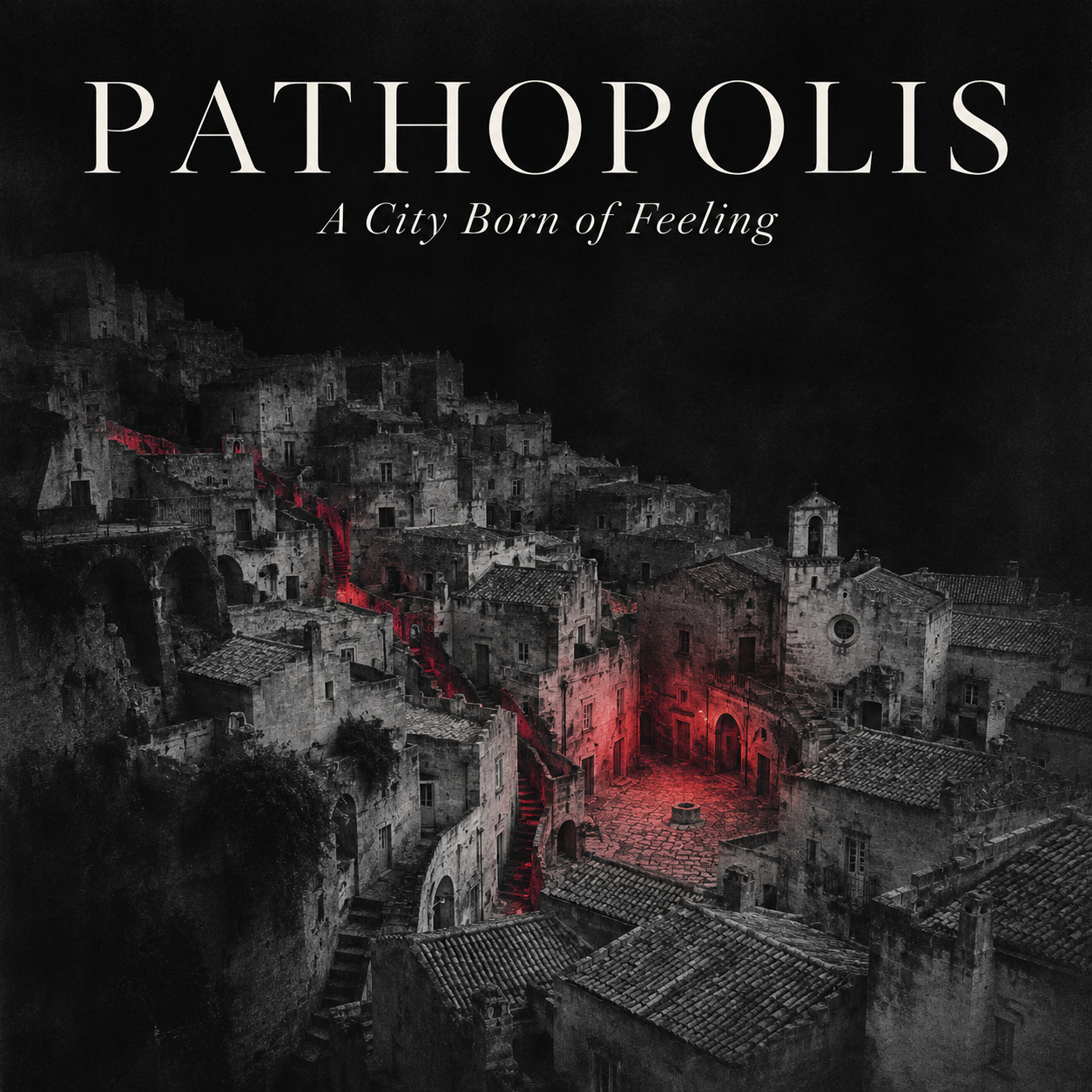
When the founder lays the first stone not with his mind but with his heart, and a city rises on an emotion
By Ibrahim Fawakherji — ArchUp
Urban history, as it is usually told, teaches us that cities rest on cold reasons. A site on a river, a crossing of trade routes, a fertile plain, a defensible harbour guarding a kingdom. This is the language we are used to explaining settlement with, the language of geography, economy and strategy. But the more closely I examine the oldest cities, the ones most lodged in humanity’s conscience, the more I find a warm pulse beneath the cold stone, and find that the first decision was not the decision of an engineer measuring distances, but of a human being moved by an emotion. From here I propose, not as an established fact but as a key for reading cities and a suggested criterion for classification, a new term I claim we will need in the future: the emotional city, or in the term I propose in English, the Pathopolis, the city whose first mover was a human feeling, jealousy or love or fear or grief or ambition or revenge or faith, a feeling that then turned, through a long chain, into permanent stone and an architectural identity.
A chain from the heart to the stone
Before I offer the examples, I want to set out the method, because feelings do not build with walls alone, they pass through a chain that can be traced. The feeling generates a decision, the decision is translated into a ritual or legal act, the act takes shape in a building, and then, long afterwards, a narrative is written to fix the meaning and grant the place its legitimacy. This chain is useful because it gives us a scale by which to distinguish what the sources document from what memory adds later. The document is at its strongest at the beginning of the chain, the architectural trace is at its truest in the middle, while the foundation myth stands at its end, where the story is composed generations after the event to lend the place its awe. This does not strip the feeling of its value, it teaches us a golden rule: that historical emotions may be entirely real even when they rest on events hard to prove from contemporary sources, and that their effect in making cities matters more, and lasts longer, than the question of verifying their details.
Mecca, when jealousy becomes a door to a thriving house
I begin with the greatest example I know, and the nearest to my heart, Mecca. Here I speak as tradition narrates it, not as the laboratory would judge it, because the story at its core is a story of feelings before it is a heavenly command. Abraham, peace be upon him, was married to Sarah, who was barren, and she herself suggested that he marry Hagar, and then Ishmael was born. And here there entered the human heart an emotion I know to be at times beyond endurance, a woman’s jealousy. Sarah could not bear their closeness and love, and so jealousy was the first spark that drove the departure, the going out of Hagar and her child from the land of Syria toward a barren valley with no crop and no water. Consider the paradox with me: the greatest spiritual centre in human history did not begin with a revelation drawing a city’s map, but with a household shaken by jealousy, and with a woman and child left in the open. Then came the rest of the chain, Hagar’s running between Safa and Marwa in mingled despair and hope, then the gushing of Zamzam beneath the infant’s foot, then the building of the Kaaba, then the tribes converging on the water, then the sanctuary, then the whole geography of the rites. Purely human feelings, jealousy and grief and trust and love, turned over the centuries into the widest emotional city humanity has known. And independent evidence, from pre-Islamic poetry, confirms that a real pilgrimage to Mecca existed before the mission, a circling and sacrifice and shaving in the name of one god, which anchors the continuity of the sacred place. As for the Abrahamic frame in its details, that is what text and tradition established, and this is natural in every emotional city, for the narrative comes to grant the first feeling a depth and a lasting legitimacy. What matters, in my view, is not that we put the details on trial, but that we grasp that it was the feeling that moved the stone, and that it was faith that turned a local sanctuary into a direction of prayer for an entire world.
Ambition, the most documented of emotions
If jealousy is a rare spark hard to prove, ambition is the founding emotion the sources document most. Capitals built from nothing to displace an existing power are, for the most part, the work of an ambitious ruler or reformer who wants to break the grip of entrenched elites and manufacture a new loyalty through which to monopolise the production of legitimacy. From Akhenaten’s capital at Amarna, which moved the king far from the priests of Thebes, to the Assyrian capitals that separated the ruler from the old nobles of Ashur and adorned their palaces with reliefs proclaiming the king’s might. Baghdad is the classic example of ideological ambition: the round City of Peace that al-Mansur built placed the palace at the exact centre, announcing a shift from the image of the caliph as protector to the image of the axis of the cosmos on the Sasanian model, until it became a technique of rule to be imitated. But ambition alone is fragile, and the proof is that a capital raised to embody a ruler’s private emotion rarely outlives his dynasty. Amarna collapsed because Akhenaten went too far in pushing the elites away without winning them over, while the Assyrian capitals survived because they negotiated with the priesthood through covenants and exemptions. Ambition draws the map in the positive, but it needs an independent economy and culture so as not to die with its author.
Fear, when a city is built in flight
Beside ambition stands fear, an emotion that has built entire cities in flight rather than in attraction. Samarra arose from fear and chaos, when street battles between the new Turkish troops and the old Arab and Persian soldiers threatened the safety of civilians, so al-Mu’tasim left, and the resulting city became a vast stage for a narrowing military elite, abandoned as a capital in under sixty years. Modern examples repeat the same pattern mixed with prophecy and self-image: the Burmese city of Mandalay rose on a prophecy to re-fix the royal capital as a centre of the cosmos in the face of the coloniser, and lasted as a capital only twenty-nine years. And in our own time an entire capital was moved to a new city because an astrologer warned the regime it would fall if it stayed where it was, and ministries were built with wings in the shape of a scorpion as a protective talisman, and a replica temple was erected because there is no legitimacy for a capital without a great temple. Fear, then, is an urban emotion of the first order, but it builds cities that carry their anxiety in their very planning, and remain as fragile as the source of fear that created them.
Grief and love, two emotions to be read with care
Then come grief and love, the most misunderstood of all. The most famous monument to love in the world, the Taj Mahal, is precisely the example we must read with care. The story of eternal love attached to it rests on a rhetorical Persian account of Shah Jahan’s grief, a beard whitened in a night, a week of seclusion, two years of mourning, and then nineteenth-century European romanticism turned that into a legend. A critical reading reveals a ruler his contemporaries described as proud and power-loving, an inscriptional programme dominated by verses of the Last Day, paradise and the bearers of the throne, and a garden designed to be a replica of paradise. The Taj is closer to a statement about imperial destiny and an attempt to define God on Shah Jahan’s terms than to a simple romantic symbol, and the grief was real and at the same time an opportunity, for the emperor himself moved his capital while his wife’s mausoleum was not yet complete. Grief, in truth, builds cities not through grand gestures but through the daily organisation of death, through cemeteries and tomb-gardens, as at Amarna, where the necropolises were an integral part of the urban scene, and the handling of the dead was a civic service and a dimension of identity. Love, meanwhile, mostly lives in the record as literature rather than stone, and I give you an example you love, Verona, the city of love, which became a destination for the world’s lovers not because a story happened there but because a play was written about it; Juliet’s house and its balcony are a narrative later projected onto an old stone, and that is the lesson, that the narrative is tailored onto the city after the fact, and that love may make a whole emotional city without a single confirmed event.
Jealousy and revenge, building and demolition
There remain jealousy and revenge, two faces of a single coin. Jealousy in its institutional form, that is, rivalry between states, is among the clearest drivers of lavish building. In al-Andalus and Ifriqiya the Umayyad city of al-Zahra and the Fatimid Sabra al-Mansuriyya rose at almost the same time, and the archaeology reveals a genuine urban escalation: walled enclosures close in size, water channels re-routed so that water would reach the new city before the old capital, and markets deliberately diverted from the old metropolis to the newborn city. Here jealousy is not a private feeling but a structural relationship between two states, embodied in stone and water and tax. Revenge, by contrast, is most often expressed by demolishing a city rather than building one, by a rite of de-foundation, for the conqueror would destroy the city, sow its site with salt and curse whoever rebuilt it, as whoever rebuilt Jericho was cursed, and as the Roman Senate forbade the habitation of Carthage with curses. This proves that a city’s permanence in the ancient imagination was not a matter of inhabitants and trade alone, but of a ritual and legal status, for a city can be stripped from existence symbolically just as it is built. Revenge, then, draws the map in the negative, making voids and ruins and cursed sites, while ambition, love and faith draw it in the positive.
Why we need this classification now
It may be said that all this is a past that is over, and that today’s cities are planned with data and models, not feelings. I claim the exact opposite. The new administrative capitals built from nothing in our age, the cities moved in flight from congestion or heavy memory, the mega-projects launched to tell the world this is me, are all emotional decisions at their core, ambition and fear and pride and hope disguised behind feasibility tables. The only difference is that we have stopped calling the emotion by its name, so we see the walls and no longer see the heart that moved them. This is why I propose the emotional city as a new criterion in urban research by which to classify cities, not as a substitute for geography and economy, but as a deeper layer beneath them, in which we ask about the founding emotion before we ask about the location. For when we know a city rose on fear, we understand why anxiety inhabits its planning. When we know it rose on ambition, we anticipate its fragility if it does not acquire an independent life. And when we know it rose on faith, we grasp why it is hard for any power to dislodge it.
Conclusion: the heart is older than the map
I return to where I began. We were taught that cities rest on the mind, on the cold calculation of site and resource. I say that the greatest of them rose on the heart, on a jealousy that drove a woman out to a valley so the valley became a direction of prayer, on an ambition that turned a city around a palace so the palace became the centre of the world, on a fear that moved a capital so anxiety carried its name, on a grief that raised a mausoleum so the mausoleum became a statement about immortality, and on a jealousy between two states so that water ran out of its course. Feelings do not lay the stone with their own hands, but they make the decision that lays it, and then institutions, rituals and narratives come to translate it into built form. And if I were to sum up my thesis in a sentence, it is that the emotional city is not an exception in the history of settlement, but its forgotten rule, and that the truest way to understand a city is not to ask where it rose, but to ask on what feeling it rose, for in the history of cities the heart is older than the map, and outlasts it.
By Ibrahim Fawakherji — ArchUp
Sources
- Chatterjee E, et al. Feeling Modern: The History of Emotions in Urban South Asia. Journal of the Royal Asiatic Society, 2017.
- Macedo J, Tran LV. Brasília and Putrajaya: Using Urban Morphology to Represent Identity and Power in National Capitals. Journal of Urbanism, 2013.
- Cressier P, Vallejo Triano A. Madinat al-Zahra’ et Sabra al-Mansuriyya. Journal of Islamic Archaeology, 2016.
- Candier A. Conjuncture and Reform in the Late Konbaung Period. Journal of Burma Studies, 2011.
- Webb P. The Hajj Before Muhammad: The Early Evidence in Poetry and Hadith. Millennium, 2023.
- Joffe AH. Disembedded Capitals in Western Asian Perspective. Comparative Studies in Society and History, 1998.
- Kavuri-Bauer S. The Impact of Akhlaq-i Nasiri on the Forms and Spaces of Akbar’s Fatehpur Sikri. South Asian Studies, 2019.
- Seekins DM. Runaway Chickens and Myanmar Identity. City, 2009.
- Begley WE. The Myth of the Taj Mahal and a New Theory of Its Symbolic Meaning. The Art Bulletin, 1979.
- Stevens A. Death and the City: The Cemeteries of Amarna in Their Urban Context. Cambridge Archaeological Journal, 2017.
- Gevirtz S. Jericho and Shechem: A Religio-Literary Aspect of City Destruction. Vetus Testamentum, 1963.
- Finkelstein I, et al. Has King David’s Palace in Jerusalem Been Found? Tel Aviv, 2007.