Arc’teryx’s Beijing Flagship: Harmonizing Nature and Urbanity


In the heart of Beijing’s bustling Sanlitun neighborhood, a peculiar juxtaposition unfolds—the serene ambiance of Vancouver’s Coast Mountains intersects with the frenetic urbanity of China’s capital. At the nexus is Arc’teryx’s new flagship store, a two-story haven designed by Still Young, a Shanghai-based studio. Beyond merely retailing high-performance outdoor apparel, the store endeavors to transport Beijingers into the adventure-driven lifestyle of Canada’s wilderness. Eric Ch, founder of Still Young, underscores that the store’s interior isn’t merely a display of outdoor gear. It’s a narrative that fosters a connection with nature.
Arboreal Reverence: A Tree-Inspired Entryway
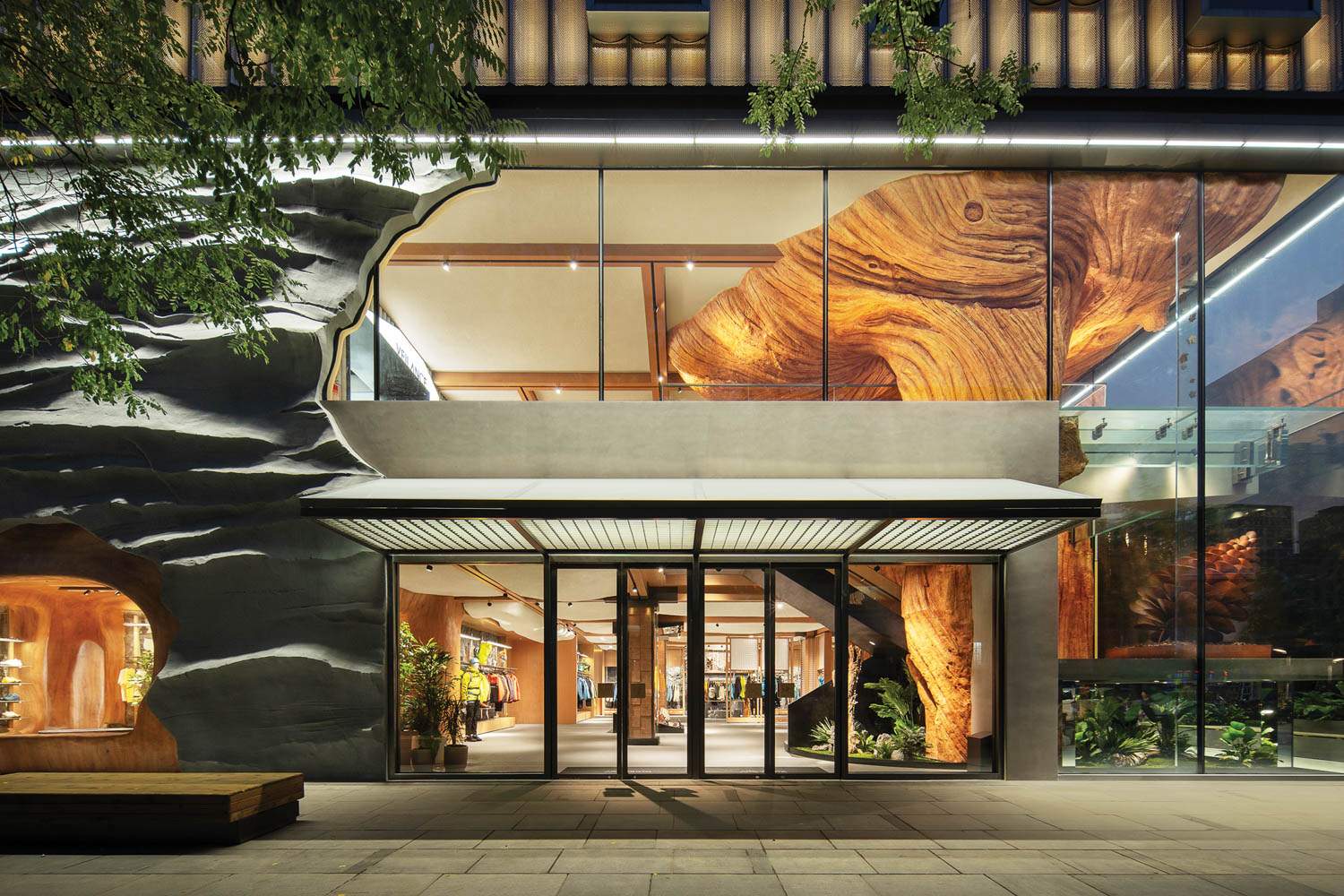
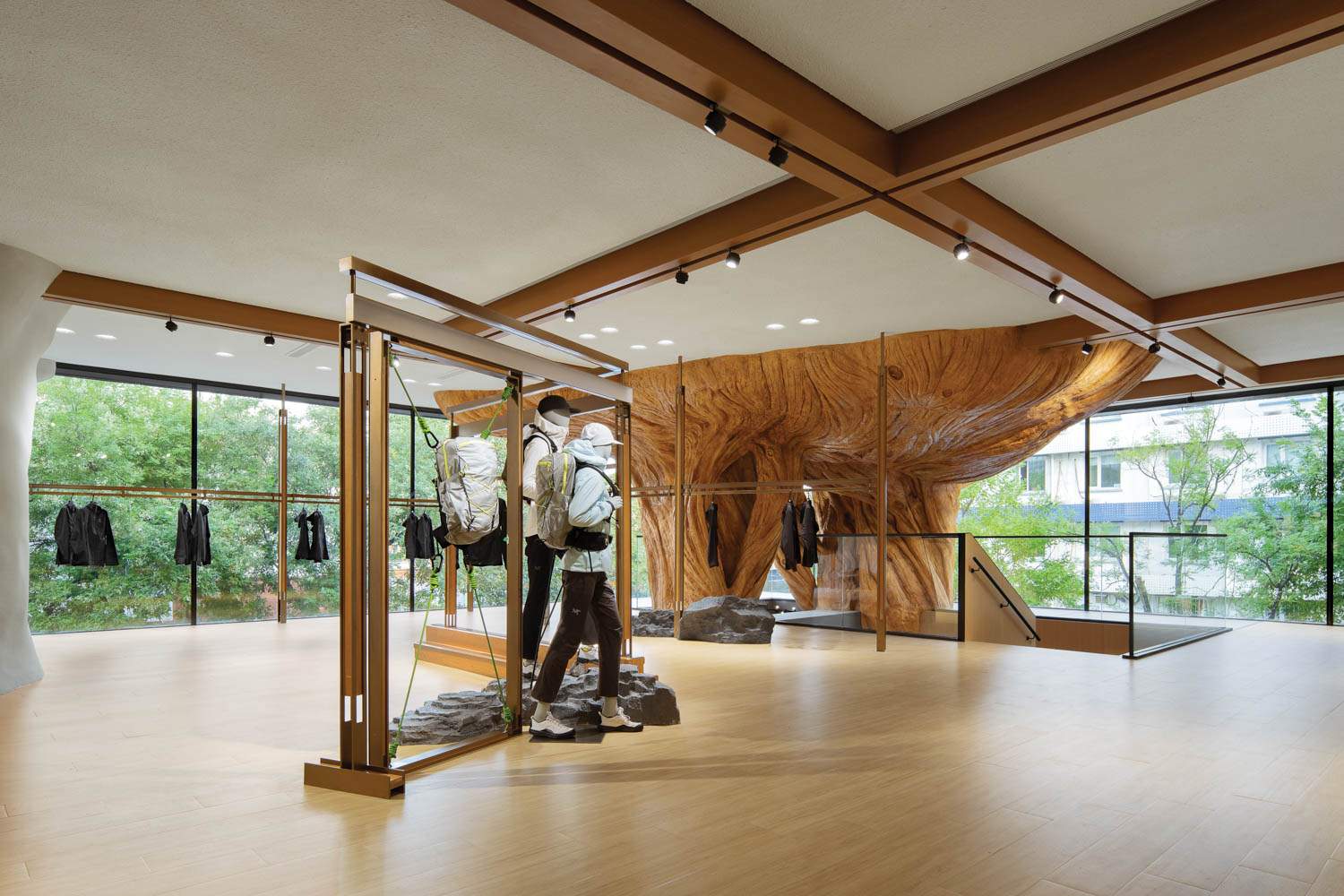
To resonate with the essence of nature, Still Young embarks on a symbolic journey, taking inspiration from the most recognizable emblem of the natural world—a tree. Collaborating with local artists, they fashion a colossal fiber-reinforced–plastic sculpture resembling an ancient tree trunk. This gnarled creation envelops the main staircase, making a grand statement at the store’s entrance. Visible from the street, it creates an illusion that the store evolved around this arboreal behemoth.
Organic Forms and Material Alchemy: Indoors as Nature’s Embrace
Venturing inside, the organic forms and natural materials continue to weave an immersive narrative. Walls and ceilings, clad in glass fiber–reinforced concrete with a wood-effect finish, craft an illusion of a hollow within a tree. The biomorphic surfaces persist, shaping grottolike fitting rooms and a rock cavern-themed events space. These elements, coupled with artificial-stone outcrops and log-inspired bleachers, form islands for visual merchandising. Therefore, creating a forest-like exploration within the store.
Cityscape Fusion: Industrial Elements and Contemporary Beijing
In a dance of contrasts, certain zones within the store adopt a more industrial aesthetic, tethering the experience to the contemporary Beijing landscape. The second floor, dedicated to urban wear, features a gray palette with concrete floor tiles, metal elements, and LED-illuminated acrylic light boxes. This fusion of nature-inflected spaces and urban-industrial zones reflects the brand’s dual ethos—rooted in rugged terrains yet embracing sophisticated technology.
Narrating Brand Philosophy: Crafting Customer Experiences
Eric Ch sees the store design not as a mere project but as a narrative—a tale that delves into Arc’teryx’s history, philosophy, and the climatic essence of its home in Vancouver. The goal is to transcend traditional retail by narrating a brand story and creating experiential spaces. Beyond showcasing products, the store aspires to encapsulate a lifestyle and values. Therefore, bringing forth a seamless blend of commerce, culture, and conservation.
Sustainable Symbolism: Architectural Echo of Environmental Care
In a bid to mirror Arc’teryx’s intrinsic link to the natural world, Still Young prioritizes materials and construction methods that echo environmental consciousness and sustainability. Furthermore, The facade itself becomes a canvas, juxtaposing glass expanses with slabs of fiber-reinforced plastic mimicking mountain escarpments. A giant pine cone, an artisanal creation molded entirely from factory waste pulp, stands as a symbolic beacon of art, craft, and sustainability.
In Conclusion: Fusing Wilderness and Innovation
The Arc’teryx flagship store in Beijing is more than a retail space; it’s a symphony of design elements that transcends commerce. It’s a portal connecting the urban pulse of Beijing with the wilderness of Vancouver, merging the brand’s legacy with contemporary aspirations. Still Young’s creation goes beyond the transactional—it’s an ode to nature, an immersive narrative, and a sustainable architectural endeavor reflecting care for Earth’s future.
Finally, find out more on ArchUp: