Bamboo Pavilion in Bali Transforming a Neglected Space into a Regenerative Architectural Hub

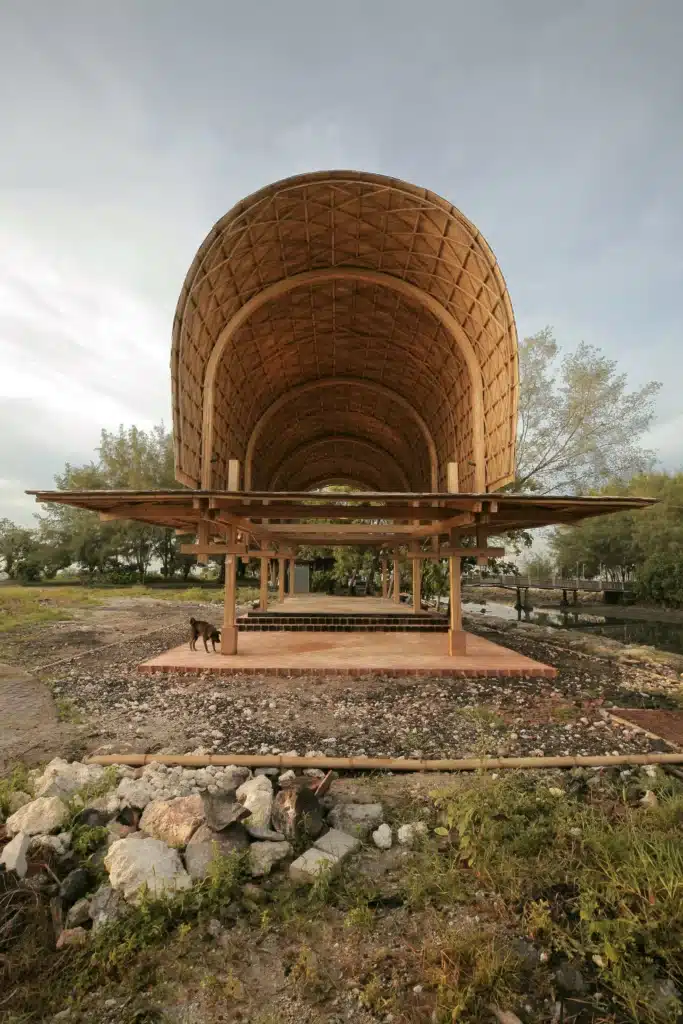
In the heart of Denpasar, Bali, a disused parking lot has been transformed into a bamboo pavilion that exemplifies sustainable and regenerative architecture. The design focuses on creating an open community space that harmonizes with the surrounding coastal environment, relying on natural materials and an architectural approach that reconnects people with place and local heritage.
Architectural Concept and Design Approach
The pavilion embodies the principles of regenerative architecture, which goes beyond mere physical presence to actively reduce environmental impact and revive traditional craftsmanship. The overall form is inspired by traditional Balinese structures, such as open village halls that serve as central gathering spaces for daily life.
The vaulted roof functions as a natural canopy, providing shade and cross ventilation while allowing balanced light penetration. Its design enables passive cooling without mechanical systems, creating a visually harmonious rhythm with the surrounding coastal landscape.

Materials and Sustainability
The structure relies on locally sourced, compressed bamboo, providing strength comparable to steel while remaining fully renewable. Additional natural materials, including reclaimed volcanic stone, traditional lime plaster, and reused clay roof tiles, contribute thermal mass and further reduce the building’s embodied carbon.
All materials were processed and assembled locally, supporting the regional economy and revitalizing traditional craftsmanship, while ensuring the pavilion integrates organically with its natural and cultural surroundings.

Spatial and Social Integration
The interior space is designed for versatility:
- Social area for daily gatherings and community interactions.
- Educational platform for workshops and learning activities.
- Open-air stage for performances and local events.
The design integrates material sustainability and functional flexibility, with the vaulted roof providing both shading and natural ventilation, while creating a visual dialogue between the building’s natural materials and the coastal environment. In this way, the pavilion acts as an organic extension of the landscape, rather than a detached element.

Conceptual and Philosophical Approach
The pavilion emphasizes architecture as a regenerative force, not merely a functional construction. Its core philosophy merges local heritage with innovative design, achieving a balance between people and nature. The project illustrates architecture’s ability to:
- Restore connections between community and place.
- Reduce environmental impact through renewable materials.
- Provide an open public space that strengthens social and cultural engagement.
Project Summary Table
| Element | Description |
|---|---|
| Location | Denpasar, Bali, Indonesia |
| Project Type | Open community pavilion |
| Design Concept | Regenerative architecture integrating local heritage with innovation |
| Materials | Locally sourced compressed bamboo, reclaimed volcanic stone, lime plaster, clay roof tiles |
| Sustainable Features | Natural ventilation, passive cooling, carbon storage, material reuse |
| Functions | Social gathering space, educational platform, open air stage |
| Architectural Features | Vaulted roof, natural shading, visual dialogue with coastal environment |
| Social Impact | Supports local craftsmanship, enhances community engagement |

✦ ArchUp Editorial Insight
The Bamboo Pavilion in Bali offers a visually cohesive experience, with its vaulted bamboo roof forming a natural canopy that interacts gracefully with sunlight and shadow, while organic lines flow smoothly over the open space. The contrast between natural materials and the surrounding coastal environment enhances a sense of openness and harmony. Critically, the design demonstrates a conscious approach to sustainability, though it faces challenges in maintaining functional flexibility under a fixed roof. Nonetheless, the project delivers clear architectural and social value, redefining the relationship between the built environment and the local community in an innovative, sustainable manner.
Architecture professionals can follow ArchUp’s events section for verified updates on exhibitions, conferences, competitions, and results.