Batumi Chess Palace: Chessboard Architecture


Context of Chess Culture in Georgia
Georgia has a strong presence in chess culture that goes beyond its demographic size, having produced a number of prominent champions in the game. Chess is also embedded in its educational and cultural system in a foundational way rather than as a secondary element. Within this context, the construction of the “Chess Palace” in Batumi comes as a relatively delayed response to an already existing presence, reflecting the transformation of this cultural relationship into a specialized physical facility.
Architectural Organization and Functional Program
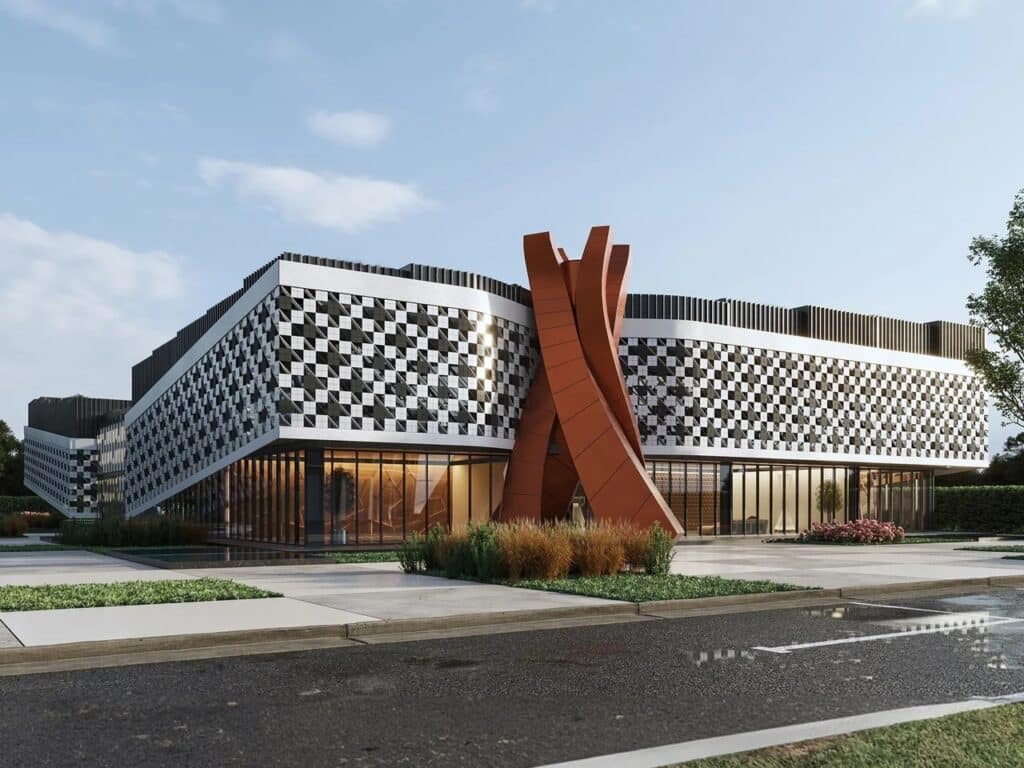
The building is based on a direct interpretation of the idea of chess through its overall organization, as its form is inspired by a flattened chessboard. It extends 60 meters in depth and consists of two floors, with completion scheduled for 2027. The functional program includes a tournament hall, a chess library, exhibition spaces, hotel rooms, a gym, and study rooms, making it a multi-use structure centered around a single defined activity.
Facade as a Dynamic Visual System
The façades are covered with perforated solar shading systems that form a grid of black and white squares in a lattice-like pattern. This pattern changes visually with the movement of the sun, making the building appear static in photographs but perceptually dynamic over time. In this sense, the façade functions as a chessboard-like surface in motion, where appearance shifts without any change in the physical structure, supported by an HPL panel system that adds a layer of durability to this visual solution.
Extension of the Design Logic Across the Site
The design expands the logic of the chessboard to the entire site rather than limiting it to the façades. From an aerial perspective, the roof alternates between planted green areas and glazed skylights within a single organizational grid that reflects the same visual rhythm of the façade. At ground level, this logic continues through large-scale paving that alternates between light and dark tones, creating a visual extension that connects the building to its surroundings. Through this repetition across all visual axes, vertical, horizontal, and internal, the binary system becomes a comprehensive framework governing the entire spatial experience of the site, a rare conceptual consistency in buildings with symbolic intent.
Entrance as an Abstract Alternative to Direct Representation
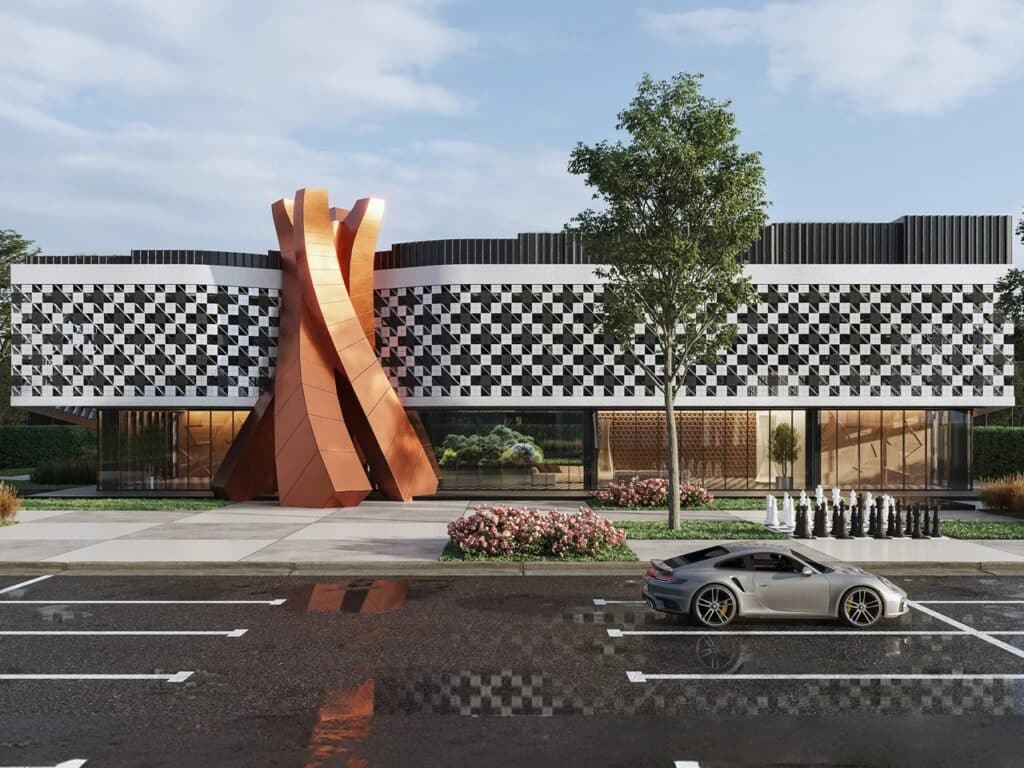
Instead of presenting a literal chess piece at the entrance, a Corten steel installation was adopted, composed of interwoven curved fins that rise in a spiraling motion. This configuration sits between abstraction and suggestion, referencing the idea of a chess piece without directly representing it. As a result, the entrance is read as an independent architectural element rather than a decorative symbol. The contrast between the oxidized steel color and the building’s monochromatic mass also defines a clear point of entry within the urban context.
Functional Program and Operational Context
The functional program reflects an ambition to develop a structure oriented toward chess tourism, including a tournament hall, chess library, exhibition spaces, conference halls, a sports shop, a food facility, hotel rooms, as well as rooms designated for people with disabilities and a gym. This diversity aims to create a fully integrated environment that allows all chess-related activities to take place within a single location. Thus, the project carries a public dimension alongside its conceptual character, while its final evaluation remains dependent on the effectiveness of its actual performance upon completion.


✦ ArchUp Editorial Insight
The “Chess Palace” in Batumi operates less as an independent architectural project and more as a material translation of an already existing institutional cultural system, where chess culture in Georgia functions as an integrated educational and organizational extension within the broader public system, rather than as a standalone recreational activity. The resulting architectural form can be read as a regulatory response aimed at absorbing this cultural density into a unified urban framework, where the massing, functional program, and façade system are shaped as coordinated solutions balancing the demands of symbolic representation with climatic performance requirements. The extension of the chessboard grid across roofs, façades, and ground surfaces reflects an attempt to stabilize identity through structural repetition, while the multiplicity of functions points to an operational model based on maximizing tourism flow within a standardized cultural infrastructure. Ultimately, the project appears as a negotiated outcome between the logic of cultural investment and the constraints of producing multi-use buildings, rather than an autonomous design statement.