The Belly of the Whale: A Dwelling Harmonizing with the Harsh New Brunswick Shores

Architecture Meets the Rugged Wild
The Belly of the Whale Residence project
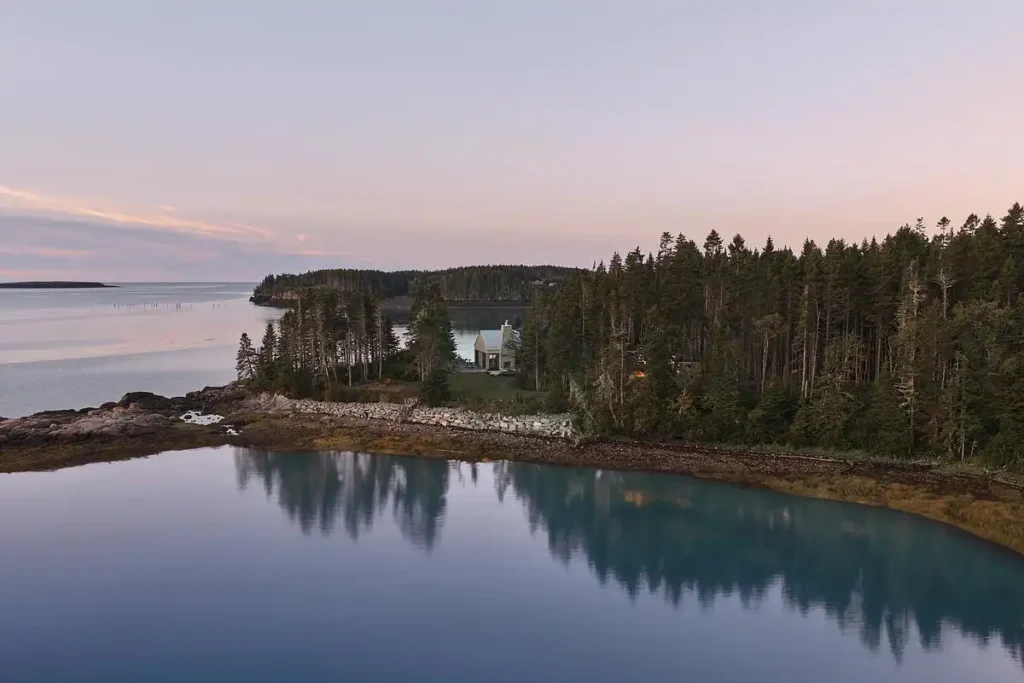
roots itself in the Storied Architecture methodology. The goal wasn’t merely to construct a dwelling. Acre Architects sought to weave an architectural narrative that interacts deeply with the challenging environment of New River Beach, New Brunswick, Canada. The primary challenge required the firm to create a home that met every functional necessity. It also had to settle gently into its rugged coastal site along the Bay of Fundy. The design ensured it never dominated the natural landscape. The team adopted the concept of Belly of the Whale to guide the configuration. This transforms essential spaces into sculptural, narrative experiences. It skillfully balances intimacy and drama.
The Visitor’s Journey: Separating Paths, Contemplating the View
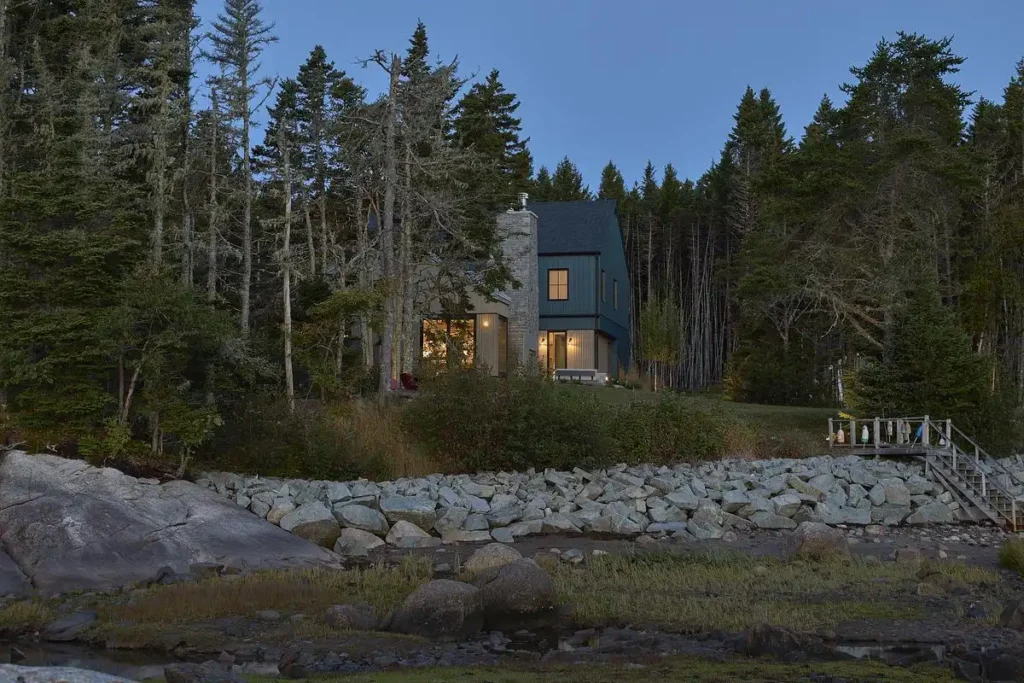
The visitor’s experience begins with a key realization. The Belly of the Whale Residence isn’t a single mass, but two distinct entities. Two architectural volumes form the dwelling. A metaphorical passage dubbed the “Streamlet” visually separates them. This partition serves a precise organizational purpose. It intelligently divides private life from social activity. This configuration grants the overall form a sense of quiet rhythm.
Upon entering the communal volume, the reader feels transported. One feels like stepping into an illuminated, celebratory hall. This section is the dramatic heart of the Belly of the Whale Residence. A soaring wooden ceiling showcases the design’s precision. The ceiling reflects curved, ribbed forms that resemble a whale’s ribcage. The architects designed this space to be open and expansive. It orients entirely towards the vast oceanic vistas. It serves simultaneously as a refuge and an observation platform.
Material Composition and Performance Ratios
The project employed specific structural and construction compositions. These achieved the necessary balance between dramatic expression and environmental integration:
- Structural Timber: Timber forms the ribbed internal structure of the ceiling at a ratio of 85%. This lends warmth and acoustic depth to the communal volume.
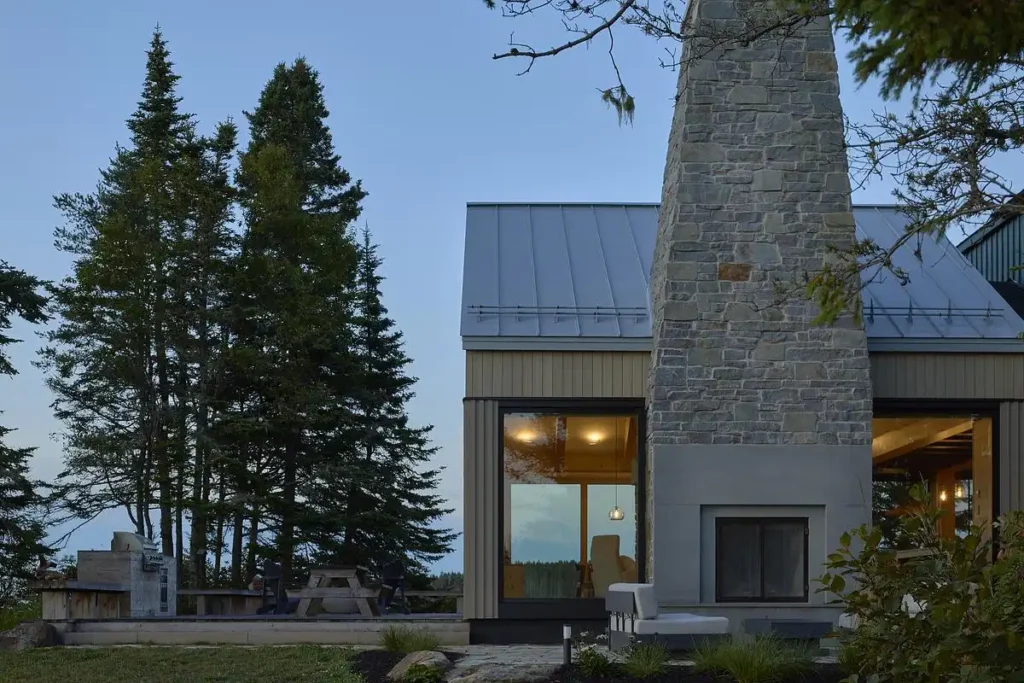
- Integrated Facades: Dark, muted materials cover the facades of the private volume at a ratio of 70%. This aims to reduce reflection and visually integrate with the forest colors.
- Thermal Glass Insulation: High performance double-glazing fills the panoramic windows at a ratio of 90%. This ensures maximum thermal efficiency against the cold Bay of Fundy winds. This relates to sustainability goals.
- Rocky Groundwork: Natural rock outcrops anchor the dwelling’s foundations. This accounts for 100% of the ground base at the anchoring points. It firmly established the Belly of the Whale Residence on its site.

Visual Harmony: Subduing the Mass
The private volume houses bedrooms and personal areas. This is in deliberate contrast to the dramatic openness of the social core. This volume is designed to appear visually recessive. It is seen withdrawing into the surrounding woods. This physical recession allows the natural environment to remain the dominant visual force on the site. This is true despite its power and ruggedness. The intentional subduing of this volume’s presence helps soften the building’s overall silhouette. The Belly of the Whale Residence stands out as a model that underscores the importance of context. Here, the architecture acts as a framework for experiencing the site. It avoids being the sole visual focus. You can find this and similar projects in our archive.
✦ ArchUp Editorial Insight
The Belly of the Whale Residence presents a striking visual duality, dominated by the curved wooden ceiling in the communal volume, which clearly enacts the project’s narrative form within the interior design experience. This separation between the dramatic timber ribcage and the muted, forest-receding service block—is an effective design approach for establishing identity. However, it prompts a critical inquiry into whether a more organic, continuous integration could have unified the two parts, rather than the sharp contrast chosen. The project successfully models “Storied Architecture,” using material and form to deepen contextual awareness. Ultimately, this residence represents a serious attempt to root the construction firmly within its harsh coastal environment.