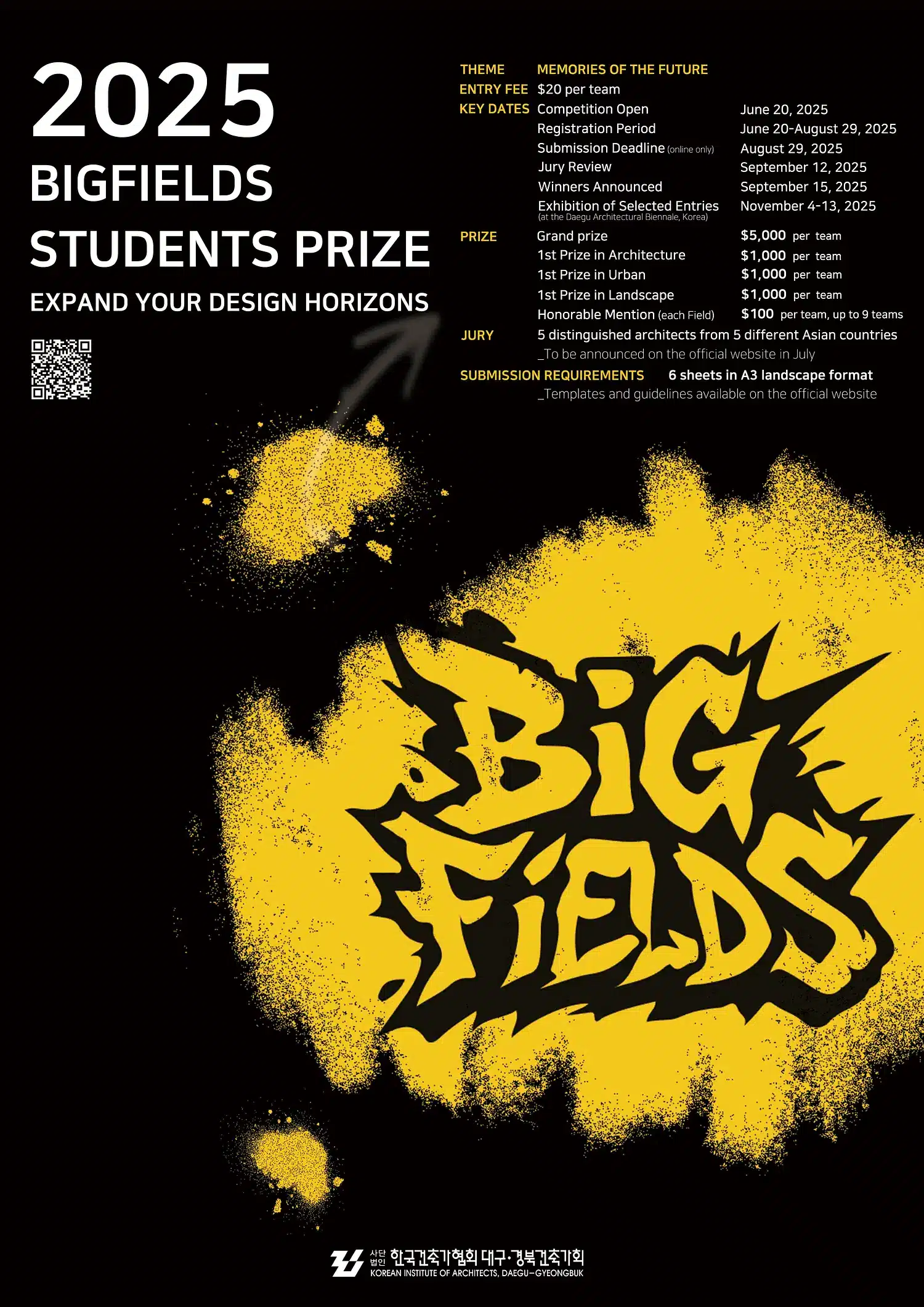
Bigfields Students Prize 2025

The Bigfields Students Prize invites students from across Asia to ask deep questions about the future of architecture, cities, and landscapes. With no fixed site or program, the competition encourages bold and creative thinking under the uniting theme “Memories of the Future.” It asks participants to design spaces—not for the past or present—but for those moments and places worth remembering in years to come. This is more than a design challenge. It’s an opportunity to explore what future generations might look back on, feel connected to, and hold dear.
Competing teams—whether undergraduates or graduates—can interpret the theme through architecture, urban planning, or landscape design. Their entries become part of a shared vision rooted in cultural identity, regional traditions, and personal narratives. Winners will be awarded cash, exhibition space at the Daegu Architectural Biennale, and recognition from a respected jury representing Malaysia, Indonesia, Korea, China, and India.
This competition not only invites imaginative projects but also offers students real-world exposure and validation for their ideas. It’s a platform where young talents shape Asia’s architectural narrative, communicating visions that question how memory, meaning, and design connect.
Competition Overview and Purpose
The Bigfields Students Prize centers on the theme “Memories of the Future.” It asks: What will people remember about our time? It challenges students to design emotionally resonant spaces that speak across time.
Participants may work in three categories:
- Architecture — building scale ideas
- Urban — city-scale thinking
- Landscape — natural and hybrid environments
This open brief format means no boundaries. Teams can explore speculative futures, personal or cultural memory, or sustainable landscapes reimagined for emotional depth.
Who Should Apply?
- Undergraduate or graduate students from Asia
- Students of architecture, urban design, landscape architecture, or related fields
- Teams only; creative, cultural, and interdisciplinary approaches welcome
What Makes It Unique?
- No fixed site: design is speculative, narrative-driven
- Theme-focused: memory and future merged through design
- Asian diversity: entries rooted in local culture, global interpretation
- Exhibition: selected works shown at Daegu Biennale, Korea
Processes and Submission
Participants must register a team and submit work online by August 29, 2025. Each entry must include visual boards and a clear statement explaining the idea and its link to memory.
Judging takes place on September 12th. Winners are notified three days later. Final works are displayed in Daegu in November during the Architecture Biennale.
Entry Fees
| Entry Type | Fee |
|---|---|
| Per Team (any category) | $20 |
Payment is processed via the official competition website.
Awards
| Award | Prize | Number of Teams |
|---|---|---|
| Grand Prize | $5,000 | 1 |
| 1st Prize – Architecture | $1,000 | 1 |
| 1st Prize – Urban | $1,000 | 1 |
| 1st Prize – Landscape | $1,000 | 1 |
| Honorable Mentions (per field) | $100 | 9 total |
Key Dates
| Phase | Deadline or Date |
|---|---|
| Competition Opens | June 20, 2025 |
| Registration Ends | August 29, 2025 |
| Submission Deadline | August 29, 2025 |
| Jury Review | September 12, 2025 |
| Winners Announced | September 15, 2025 |
| Exhibition | Nov 4–13, 2025 |
Eligibility
Open to current students across Asia. Participants must enter as a team (1+ members). Proposals can be digital or hybrid; no physical models should be submitted. The competition is administered by Bigfields Competitions and supported by the Daegu Architectural Biennale.
Architectural Analysis
The Bigfields Students Prize encourages a layered design logic that bridges cultural memory and speculative futures. With no predetermined site, spatial concepts must rely on strong material and visual symbolism—drawing layouts, section models, diagrams—to convey memories yet to exist. The brief asks for human-centered and sustainable narratives, so materials should reflect local heritage and ecological responsiveness—think bamboo, stone, recycled materials, green infrastructure.
The lack of site constraints invites playful yet critical spatial interpretations—urban cores recalled through memory-driven public plazas, landscapes formed around generational stories, or architecture built to evoke intangible feelings. The challenge lies in grounding these speculative ideas in material logic, structural feasibility, and narrative clarity. Without context, proposals may risk floating into abstraction. Critically, reaching emotional anchoring through design detail and site-specific culture is vital.
Project Importance
This competition teaches students to design with emotion, place, and memory, not just function. It encourages typology that merges architecture, urban, and landscape fields through narrative complexity. This is crucial in an era where global cities risk losing local identity.
By imagining future memories, participants learn to:
- Prioritize emotional connection in design
- Root concepts in cultural and ecological context
- Practice speculative architecture that is anchored in real human experience
- Build dialogue through exhibition and peer review
Why now? As climate change reshapes landscapes and memory of place shifts, designers must create spaces that people can connect with emotionally—spaces that remember and are remembered. This competition cultivates capacity to think beyond object-making, toward cultural continuity through design.
✦ ArchUp Editorial Insight
The Bigfields Students Prize is a powerful call for emotional speculation in architectural education. It asks students to design beyond function and form—to craft memories yet to exist. The open format allows cultural diversity but risks superficial proposals lacking material grounding. However, its strength lies in encouraging designers to align memory, identity, sustainability, and innovation. The award offers young designers a meaningful platform to explore human-centered futures across Asia, making it a timely and important initiative.
Conclusion
The Bigfields Students Prize challenges students to imagine spaces rooted in memory and open to future meaning. By removing site constraints, it enables speculation—architectural thought experiments that are deeply emotional, culturally specific, and ecologically attentive.
Participants must find balance between narrative invention and design feasibility. They must embed cultural memory in form, material, and space. This aligns with a broader need in architecture: projects that resonate emotionally while responding responsibly to climate, identity, and community.
In a rapidly changing Asia, the competition sparks cross-border conversations about memory, belonging, and built environment. It empowers the next generation of designers to design not just for now, but for what we choose to remember. By shaping collective memory through design, students become custodians of future cultural landscapes.
Explore the Latest Architecture Exhibitions & Conferences
ArchUp offers daily updates on top global architectural exhibitions, design conferences, and professional art and design forums.
Follow key architecture competitions, check official results, and stay informed through the latest architectural news worldwide.
ArchUp is your encyclopedic hub for discovering events and design-driven opportunities across the globe.