When the Wall Does the Mind’s Work

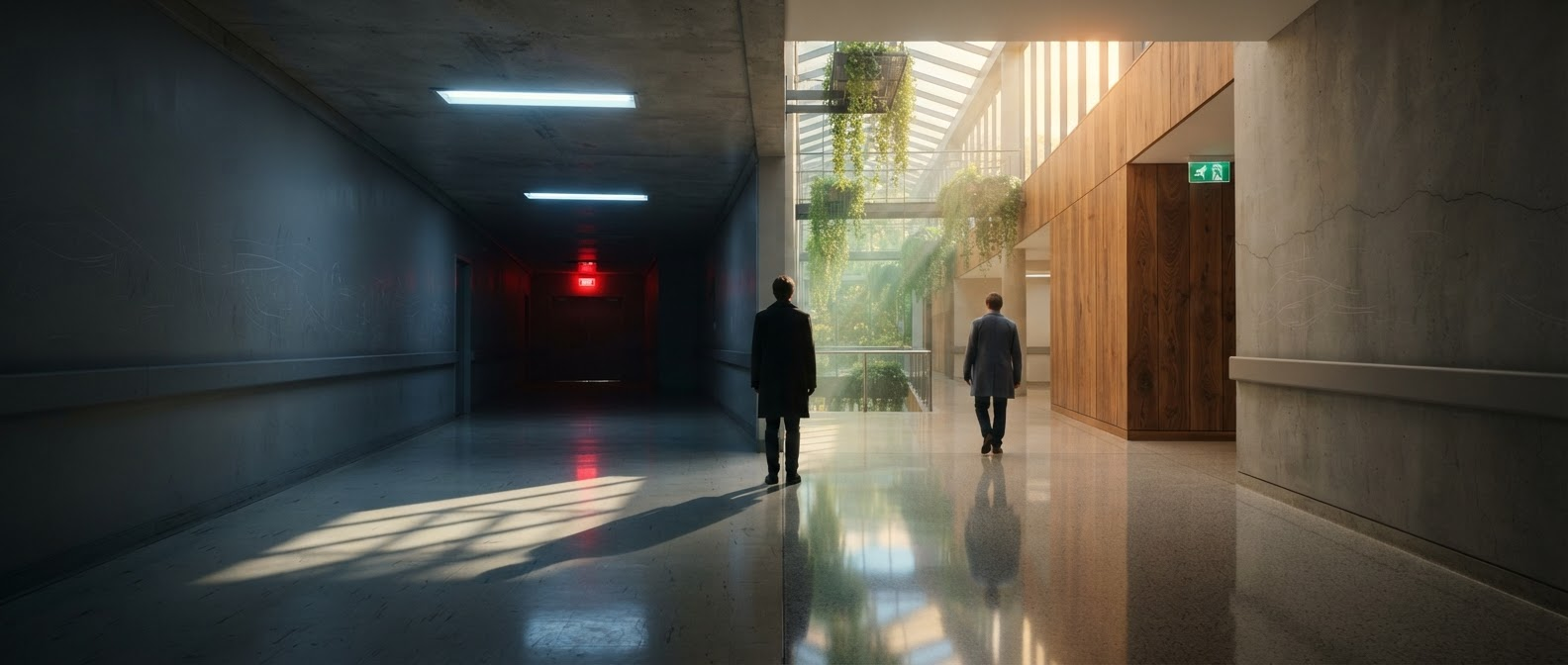
How Built Space Functions as an Emotion Regulation Mechanism Before Its Occupant Feels a Thing
There is a moment anyone who has entered a large hospital knows well: the moment the footsteps slow at the entrance to a long corridor, before the clinic, before the physician, before anything at all. Nothing has yet happened, and yet the body has already outpaced the mind, releasing whatever cortisol the situation demands. This raises the question of how Calming Design could change our experience in such spaces. This is the question architecture has long declined to ask: if psychological stress begins before the event, why do we design buildings as though people only start feeling once they have arrived?
Cognitive Appraisal How the Brain Decides a Place Is a Threat
In 1984, Richard Lazarus and Susan Folkman articulated what would become one of the most consequential frameworks in contemporary psychology: the transactional model of stress and coping. Its core proposition is straightforward in appearance and unsettling in implication — stress is not a property of the event alone, nor of the person alone, but of what arises between them in the moment of cognitive appraisal.
That appraisal unfolds in two stages. The first asks whether the situation constitutes a threat, a challenge, or nothing of consequence. The second asks what, if anything, can be done about it. The architectural implication, as Zotovic clarifies in his analysis of transactional theory, is that a person’s response within a space is not a reaction to what is actually occurring, but to what the brain has already assessed as being about to occur. A narrow, dimly lit corridor leading to a waiting room causes no physical harm, yet it triggers the same neurological alert signals as genuine danger — because the primary appraisal has already been issued.
Here lies the design opportunity: if stress originates in anticipatory appraisal, a space designed with sufficient care can intervene in that appraisal before it reaches its conclusion.
Gross and the Fifth Gate Where Architecture Competes with Clinical Psychology
A decade after Lazarus, James Gross developed a more granular framework for what he termed emotion regulation, proposing that human beings possess five distinct intervention points along the emotion-generative process: situation selection, situation modification, attentional deployment, cognitive reappraisal, and response modulation. It is the first and third of these that concern the architect most directly.
Situation selection — the advance choice to approach or avoid a given environment. When hospital entrances are designed with open gardens or glazed façades oriented toward open sky, the designer is effectively reprogramming situation selection before the visitor arrives, converting the act of approaching the building from a necessary avoidance into a positive experience. It is worth noting that what Gross identifies as situational avoidance represents the most common form of stress avoidance: the physical withdrawal from an anxiety-inducing place. This behavior is legible in attendance figures at primary care clinics and health centers whose design fails to reassure.
Attentional deployment redirecting a person’s attention through distraction or focused concentration. Directional lighting, visual depth achieved through spatial layering, and materials that invite tactile engagement all operate precisely at this intervention point. As Webb and colleagues demonstrate in their extension of Gross’s expanded process model, these strategies can function automatically — without conscious awareness on the part of the occupant which grants them exceptional influence in spaces entered during states of vulnerability or uncertainty.
Avoidance as Strategy What It Reveals About Occupants and Pedestrians
To understand what makes a building avoided, it is necessary to engage with what Roth and Cohen identified as the master dimension of coping: the approach-avoidance polarity. In their 1986 paper published in the American Psychologist, they demonstrated that avoidance is adaptive when an individual perceives a situation as beyond personal control but becomes costly when it prevents the processing that needs to occur.
The architectural translation of this finding is a concept best described as perceived controllability: a space in which the occupant understands its layout, can read its directional logic, and can anticipate what lies around the next turn generates less avoidance motivation and more approach behavior. The inverse holds equally. A space that produces disorientation or traps its user within single-option paths activates precisely the sense of lost control that psychological research consistently associates with avoidance rather than engagement.
Experiential Avoidance When the Architect Builds Without Knowing What Is Being Built
The most generative concept within this theoretical body did not emerge from conventional stress models but from the behavioral tradition of Acceptance and Commitment Therapy. There, Hayes and colleagues defined experiential avoidance as the unwillingness to remain in contact with aversive private experiences — thoughts, emotions, bodily sensations — and the persistent effort to escape them through strategies ranging from distraction to behavioral withdrawal. Chawla and Ostafin, in their comprehensive empirical review, established that this form of avoidance functions as a transdiagnostic functional dimension: it does not characterize a particular disorder but describes a mode of responding to any form of pressure.
The architectural implication is this: whenever a space is configured in a way that positions its occupant in unmediated confrontation with a source of stress — without gradation, without psychological distance — it activates experiential avoidance responses rather than positive adaptation. Architecture school design studios offer a pointed example. When critique sessions are held in fully exposed spaces with no spatial separation between the presentation zone and the audience, the student immediately appraises the situation as an existential threat rather than a creative challenge, and subsequently avoids the studio rather than learning from it. The spatial design of academic critique is not an aesthetic question. It is, in functional terms, a psychological one.
The Cumulative Cost of Avoidance What Silent Architecture Discloses
Among the more troubling findings in this body of research is what Holahan and colleagues concluded from their ten-year longitudinal study: avoidance does not eliminate stress — it generates it anew. Problems that are evaded accumulate; pressures that are escaped produce additional pressures, forming a cycle in which avoidance feeds the very distress it was intended to relieve.
In architecture, this principle manifests in what might be called spatial debt design interventions that provide momentary comfort (a wider corridor, stronger lighting at the entrance alone) without addressing the full spatial experience. A hospital whose entrance comprises a generous atrium that then opens onto a maze of dim, indistinguishable corridors delivers immediate relief in precisely the manner that avoidance does, then collects its cost later in the form of escalating anxiety and disoriented wayfinding decisions. The finding by Roskes and colleagues — that avoidance motivation depletes self-regulatory resources and produces, at best, relief rather than flourishing — warrants serious attention from every designer working in healthcare, educational, and public environments.
Toward an Avoidance-Resistant Architecture Space That Encourages Approach
What do these findings yield in practice? A set of design principles that can be drawn from this theoretical body — not as aesthetic preferences, but as functional psychological frameworks.
Gradation over direct confrontation. The incremental spatial transition from exterior to interior from garden to colonnade to lobby to waiting area — allows the brain to revise its cognitive appraisal in sequence, rather than rendering a final verdict at the first moment of contact.
Visual legibility. Revealing the path before the occupant commits to it — through directional lighting, transparent partitions, or visible floor-level cues — raises the user’s perceived controllability and reduces the likelihood of a threat appraisal.
Attentional refuges. Zones where the occupant can voluntarily redirect attention — a window oriented toward a natural element, a materially textured wall, a visually screened seat — operate directly on Gross’s attentional deployment point, offering the user the option of emotional self-regulation without imposing it.
The spatial design of critique environments. In architectural and professional education settings particularly, the critique space merits systematic reconsideration. A soft spatial separation between evaluator and evaluated, and a visual frame that communicates challenge rather than judgment, can produce measurable effects on both the student’s psychological response and the quality of the critical exchange itself.
What remains largely absent from architectural discourse is a direct engagement between cognitive emotion regulation models and everyday spatial design decisions. How a waiting environment is configured, how a building’s threshold is designed, how light is distributed along a corridor leading to a difficult room — each of these decisions carries embedded psychological theory, whether or not the designer is aware of it. The distance between knowing and not knowing is the distance between space that settles and space that simply stands
✦ ArchUp Editorial Insight
Spatial debt in institutional and healthcare environments is not an aesthetic failure but the direct physical consequence of capital allocation frameworks and throughput economics. Institutional procurement models systematically front-load capital expenditure into high-visibility, symbolic thresholds—such as glazed atria designed for civic branding—while aggressively compressing interior circulation into minimum-cost floor plates. When operational governance prioritizes volume density and occupancy turnover over cognitive continuity, spatial layouts inevitably default to double-loaded, disorienting corridors that maximize programmatic yield per square meter. The acute psychological stress response generated along these thresholds is therefore not an arbitrary reaction to an interior wall, but the predictable architectural symptom of an institutional balance sheet that values marketing at the perimeter while treating cognitive stabilization within the floor plate as an unmonetized externality..
References
Zotovic, M. “Coping with Stress: Basic Conceptual and Theoretical Questions from the Standpoint of the Transactional Theory.” Psihologija, 2004.
Goh, Y.W.; Sawang, S.; Oei, T.P.S. “The Revised Transactional Model of Occupational Stress and Coping: An Improved Process Approach.” The Australian and New Zealand Journal of Organisational Psychology, 2010.
Roth, S.; Cohen, L.J. “Approach, Avoidance, and Coping with Stress.” American Psychologist, 1986.
Gross, J.J. “The Emerging Field of Emotion Regulation: An Integrative Review.” Review of General Psychology, 1998.
Webb, T.L.; Totterdell, P.; Ibar, D.N.H. “Foundations and Extensions for the Extended Model: More on Implicit and Explicit Forms of Emotion Regulation.” Psychological Inquiry, 2015.
Hayes, S.N.; Strosahl, K.; Wilson, K.J. (as cited in): Chawla, N.; Ostafin, B. “Experiential Avoidance as a Functional Dimensional Approach to Psychopathology: An Empirical Review.” Journal of Clinical Psychology, 2007.
Wolgast, M.; Lundh, L.G.; Viborg, G. “Experiential Avoidance as an Emotion Regulatory Function: An Empirical Analysis.” Cognitive Behaviour Therapy, 2013.
Roskes, M.; Elliot, A.J.; De Dreu, C.K.W. “Why Is Avoidance Motivation Problematic, and What Can Be Done About It?” Current Directions in Psychological Science, 2014.
Holahan, C.J.; Moos, R.H.; Holahan, C.K.; Brennan, P.L.; Schutte, K.K. “Stress Generation, Avoidance Coping, and Depressive Symptoms: A 10-Year Model.” Journal of Consulting and Clinical Psychology, 2005.
Newman, M.G.; Llera, S.J. “A Novel Theory of Experiential Avoidance in Generalized Anxiety Disorder: A Review and Synthesis of Research Supporting a Contrast Avoidance Model of Worry.” Clinical Psychology Review, 2011.