Sand Batteries: When the Building Begins to Store Heat

Sand batteries store energy as heat within granular solids rather than through electrochemical processes. Excess electricity or solar energy heats sand inside insulated volumes for later use in district heating or industrial applications. This technology utilizes abundant, inexpensive materials capable of withstanding temperatures exceeding eight hundred degrees Celsius.
Integrating thermal storage into architecture transforms buildings into active energy reservoirs. While implementation requires managing material impurities and heat exchange efficiency, these systems offer a sustainable way to balance energy production and demand. This shifts the role of structural mass from passive protection to active infrastructure for managing time.
Thermal storage is usually hidden from architecture. It sits behind plant-room doors, inside insulated tanks, beneath mechanical diagrams, or somewhere beyond the boundary of the building itself. Yet one emerging technology raises a more architectural question: what happens when one of the oldest materials associated with construction and landscape becomes an energy-storage medium?
A sand battery does not store electricity in the electrochemical sense of a lithium-ion battery. It stores heat. Excess electricity, solar energy, or industrial waste heat is converted into thermal energy and transferred to sand or another granular solid. The heated material is then kept inside an insulated storage volume until the energy is required again.
The principle is remarkably simple. Its implications are not.
Research has investigated sand at temperatures extending toward 800–1,000°C, far above those required for ordinary domestic heating. Depending on the system, the stored heat can later support district heating, industrial processes, agricultural drying, compressed-air energy storage, or potentially power-generation cycles.
For architecture, this introduces a different conception of energy infrastructure. Instead of treating energy only as something delivered continuously through wires and pipes, buildings and districts may increasingly contain thermal reserves: large masses charged when energy is abundant and discharged when demand returns.
Sand Is Not the Battery
The name can be misleading.
There is no electrochemical reaction comparable to a conventional battery. Sand functions primarily as a sensible thermal energy storage medium. When its temperature rises, energy is retained as heat; when the sand cools, that energy can be extracted.
In simplified terms, the stored thermal energy follows:
Q = m × cp × ΔT
where m is the mass of the storage material, cp its specific heat capacity, and ΔT the temperature difference through which it is charged.
This equation explains both the attraction and limitation of sand.
Its specific heat capacity is not extraordinary. Measurements of desert sands cited in the research are around 0.92–0.98 kJ/kg·K, whereas molten nitrate salts can reach roughly 1.5 kJ/kg·K. But sand can potentially tolerate a much larger temperature range. Experimental characterization has investigated desert sand from approximately 150°C to 1,100°C, with useful operation generally discussed below the temperatures at which significant agglomeration becomes problematic.
The material therefore compensates partly for modest heat capacity through a large ΔT.
And unlike many engineered storage materials, sand is abundant, inexpensive, non-flammable, relatively inert, and capable of operating at atmospheric pressure.
That combination changes the economics of storing heat.
Four Ways of Building a Sand Battery
There is no single standard sand-battery architecture.
Research has developed several configurations, and their differences matter because they produce very different spatial and mechanical requirements.
One of the more sophisticated systems is sandTES, developed through research at the Technical University of Vienna. Sand particles are fluidized using air so that the granular material behaves almost like a liquid. The particles can then move through a heat exchanger, be heated, transported to a hot-storage hopper and subsequently returned through the exchanger during discharge.
This arrangement separates the quantity of stored energy from the power of the heat exchanger. Increasing storage duration can therefore mean enlarging the sand reservoir without proportionally redesigning the entire energy-conversion system.
Another approach uses a moving packed bed. Sand descends by gravity while hot air crosses through it, transferring heat to the particles. Research associated with high-temperature solar applications has examined air entering such systems at temperatures approaching 800°C.
A third approach goes further by allowing particles to fall directly through concentrated solar radiation. In this configuration, the granular material can become absorber, heat-transfer medium and storage medium simultaneously.
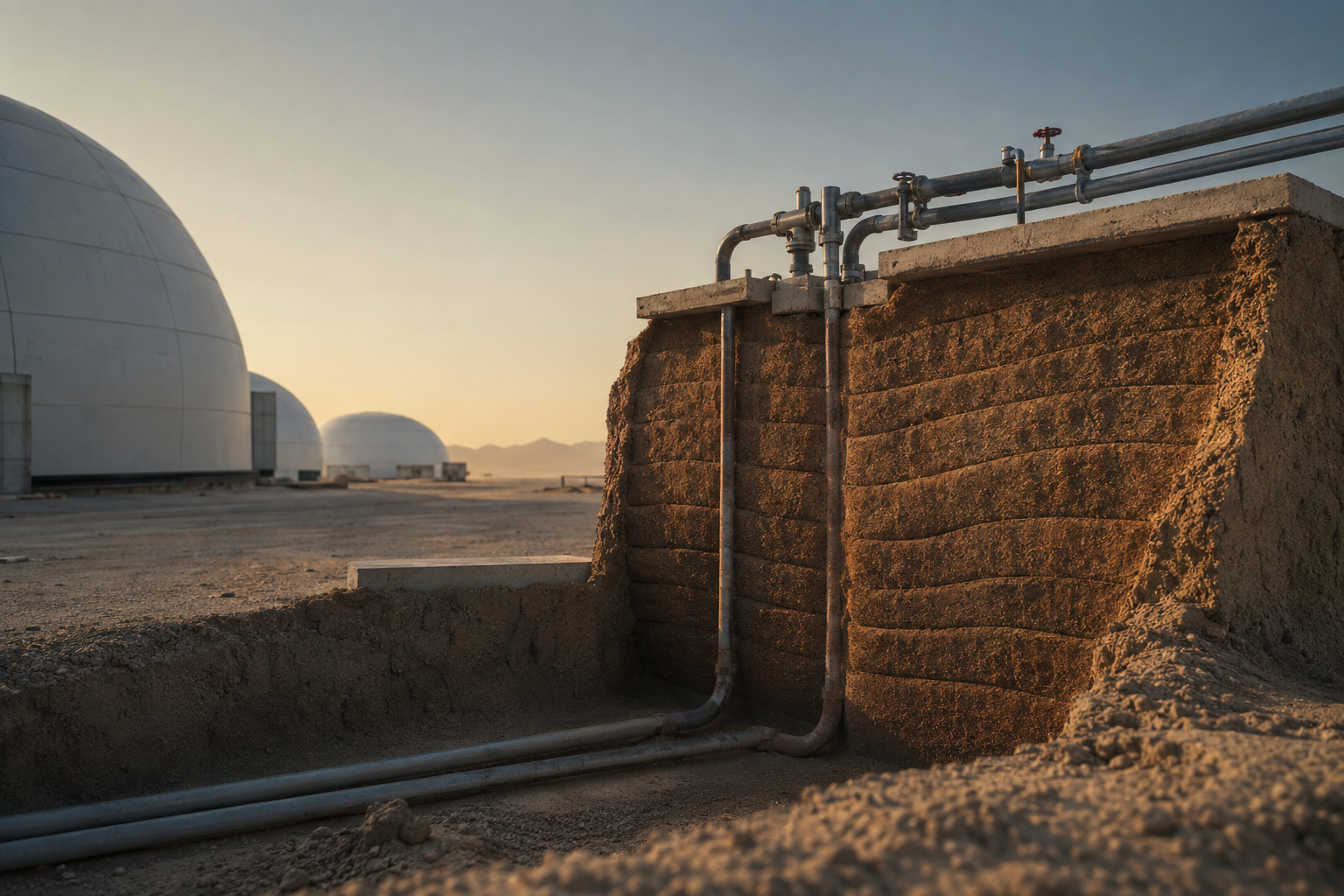
The simplest configuration is perhaps the most immediately legible architecturally: a stationary insulated volume of sand penetrated by pipes. Hot fluid circulates through the tubes, transfers energy to the surrounding sand and later retrieves it. Experimental research has tested such arrangements for lower-temperature applications including space heating and agricultural drying.
The “battery”, therefore, may resemble anything from sophisticated industrial machinery to an insulated mass containing little more conceptually complicated than sand and a heat exchanger.
The Desert Is Not Automatically a Battery
For arid regions, the proposition sounds almost irresistible.
If sand stores heat, and desert countries possess enormous quantities of sand, the material appears practically free.
The reality is more complicated.
Sand is not thermally uniform. Mineral composition, grain size, porosity and impurities influence conductivity, heat capacity, flow behavior and stability.
Research on desert sand from China’s Tengger Desert, for example, identified particles in the 200–300 μm range as offering a particularly useful combination of storage performance, resistance to thermal shock and manageable agglomeration. Other heat-exchanger configurations have favored significantly larger particles, around 1–3 mm, because designers must balance heat transfer against pressure drop.
Temperature introduces another complication.
Quartz undergoes its well-known α-to-β phase transition at approximately 573°C. More consequential for moving-particle storage is the behavior of impurities at still higher temperatures. Some investigated sands begin weak agglomeration above roughly 800°C, with the problem intensifying around 900–1,000°C. Low-melting compounds involving calcium, aluminum and magnesium can cause grains to bind together; sufficiently severe sintering can eventually destroy the ability of the material to flow.
Natural sand can also contain carbonates. During the first high-temperature cycle, calcite decomposition may release CO₂ and produce measurable mass loss. Subsequent cycles can then become considerably more stable.
The architectural implication is important: local availability does not eliminate material engineering.
A future thermal-storage facility in Riyadh, Abu Dhabi or the Sahara cannot simply excavate the nearest dune and assume predictable performance. The material must be characterized, screened and matched to the operating temperature and heat-exchange system.
From Mechanical Equipment to Architectural Mass
The most interesting question begins where much of the engineering literature stops.
Where does this mass go?
A building already contains thermal mass. Concrete slabs, masonry walls and stone surfaces absorb and release heat every day. Passive architecture has exploited this phenomenon for centuries.
Sand batteries operate on the same physical family of principles but at a radically different scale of temperature, control and energy density.
That creates at least three possible architectural scales.
At the building scale, lower-temperature storage could potentially become part of basement or service infrastructure. The storage mass would receive energy when electricity is inexpensive or renewable generation exceeds immediate demand and return heat to domestic hot-water or space-heating systems later.
At the campus scale, several buildings could share a larger thermal reservoir located alongside central mechanical infrastructure.
At the district scale, the sand store ceases to resemble building equipment altogether. It becomes urban energy infrastructure: an insulated thermal mass connected to district-heating networks, renewable generation or industrial waste-heat sources.
This distinction matters because thermal storage becomes increasingly attractive as duration increases.
Research comparing active sandTES with passive regenerative storage for adiabatic compressed-air systems found the active approach particularly advantageous for storage durations exceeding approximately 24 hours on an exergetic basis.
Electricity generation and heat demand do not necessarily occur at the same moment. Solar production peaks during daylight. Heating demand may peak after sunset. Industrial waste heat may be produced continuously while neighboring demand fluctuates.
Thermal storage inserts time between production and consumption.
That is its real architectural contribution.
The Building as a Thermal Reservoir
Architecture traditionally organizes matter to manage space.
Energy storage asks it to organize matter to manage time.
A wall separates inside from outside. A roof separates occupied space from climate. A thermal battery separates the moment when energy is available from the moment when it is required.
This creates an interesting convergence between passive architectural traditions and contemporary energy infrastructure.
Traditional thick masonry buildings stored daytime heat and released it later. Earthen construction moderated temperature through mass. Courtyards, shading, ventilation and material inertia worked together to delay climatic exchange.
Sand storage takes the principle of thermal inertia and makes it active, measurable and controllable.
The difference is fundamental.
A thick stone wall passively absorbs whatever thermal conditions reach it. A thermal storage system can deliberately be charged with surplus renewable electricity converted into heat, isolated thermally, and discharged according to demand.
The thermal mass stops being merely a property of the envelope.
It becomes infrastructure.
Why Not Simply Use Lithium Batteries?
Because electricity and heat are not always interchangeable problems.
If the final requirement is electricity, converting electricity into heat and subsequently converting that heat back into electricity introduces losses and additional equipment. Sand batteries should therefore not automatically be presented as competitors to electrochemical batteries.
Their strongest case appears where the required product is heat itself.
Buildings consume substantial energy for space heating and domestic hot water. Cities with district-heating systems move enormous quantities of thermal energy. Industry requires heat at temperatures ranging from relatively modest levels to several hundred degrees Celsius.
Storing thermal energy directly can avoid the unnecessary conversion of stored heat back into electricity.
This is also why the very high temperatures possible with granular storage are significant. Conventional building heating may require only a fraction of 800°C, but industrial processes and high-temperature power cycles can exploit conditions ordinary water tanks cannot approach.
Sand therefore occupies a different territory from the battery inside an electric vehicle or phone.
It is less a replacement for the electrical battery than a potential alternative to burning something later simply because heat is needed later.
Cheap Material Does Not Mean Cheap System
The simplicity of sand can obscure the complexity surrounding it.
A thermal store requires insulation. It requires heat exchangers. Active systems require blowers, conveyors or particle-handling equipment. Moving sand is abrasive. Heat exchanger surfaces and porous components experience erosion. At high temperatures, materials themselves become expensive engineering problems.
Fluidized systems also consume auxiliary electricity to move air. If excessive blower energy is required, part of the efficiency advantage disappears. Research on sandTES therefore emphasizes operation close to minimum fluidization velocity and recovery of heat from fluidization air.
Heat transfer presents another limitation. Static sand has relatively modest thermal conductivity. One study cited in the supplied research gives approximately 0.45 W/m·K for 1 mm grains at 500°C. Simply constructing a giant insulated container of sand does not guarantee that energy can be inserted and extracted at the required rate.
The geometry of the heat exchanger becomes as important as the quantity of storage material.
Experimental discrepancies illustrate the difficulty. In one air-sand heat-exchanger study, numerical simulations predicted effectiveness around 85–90%, while experimental measurements were closer to 40%, with boundary effects, heat losses and air leakage contributing to the difference.
That gap between simulated and measured performance is precisely why the technology should not be reduced to the appealing slogan of “putting energy into sand.”
The sand is simple.
The system is not.
A New Program for the Basement
For architects, this distinction may eventually become consequential.
Mechanical rooms were once relatively peripheral to architectural thinking. Electrification, elevators, air conditioning, fire protection, telecommunications and data infrastructure progressively expanded the technical anatomy of buildings.
Decarbonization may introduce another category: energy-storage space.
That space has dimensions.
It has mass.
It has structural loads.
It requires insulation and maintenance access.
It may generate heat losses that must be incorporated into environmental calculations. High-temperature systems require substantial physical separation from occupied areas and introduce demanding material and safety considerations.
At larger scales, architects and planners must consider access for maintenance, interfaces with energy networks, proximity to heat demand and relationships between storage infrastructure and public space.
The question is therefore no longer only whether sand can store heat.
Engineering research has already demonstrated that it can.
The architectural question is:
How much space should a low-carbon city allocate to storing energy?
Sand and the Gulf
This question becomes particularly interesting in hot, arid regions.
At first glance, thermal storage for heating appears much more relevant to Finland than Saudi Arabia. But that interpretation is too narrow.
The Gulf combines exceptional solar resources, substantial industrial energy consumption, large desalination infrastructure and proximity between cities and energy-intensive industrial processes. High-temperature thermal storage could therefore have relevance beyond winter space heating.
Concentrated solar power is particularly pertinent. Falling-particle concepts can expose sand directly to concentrated solar radiation, potentially allowing the same material to collect, transport and store heat. Research on desert sands from the UAE has specifically examined their suitability for thermal storage at temperatures extending toward 1,000°C.
Waste-heat recovery provides another route. Heat currently rejected by industrial processes could theoretically be stored and shifted temporally toward useful demand rather than being immediately dissipated.
The abundant local material is therefore only one part of the equation.
The more important regional resource may be the combination of sand + solar radiation + industrial heat + available land.
That combination deserves considerably more architectural attention.
The Material Beneath Our Feet
Energy technology often advances through increasingly sophisticated materials: lithium compounds, rare-earth elements, engineered ceramics, phase-change materials and complex electrochemistry.
Sand moves in the opposite direction.
Its proposition is almost primitive.
Take a stable granular material.
Heat it.
Insulate it.
Wait.
Retrieve the heat later.
Behind that simplicity sits substantial engineering: particle behavior, thermal cycling, heat exchangers, insulation, fluidization, erosion, thermodynamics and controls. But the storage medium itself remains ordinary.
That ordinariness may be the technology’s most architecturally provocative characteristic.
For centuries, architects have treated sand primarily as an ingredient: combine it with cement and aggregate and it becomes concrete; combine it with lime and it becomes mortar; melt silica under controlled conditions and it participates in the making of glass.
Thermal storage proposes another role.
Sand does not have to become something else.
It can remain sand.
And the architecture surrounding it can transform that inexpensive mass into a device for shifting energy through time.
The future building may therefore contain two kinds of mass.
The mass that holds the building up.
And the mass that holds its heat until the city needs it.
✦ ArchUp Editorial Insight
The sand battery’s most structurally consequential contribution is not thermodynamic but temporal — and the article identifies this precisely when it states that thermal storage inserts time between production and consumption, because that insertion is what transforms the building from a passive recipient of energy infrastructure into an active participant in the governance of when that infrastructure’s output is used. The gap between simulated heat-exchanger effectiveness at eighty-five percent and measured performance at forty percent is not a technical disappointment to be smoothed over in the next research cycle; it is the most analytically honest data point in the piece, because it confirms that the distance between a material’s theoretical behavior and its performance inside an actual system — subject to boundary effects, fabrication tolerances, maintenance regimes, and the accumulated decisions of the procurement process that specified it — is precisely the distance this archive has traced across every building technology it has examined, from the compressed concrete of The Taptab Illusion to the air quality systems of The Hidden Cost of Breathing: the engineering promise is made at the specification stage, the performance gap materializes in operation, and the party who absorbs the difference is always the one who was not in the room where the specification was written. The article’s closing architectural question — how much space should a low-carbon city allocate to storing energy — is the correct question, but it requires a prior one that the piece does not ask: who decides, under what procurement framework, at whose capital cost, and with whose operational liability, because the basement that holds the thermal mass is subject to the same CAPEX-OPEX misalignment that governs every other building system, and the city that allocates space for sand storage without resolving that misalignment will discover, a decade into operation, that the most abundant material in its desert was never the sand — it was the deferred maintenance bill accumulating inside the insulated volume that the developer’s exit clause was written to avoid.
Research basis
This article is based primarily on published experimental and engineering research into sand-based thermal-energy storage, including work on active fluidized-bed sandTES systems, desert-sand characterization, moving-particle heat exchangers, concentrated-solar falling-particle systems and embedded-tube thermal storage. The supplied research synthesis contains ten academic references spanning Energy Procedia, Journal of Solar Energy Engineering, Mechanics & Industry, Energy Sources, AIP conference proceedings and related engineering literature.