Camarati Primary School & Kindergarten No. 5: Urban Courtyard

Educational Context and Urban Role
The project is located in the heart of the San Francisco district in the city of Lores, and is considered an educational facility that combines a primary school with Kindergarten No. 5 in Camarati. The overall composition aims to support the function of public education, while also highlighting its role in improving the surrounding urban environment. The project also includes a school library open to the public, creating an overlap between the educational function and the social realm without a strict separation between them.
Relationship with the Site and Morphology
The design engages with a small plot of land characterized by an inner-courtyard-like condition, where this morphological constraint is directly employed in organizing the architectural massing. At the same time, the composition seeks to achieve a balance between forming a new urban façade that contributes to defining public space, and maintaining the privacy and safety requirements of an educational facility.
| Field | Details |
|---|---|
| Architects | UMA Collective |
| Area | 1731 m² |
| Year | 2026 |
| Photographs | João Morgado |
| Manufacturers | Aronlight, Danosa, JNF, Mapei, Pavigrés, RMC, Reynaers, Sanindusa, Sola Tube, Tarkett, Vale da Gândara, Vicaima |
| Lead Architect | Rui Cruz |
| Category | Educational Architecture, Schools |
| Coordination | Jónatas Lareiro |
| Project Team | João Gaspar |
| Project Management | PROFICO – Consultores de Engenharia, S.A. |
| Engineering & Consulting (Other) | ACRIBIA |
| Landscape Architecture | CARPA – com arquitectura paisagista |
| General Construction | Ferreira Build Power |
| City | Camarate |
| Country | Portugal |


Overall Organization and Relationship with the Surrounding Environment
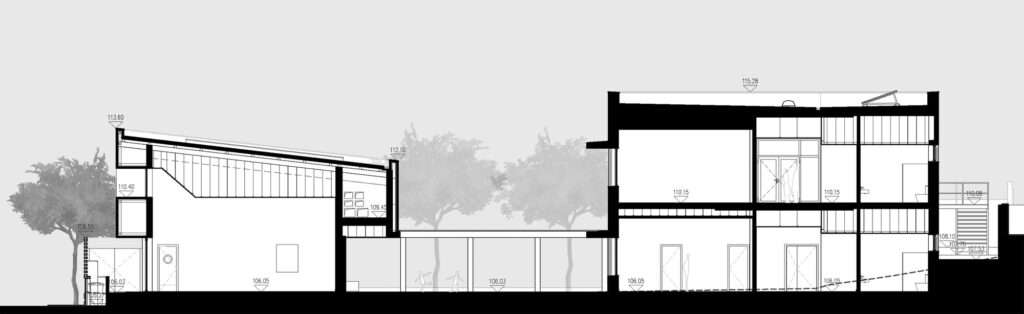
The school is arranged around a central courtyard that functions as both a visual and acoustic buffer, reducing the impact of the surrounding urban environment and mitigating noise generated by the site’s proximity to Humberto Delgado Airport. The overall concept relies on the orientation of natural light and the shaping of volumes in a way that enhances the clarity of the site’s architectural identity, through four distinct architectural masses that define the structure of the complex and organize its spatial configuration.
Entrance Composition and Connection to the Public Realm
The entrance is designed as a low-scale volume with a limited horizontal extension at ground level, acting as a transition between the architectural masses and the urban context. It is also set back within its composition to create a new plaza oriented toward the public realm, while preserving the existing trees. This allows for a controlled openness that connects the school and library to the surrounding community.
Distribution of Academic Blocks and Climatic Strategy
The classroom and educational block is composed of two floors with an east–west orientation, optimizing site efficiency. South-facing classrooms benefit from large openings shaded by precast GRC concrete elements, designed to control solar exposure and improve thermal comfort within the learning spaces, including kindergarten areas.

Shared Spaces and Environmental Strategy
The shared program areas requiring greater ceiling heights, such as the library, multipurpose rooms, and cafeteria, are located within a dedicated volume. Openings are oriented south and shaded by a structural cantilever, overlooking a courtyard enclosed by a brick lattice façade, achieving a balance between visual permeability and privacy.
Indoor–Outdoor Connectivity
The project includes a covered outdoor playground that allows year-round use, directly connected to interior spaces through GRC concrete walkways. This extension ensures continuous movement between spaces while providing protection from sun and rain, enhancing functional continuity throughout the facility.
Materials and Integration with the Landscape
The façade composition is based on exposed brick, white concrete, and gray brick lattice screens, resulting in a cohesive and calm architectural character suited to intensive use. Internally, carved courtyards within the mass, along with skylights and sun pipes, enhance lighting quality and environmental comfort. The landscape design further integrates exterior spaces with the building, forming a sequence between covered and open areas that supports continuous use of the playground, shaped by its core materials.


✦ ArchUp Editorial Insight
The project operates as a response to the expansion of public educational infrastructure policies within a dense urban fabric, where a primary school and kindergarten program intersects with an open library as a mechanism for integrating educational and public service uses. The institutional intent is to redistribute access to knowledge within a spatially constrained urban fabric neighborhood, while the small site and its inner-courtyard condition impose formal limitations on the massing strategy. Additionally, the proximity to Humberto Delgado Airport introduces a strong environmental constraint addressed through visual and acoustic buffering and the careful orientation of interior spaces. The response is expressed through a four-block organization around a central courtyard, controlled southern openings with shading devices, and a recessed entrance that liberates the public façade, transforming the building into a negotiation between safety, permeability, and operational efficiency.