Drasat 46B: Rethinking Urban Density Through Adaptive Reuse

Reframing Urban Density
Urban densification is commonly associated with vertical expansion and the increase in the number of floors. However, this project, presented as a case study by Drasat 46B, proposes a different approach. Instead of building upward, densification is treated as an intelligent reactivation of what already exists. The intervention begins by utilizing the roof of a 72-square-meter garage, transforming a limited residential addition into an analytical tool for reconsidering student housing patterns and land use in medium-sized Cities.
Reading the Site Organization
The project is located in Ocotzocuautla de Espinosa within an urban context supported by infrastructure and public transport services. The site covers an area of 333 square meters and is divided into three main elements: a family house at the rear, a garden in the middle, and a garage at the front. This arrangement reflects a clear functional distribution that defines usage zones without direct overlap between them.
Architectural Intervention Strategy
The intervention is limited to the utilization of the garage roof, measuring 9×8 meters, converting it into a habitable platform. As a result, the existing house and garden are preserved without modification, while a new residential function is introduced independently. This strategy enables a balance between addition and preservation, allowing multiple uses to coexist within the same property without requiring a complete spatial reconfiguration.


Redefining the Student Housing Model
Unlike the common model based on shared services with limited privacy in bedrooms, the project, as a case study by Drasat 46B, proposes compact yet fully functional residential units. Each studio integrates sleeping, cooking, and bathing functions within a 13-square-meter area. Thus, the small space is not understood as reduction, but as an efficient reorganization that embeds a complete housing program within a constrained volume. For more insights on innovative residential solutions, explore other Projects that redefine spatial efficiency.
Vertical Distribution and Functional Organization
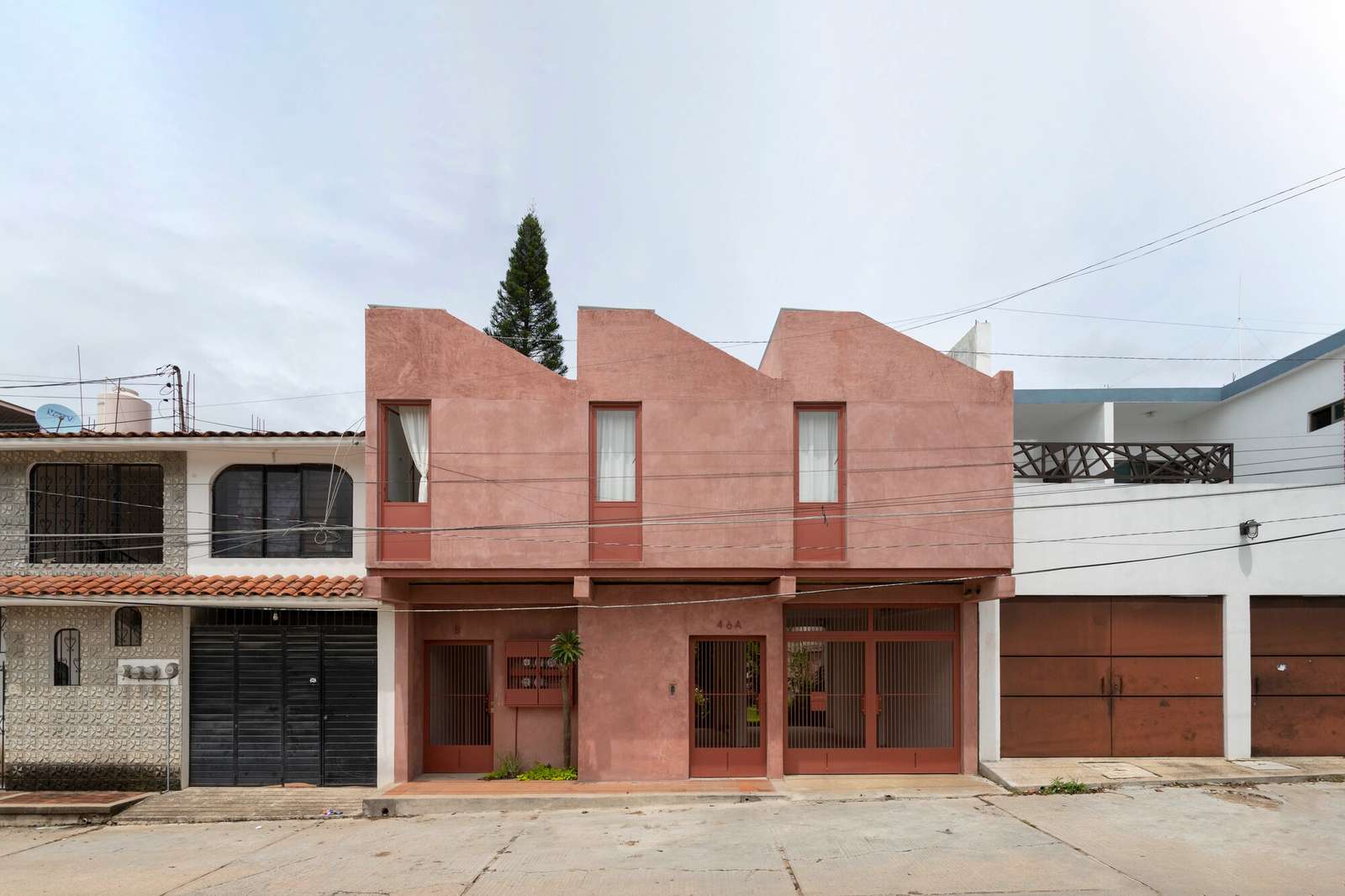
The building consists of two levels that clearly separate circulation from use. On the ground floor, a partition wall establishes independence between the entrance of the existing house and the entrance to the project, which includes a lobby, a staircase, and one residential unit. On the upper floor, five additional units are distributed alongside a shared laundry area, reflecting a functional organization that balances privacy and shared services. This approach to Design prioritizes clarity and user experience.
Ventilation and Lighting as Organizational Elements
The upper configuration relies on an open corridor acting as an intermediary element between units, enhancing cross-ventilation and providing natural lighting. As a result, its role extends beyond circulation, becoming part of the building’s environmental performance, improving spatial efficiency and interior quality. To learn about material specifications that support such environmental strategies, refer to our Material Datasheets.


Spatial Strategy and Unit Organization
The spatial approach enhances the perception of openness within a limited 13-square-meter area through rectangular layouts organized by low walls that do not reach the ceiling. This creates a continuous space where kitchen, bathroom, and living functions overlap without rigid separation. The units are arranged so that three face the main frontage, while two are positioned in parallel with an open corridor that functions as a transitional zone and incorporates green areas, strengthening connectivity and movement within the project. Such thoughtful Architecture transforms constraints into opportunities.
Material Treatment and Local Integration
The materials are characterized by simplicity and clarity: white walls and ceilings are combined with dark gray flooring and natural pine wood interiors. Externally, a reddish plaster finish is used, harmonizing with the existing tiled roof and referencing local ceramic traditions. This establishes a balance between interior neutrality and contextual integration. For a deeper look at available resources, you can browse our Building Materials collection and Archive for precedents.
Urban Density Through Reuse
The project, as a case study by Drasat 46B, demonstrates the possibility of transforming a single-family plot into a system containing seven units, including the existing house and six studios. As a result, urban densification is achieved without increasing Buildings height or altering the urban image, relying instead on reusing existing structures and optimizing spatial performance. Discover more innovative approaches to Construction that prioritize reuse over new build.


✦ ArchUp Editorial Insight
Drasat 46B operates as a spatial outcome of housing demand pressures within an urban network governed by land-value logic in Ocotzocuautla de Espinosa. The intervention does not originate from a purely design-driven intention but emerges from a gap between student housing demand and the existence of underutilized private residential plots containing surplus infrastructure such as garage roofs. The friction becomes evident between regulatory allowances that preserve low-density residential use and the economic need for vertical densification not supported by formal redevelopment. Structural responsibility and insurance considerations further encourage building additions over demolition. The outcome becomes a spatial settlement between capital efficiency and regulatory rigidity, where architecture functions less as an autonomous design act and more as a direct product of incremental financial adaptation. For ongoing discussions and updates, follow the latest Top News in the field.