Can You Really Escape Prison? An Architectural Perspective That Reveals the Truth

Introduction
Escaping prison may seem like a plot reserved for action films and TV shows but behind every attempt lies a hidden battle between a prisoner’s creativity and an architect’s strategy.
In this article, we’re not asking how to escape. Instead, we’re flipping the question: How does architecture make escape nearly impossible?
By breaking down the most common escape scenarios especially those dramatized in shows like Prison Break we’ll explore how modern prison design anticipates, counters, and often eliminates every possible route to freedom.

When Architecture Fights Back
Escape isn’t always about climbing a wall or breaking a lock. Sometimes, it’s about trying to outsmart the very structure meant to keep you in.
But what makes a prison “inescapable”? Is it the guards, the cameras, or the barbed wire?
More often than not, it’s the architecture itself that quietly does the heavy lifting.
Table: How Architecture Disarms Escape Tactics
| Escape Method | Common Approach | Architectural Countermeasures |
|---|---|---|
| Ventilation Shafts | Crawling through air vents or ducts (like in Prison Break). | Narrow vents, internal metal mesh, motion and tamper sensors. |
| Underground Tunnels | Digging below the floor to reach outside. | Reinforced concrete slabs, vibration sensors underground, layered foundations designed to resist penetration. |
| Wall Climbing or Breaking | Scaling walls or breaking structural elements. | Smooth, anti-climb surfaces; extra-high, reinforced walls; durable anti-impact materials. |
| Blind Spots in Surveillance | Exploiting camera gaps or corners out of guard view. | Panopticon-inspired layouts: centralized visibility, no dead angles, open corridors. |
| Navigating Infrastructure | Escaping through sewer lines, maintenance rooms, or electrical ducts. | Segmented infrastructure, sealed access points, alarmed security doors, restricted internal connections. |

Psychological Architecture: Controlling the Mind Before the Body
Architectural design in prisons goes far beyond walls and doors.
Modern facilities are built to instill a constant sense of surveillance whether someone is watching or not. Techniques include:
- Hidden observation points for guards.
- Cell layouts that allow visibility at all times.
- Minimal private space to limit unmonitored activity.
This layout subtly influences behavior and deters prisoners from even considering escape.
Prison Break: Entertainment or Engineering Lesson?
Prison Break wasn’t just a thrilling drama it was an unexpected crash course in architectural analysis.
The protagonist, Michael Scofield, relied not on brute force, but:
- Blueprints of the facility.
- Timing guard shifts.
- Studying structural weaknesses.
The show portrayed escape as possible through planning and intelligence. But in reality, access to such detailed layouts is rare, and modern prison design intentionally conceals every critical system behind layers of secure planning.
The Evolution of Prison Architecture
Prisons today are more than rows of cells and gates. They’re a blend of:
- Architectural planning
- Surveillance technology
- Behavioral psychology
With smart locks, AI-powered monitoring, and panoptic-inspired layouts, modern prisons function like intricate machines—designed to resist not just physical escape, but also strategic thinking.

✦ ArchUp Editorial Insight
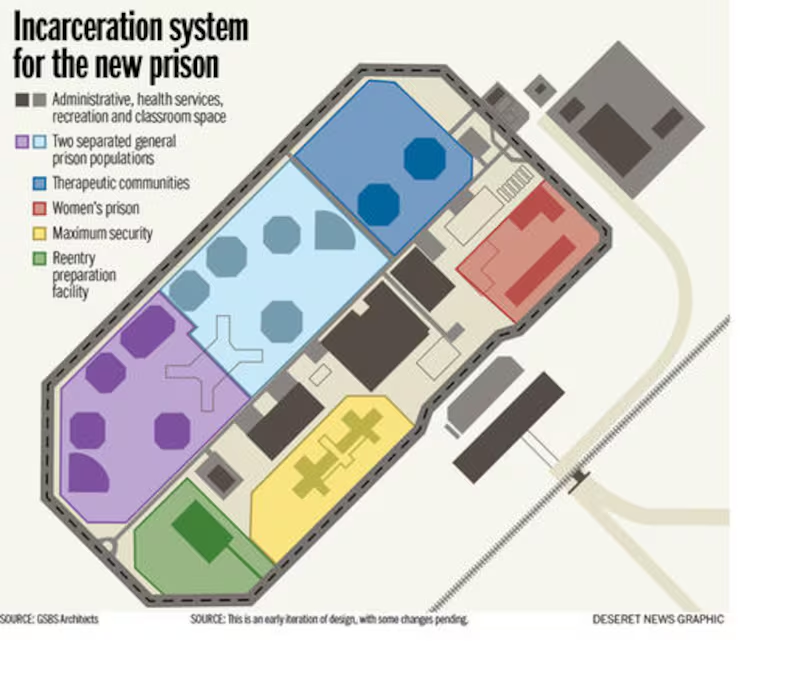
This article presents an architectural reading of “prison escape” by linking famous escape attempts with the security strategies embedded in prison layouts. The featured images portray strict geometries, including radial structures, acute angles, and spatial zoning, reflecting intentional design control. However, the visual narrative focuses solely on architectural form, lacking deeper engagement with the social or cultural dimensions behind such spaces. Can understanding carceral architecture reshape our perception of confined environments? While the contextual framing remains limited, the article offers a distinctive exploration of architecture as both a functional deterrent and a design identity.
Explore the Latest Architecture Exhibitions & Conferences
ArchUp offers daily updates on top global architectural exhibitions, design conferences, and professional art and design forums.
Follow key architecture competitions, check official results, and stay informed through the latest architectural news worldwide.
ArchUp is your encyclopedic hub for discovering events and design-driven opportunities across the globe.