Concrete Utopia: Pipes Between Architecture and Sculpture

Between Reality and Perception
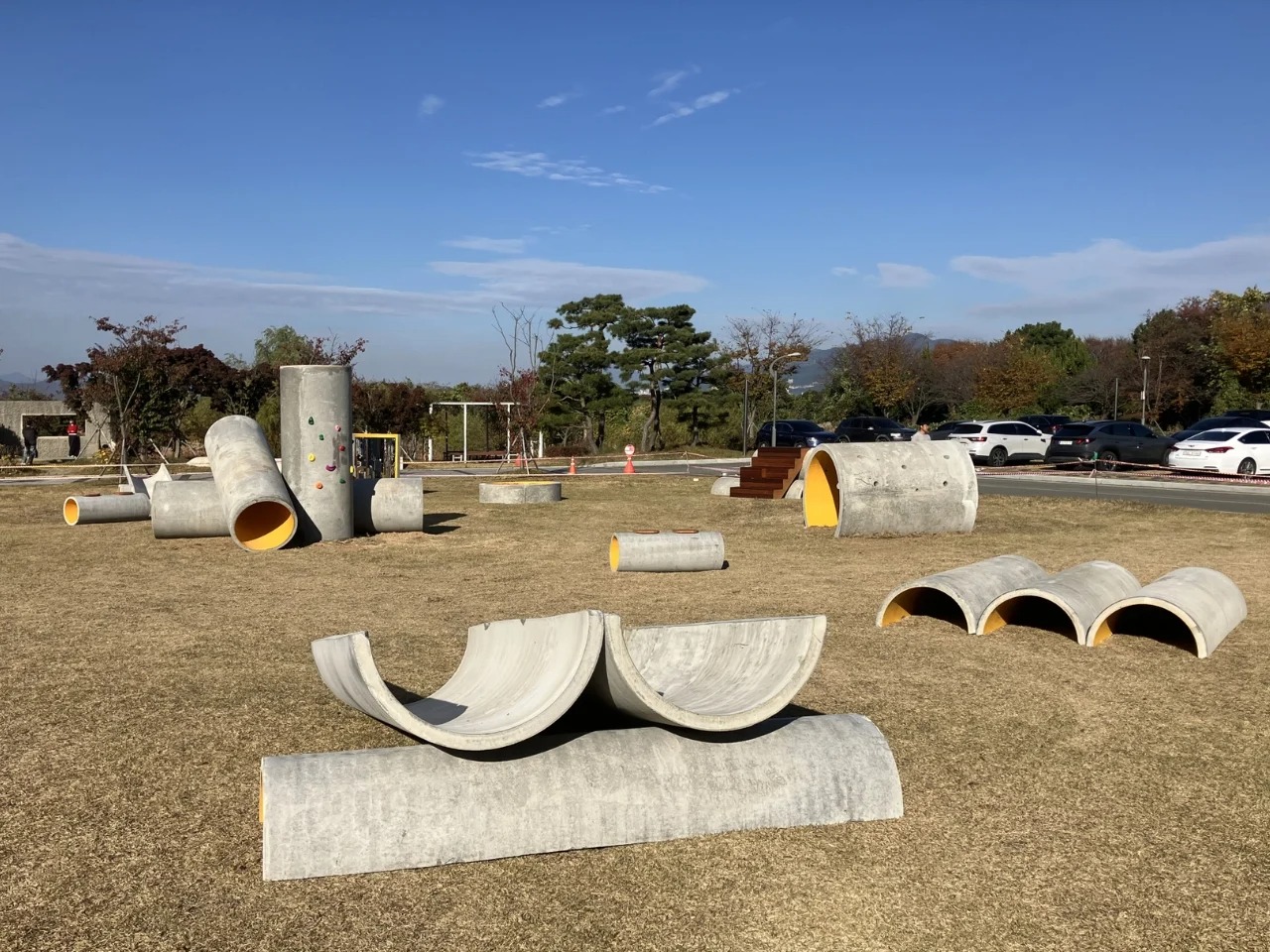
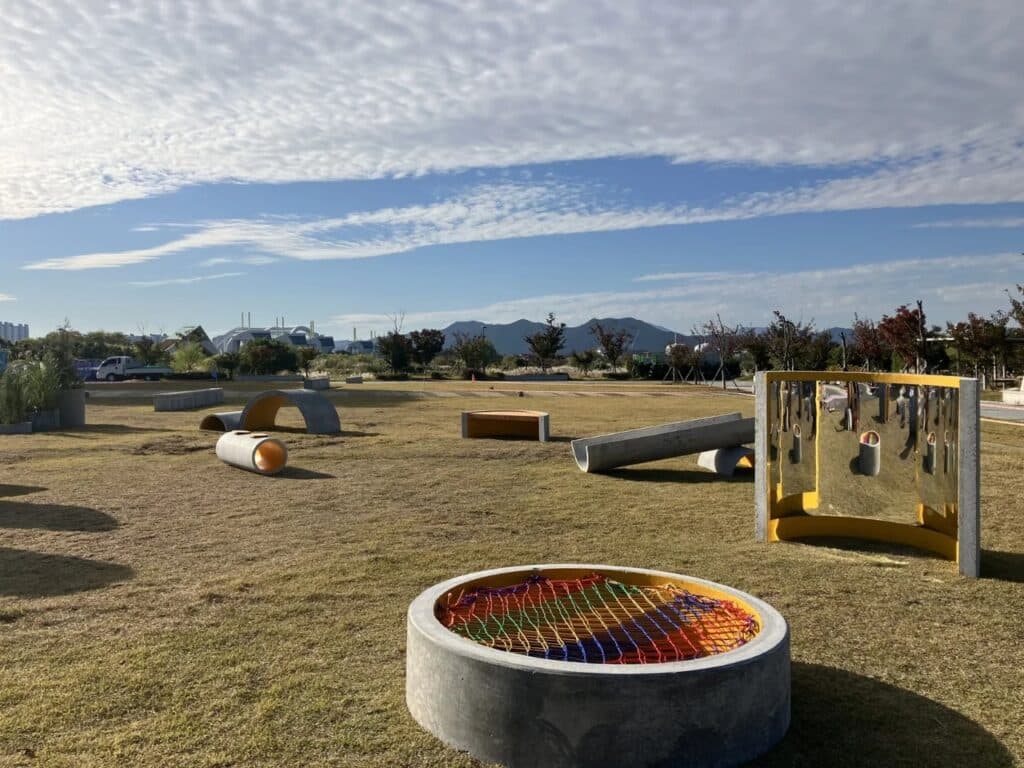
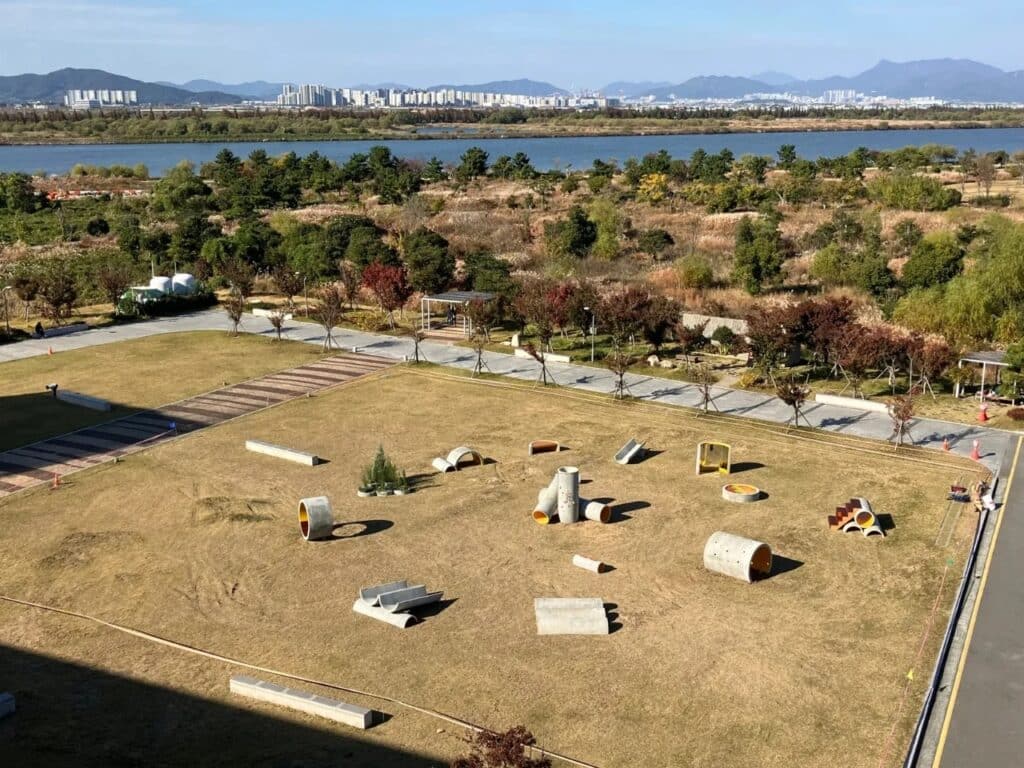
At first glance at the images of the Concrete Utopia project, it is easy to mistake it for a purely digital architectural render, one of those concepts that circulates across design platforms before disappearing as an unbuilt idea. The composition appears too perfect to be real, especially with massive concrete pipes arranged within an open courtyard where people move through the space effortlessly, as if it had always been designed that way.
In reality, however, the project is fully constructed outside the Museum of Contemporary Art in Busan, South Korea. With each reconsideration, the initial sense of visual astonishment gradually shifts into an attempt to understand the logic behind the composition.
Re-reading a Neglected Material
The project relies on concrete pipes that are typically used in infrastructure systems and then discarded after their function ends. Here, the concrete pipes are neither altered nor concealed; instead, their original form is preserved and recontextualized within a new spatial setting.
Reconfiguring Function, Not Form
Rather than remanufacturing the elements, the pipes are arranged and stacked at different angles to construct a new spatial condition. The result is not recycling in the conventional sense, but a transformation of the material’s role, from a structural component into a spatial and visual element.
A Space Between Sculpture and Architecture
The composition does not clearly belong to either sculpture or Architecture; it exists in the space between both. This ambiguity gives it an open-ended character and turns the project into an exercise in rethinking how design can be produced from existing materials without altering their essence.
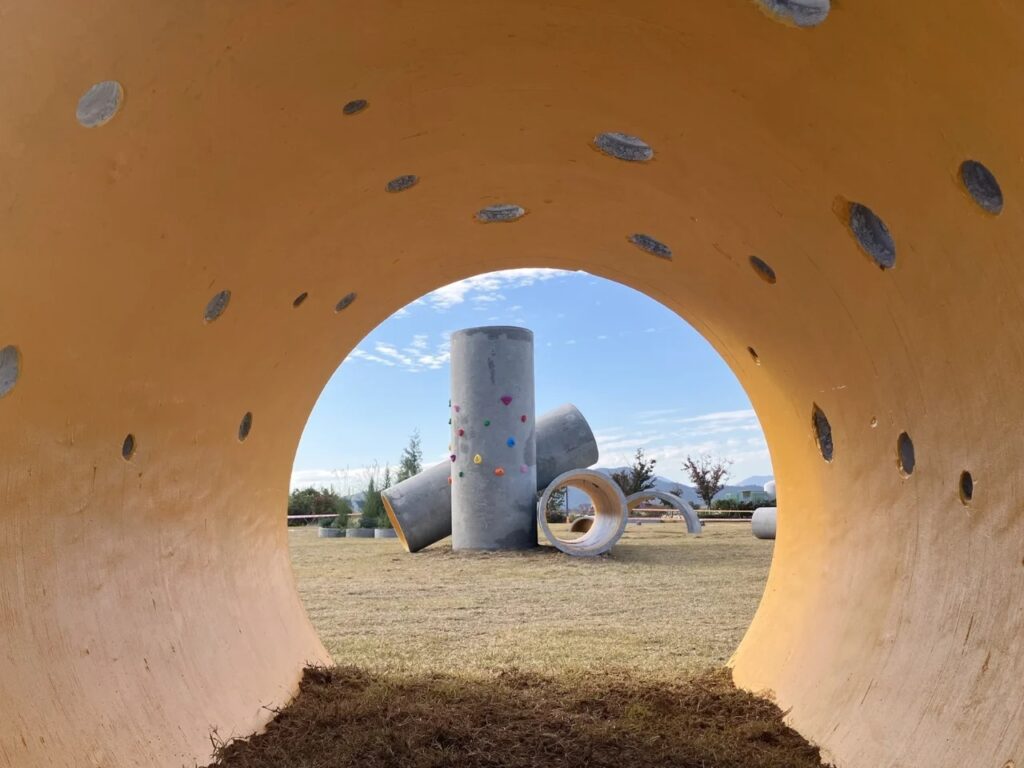
The Rhythm of Repetition and Spatial Formation
Circular geometry and repetition play a fundamental role in this composition, yet repetition is not applied in a rigid or excessive manner, an approach that often flattens visual space. Instead, it is treated as a flexible tool capable of generating variation within the same elemental unit.
The concrete pipes appear in different positions and orientations without any alteration to the material itself, producing a visual rhythm that feels ordered without being strict. This balance establishes a sense of spatial flexibility, making the composition more accessible both visually and physically, rather than keeping the viewer at a fixed observational distance. The overall experience becomes fluid and open-ended.
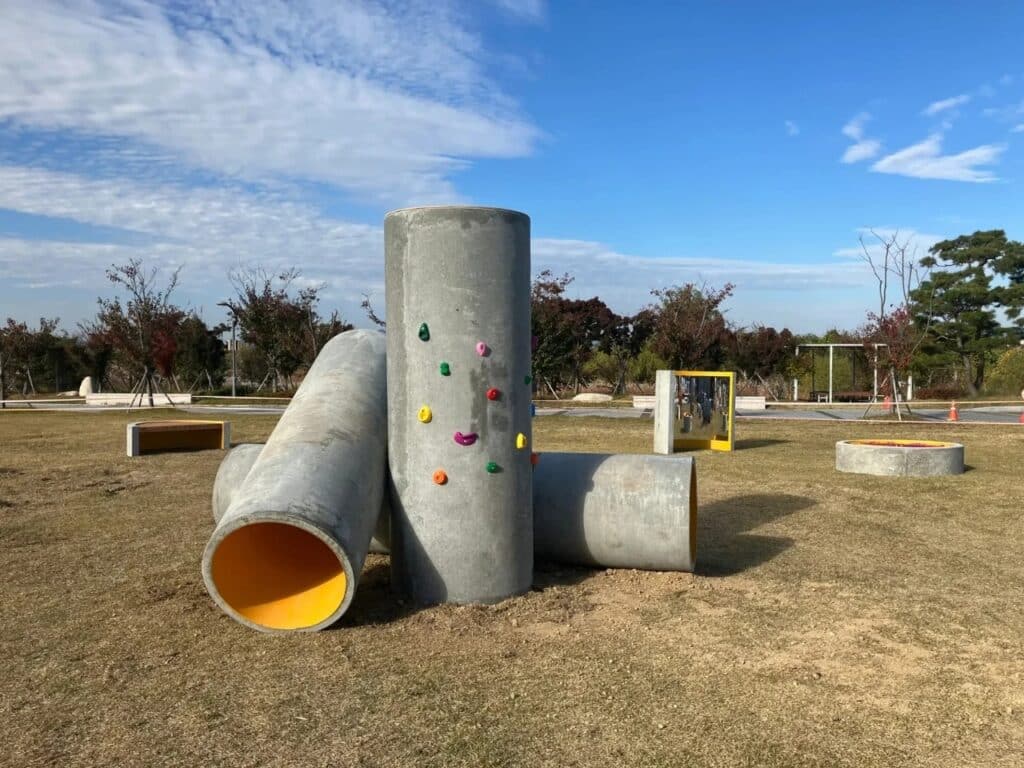
Scale as a Defining Element of Experience
One of the most critical factors in the success of this design lies in its handling of scale. These are large industrial concrete pipes that, if placed in a public space without any spatial consideration, could easily read as alien or even visually off-putting objects.
Contrary to that expectation, the proportions work in favor of the project. The openings within the pipes allow passage, sitting, and direct interaction, turning them into an inhabitable bodily experience rather than static mass.
The design does not impose a single fixed function, but instead accommodates multiple uses in a natural way. A child moving through the space experiences it differently from an adult standing inside it, yet the design does not attempt to regulate or standardize these differences.
This kind of spatial generosity creates a flexible and open-ended experience, something that more complex projects, despite greater planning and resources, sometimes fail to achieve.
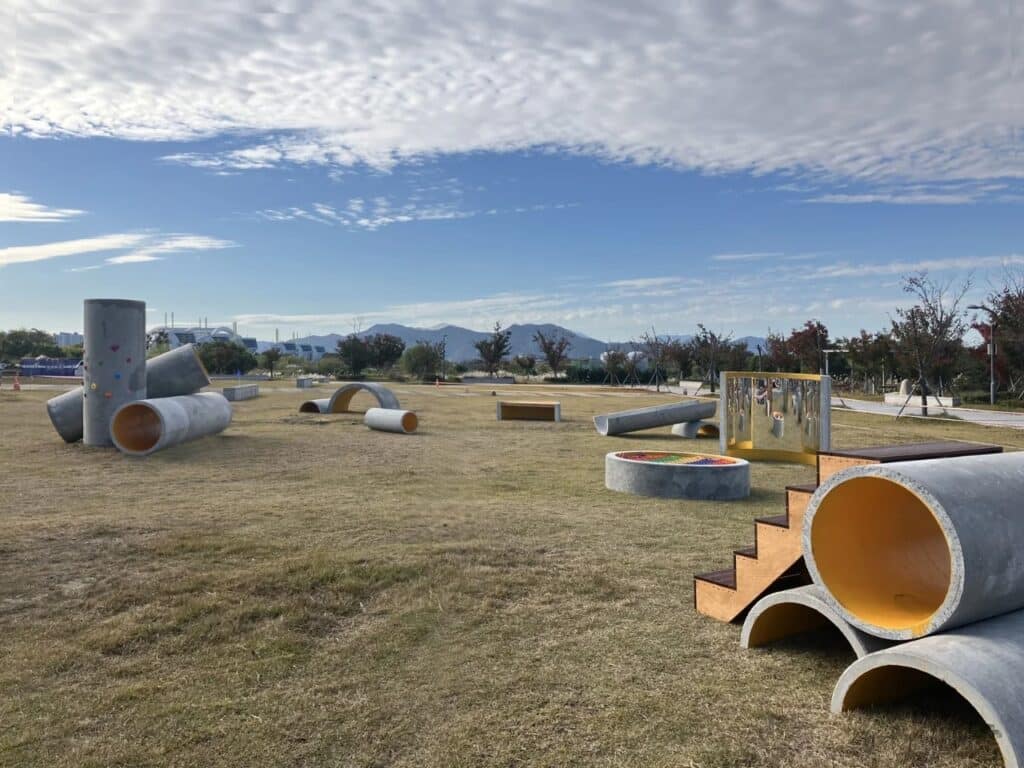
Material Presence and the Honesty of the Surface
The quality of the surface plays a significant role in shaping the project’s experience. Concrete carries a visual and tactile weight that does not disappear even when its context is altered or its function is redefined, and it does not easily become a decorative element under any form of display.
Rather than attempting to soften these qualities, the design treats them as a fundamental part of its visual language. The roughness of the material is not a flaw to be overcome, but an attribute that strengthens the identity of the composition.
From a closer distance, the surfaces reveal traces of their previous use, adding a layer of material honesty that is difficult to achieve with highly polished or excessively treated materials.
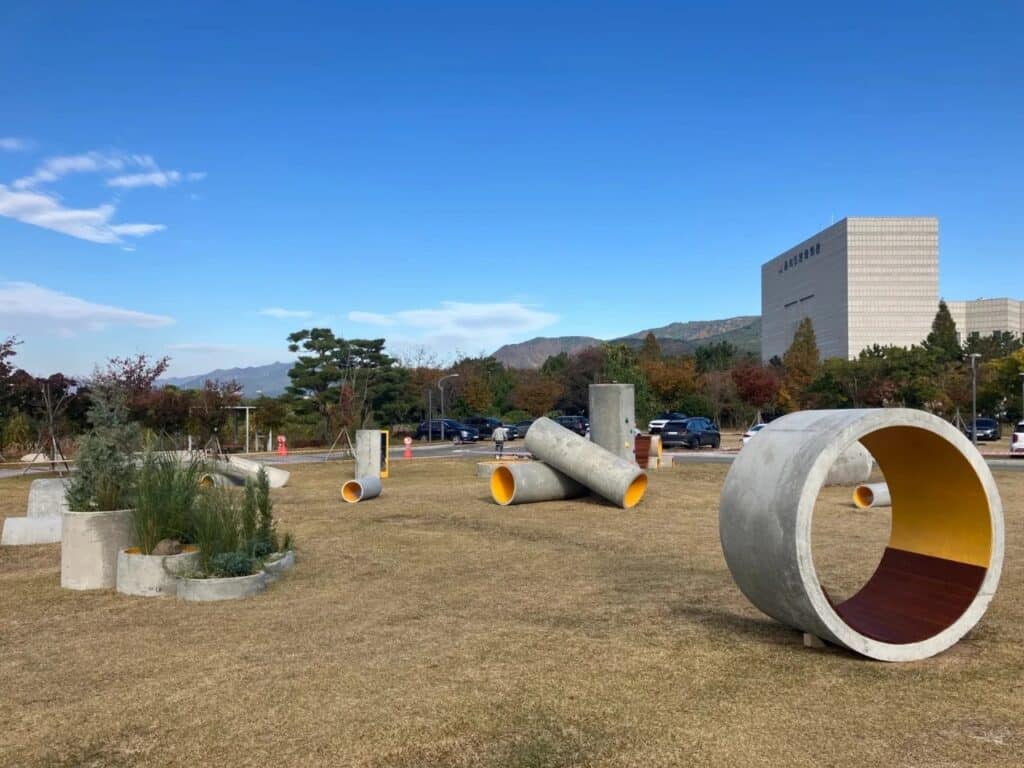
The Absence of Spatial Hierarchy
The project deliberately avoids any fixed spatial hierarchy. There is no clear front or back, and no dominant visual axis that dictates movement or orientation. This absence is not accidental, but a deliberate compositional decision that reshapes how space is perceived.
In most public environments, even well-designed ones, there is usually an underlying logic that guides users along a defined path. Here, however, that guidance is largely removed, allowing movement to become more open and less constrained.
The result is a space that does not impose a single reading, but instead allows each individual to construct their own understanding of it. This openness is not a byproduct; it is an integral part of the design’s structure and overall design experience.
Between Architecture and Artistic Installation
The project’s location within the grounds of a contemporary art museum places it in a liminal zone between sculpture and architecture. It partially behaves like a building, yet it does not fully resolve as a conventional architectural entity; at the same time, it can be read as an art installation, despite functioning in a way that is closer to infrastructural logic.
This in-between condition forms the core of the experience and is what gives Concrete Utopia its strength, as it moves beyond being either a gesture toward sustainability or a purely formal exercise in design.
Rather than separating the design question from its material resolution, the work merges both into a single point of inquiry. This kind of integration is uncommon, as design processes often keep these two dimensions distinct until the very end.
✦ ArchUp Editorial Insight
The project emerges from a procurement logic based on surplus industrial infrastructure and the museum’s programming of public space within an institutional perimeter, where discarded concrete pipes are reclassified as low-cost spatial assets for producing temporary public environments within the broader framework of construction. The friction points manifest in transportation logistics, the limits of legal responsibility associated with using heavy precast elements in an open environment, and irregular anchoring requirements governed by safety standards within cultural sites.
Rather than resolving these constraints through conventional construction, the system produces a spatial settlement in which infrastructural remnants are re-legitimized as usable volumetric units, while movement is redistributed within a non-hierarchical configuration based on spatial dispersion. Thus, the final form becomes a negotiated outcome between the economics of surplus management, institutional evaluation frameworks, and risk-regulated public access protocols, where the autonomous structure becomes less significant than the system that produced it through the logic of the original project.
Situated in Busan, one of South Korea’s most dynamic coastal design environments, the intervention reflects how context influences the reinterpretation of industrial matter into public spatial experiences.
Within this framework, the architecture does not act as a fixed object but as an adaptive condition shaped by procedural constraints, institutional negotiation, and material availability, reinforcing the idea that architecture here is less a form and more a system of relations.
Ultimately, the project demonstrates how surplus infrastructure can be reabsorbed into contemporary design thinking, where value is not generated through fabrication alone but through reprogramming existing material logic into new spatial outcomes.