Ibrahim Joharji: Crafting Bespoke Mansions with Precision and Elegance


Saudi architect Ibrahim Nawaf Joharji specializes in bespoke luxury residential design in Jeddah, where each project is tailored to reflect the individual identity and aspirations of its owner. His work spans a range of scales and site conditions, integrating sustainability, privacy, and contextual sensitivity into each design.
Notable built projects include the MABK Villa, AMA Infinity Villa, Housing Complex, and a compact luxury villa, each presenting distinct construction challenges such as curved facades, mountainside terrain, and premium material integration. Joharji’s firm manages design and construction under a unified vision, a practice he considers central to his architectural identity.
Pioneering Luxury in Saudi Architecture
Luxury residential architecture in Saudi Arabia is increasingly defined by a shift away from generic opulence toward site-specific, identity-driven design. The built portfolio of Jeddah-based Ibrahim Nawaf Joharji of INJ Architects reflects this transition through a design-build methodology that unifies conceptual development with structural execution — a practice he considers inseparable from the architectural result.
Each project begins not with a programme, but with a person.
“Every villa I design carries the initials of its owner, transforming each project into a deeply personal statement. This approach not only celebrates the individuality of my clients but also ensures that every home becomes a unique architectural story, reflecting their identity and aspirations.”
— Ibrahim Nawaf Joharji
From the initial sketches to the final construction stages, Joharji ensures each detail of his projects reflects the client’s vision while pushing the boundaries of architectural creativity. This article takes a closer look at some of his most iconic built projects, offering insight into the challenges and triumphs of their execution.
MABK Villa — Al-Basateen, Jeddah
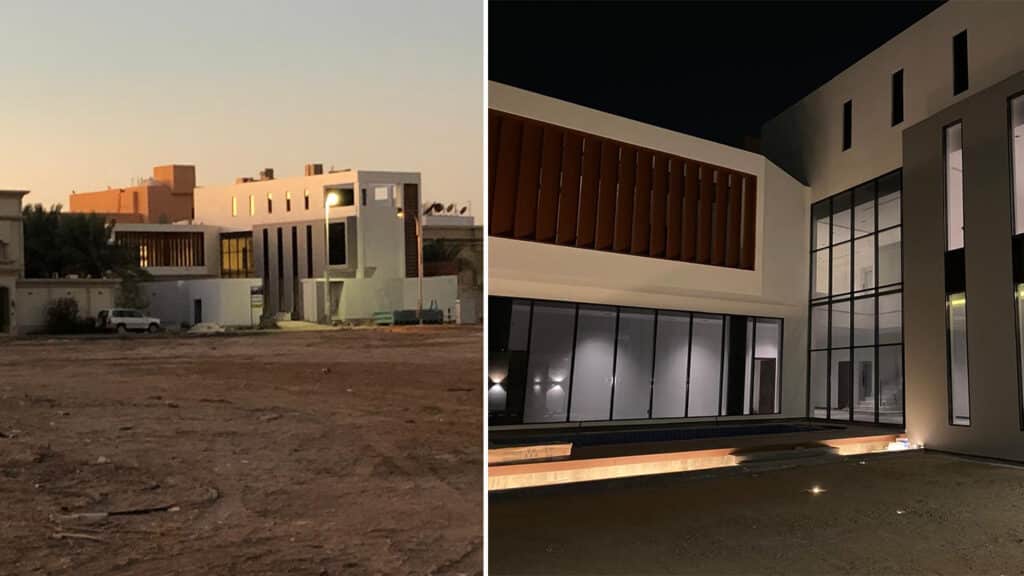
The MABK Villa addresses two conditions that define residential architecture in Jeddah’s dense urban districts: intense solar radiation and the demand for domestic privacy on a constrained 850-square-metre plot. An L-shaped plan organizes the programme to shield private zones from direct street view, while an engineered network of vertical aluminum louvers forms the primary facade element. The louvers serve as both thermal barrier and visual filter, reducing solar heat gain while allowing diffuse natural light to reach double-height interior volumes. The house appears solid from the street and luminous from within.
Built area: 1150 m² · Facade: high-performance aluminium cladding · Strategy: solar filtration and domestic privacy

AMA Infinity Villa — Jeddah
The AMA Infinity Villa began with a client brief that was formally precise: unconventional, structurally bold, and explicitly curved. The 750-square-metre residence is organized around twelve major arcs, a geometry that required custom formwork and precision material cuts throughout construction. Double-glazed glass and carefully engineered wooden molds shaped the sweeping envelope over an 18-month construction period. The curved form is not expressive for its own sake — it is oriented to optimize ventilation and solar exposure for the building’s specific position, making formal ambition and environmental performance coincident rather than competing.
Built area: 750 m² · Construction: 18 months · Key element: 12 major structural arcs
Housing Complex — Makkah Mountainside
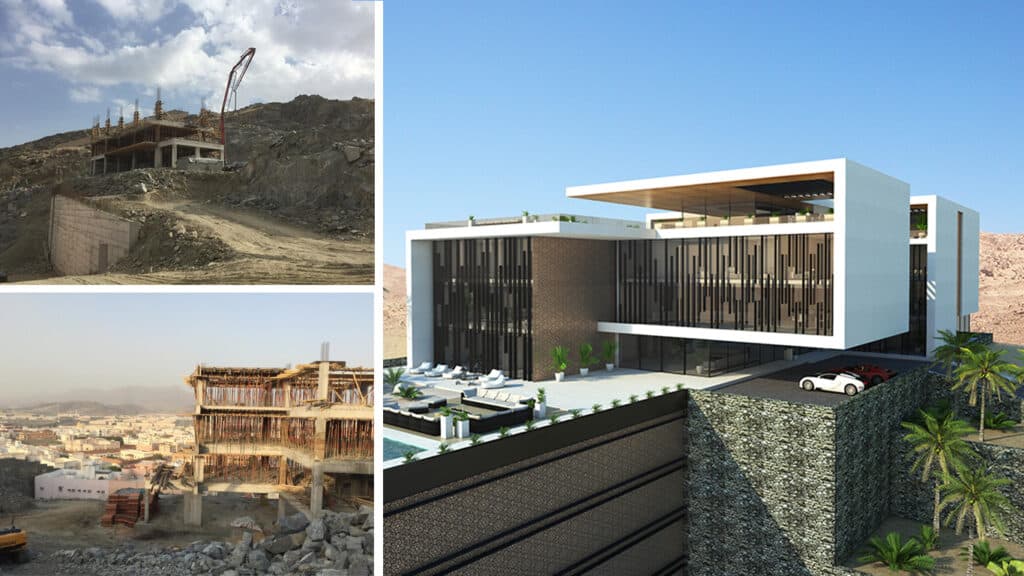
The Housing Complex occupies a rugged mountainside site, a terrain that presents both structural challenges and material opportunities. The design integrates 200 tonnes of locally sourced granite into the building fabric, treating the site’s own geology as a primary architectural material rather than an obstacle. Ten residential units are distributed across 4,850 square metres, with the complex reading as continuous with its ground — built from the mountain rather than placed upon it. Site stabilization at the foundation level required significant structural engineering, the documentation of which forms part of the project record.
Total area: 4,000 m² · Units: 10 · Granite: 200 tonnes, locally sourced

TOB Compact Luxury Villa — Jeddah
At 250 square metres, this commission operates at the opposite end of the portfolio’s scale range. The design prioritized spatial quality over spatial quantity: 3.5-metre ceiling heights, a green area constituting 30 percent of the total site, and a material palette weighted toward natural finishes — Italian marble and panoramic glass dominate the primary surfaces, with natural materials accounting for 70 percent of all interior specification. The project demonstrates that the practice’s methodology is not scale-dependent. Compactness here is a condition resolved, not a limitation apologized for.
Built area: 250 m² · Ceiling height: 3.5 m · Green area: 30% of site · Natural materials: 70%
MFJ Mansion — Al-Murjan, Jeddah
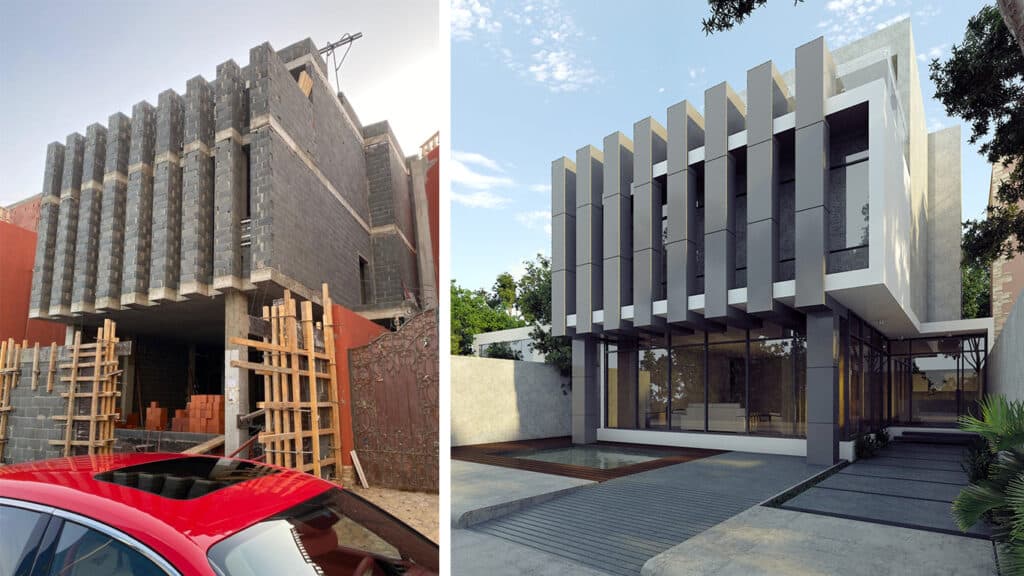
The MFJ Mansion is the most formally resolved project in the portfolio and the one that most directly engages the Hijazi architectural tradition. A double-skin facade system employs custom-engineered white geometric screens that reinterpret the mashrabiya — the historic perforated screen of traditional Hijazi domestic architecture — in contemporary structural form. Behind the screen, the mansion is organized around a deeply private central courtyard, illuminated at night and approached through a spatial sequence that transitions from public reception to family quarters. High ceilings and premium natural stone enhance passive cooling and daylight distribution throughout.
The project received the International Property Award in the Architecture category for Saudi Arabia and the Luxury Lifestyle Award for residential architecture, both in 2025.
Location: Al-Murjan, Jeddah · Facade: custom geometric screen · Awards: IPA 2025 · LLA 2025
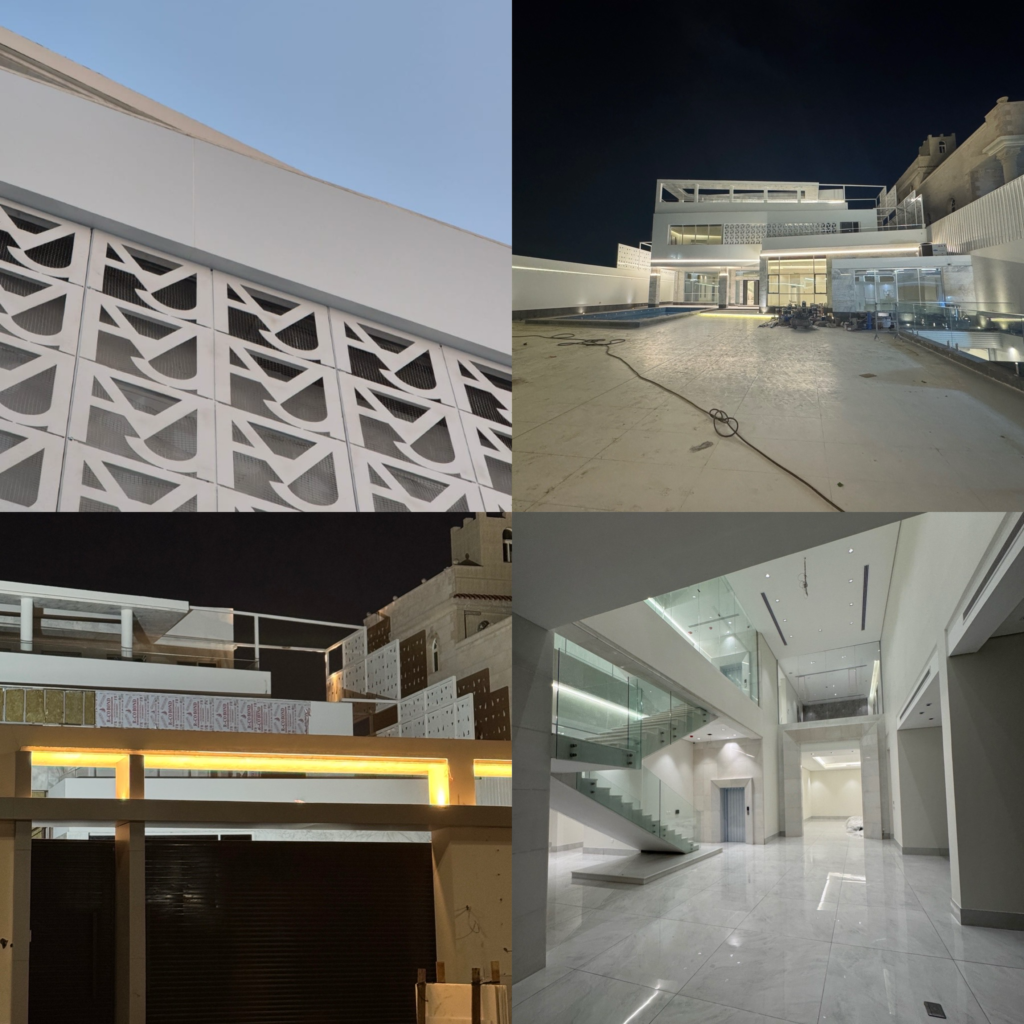
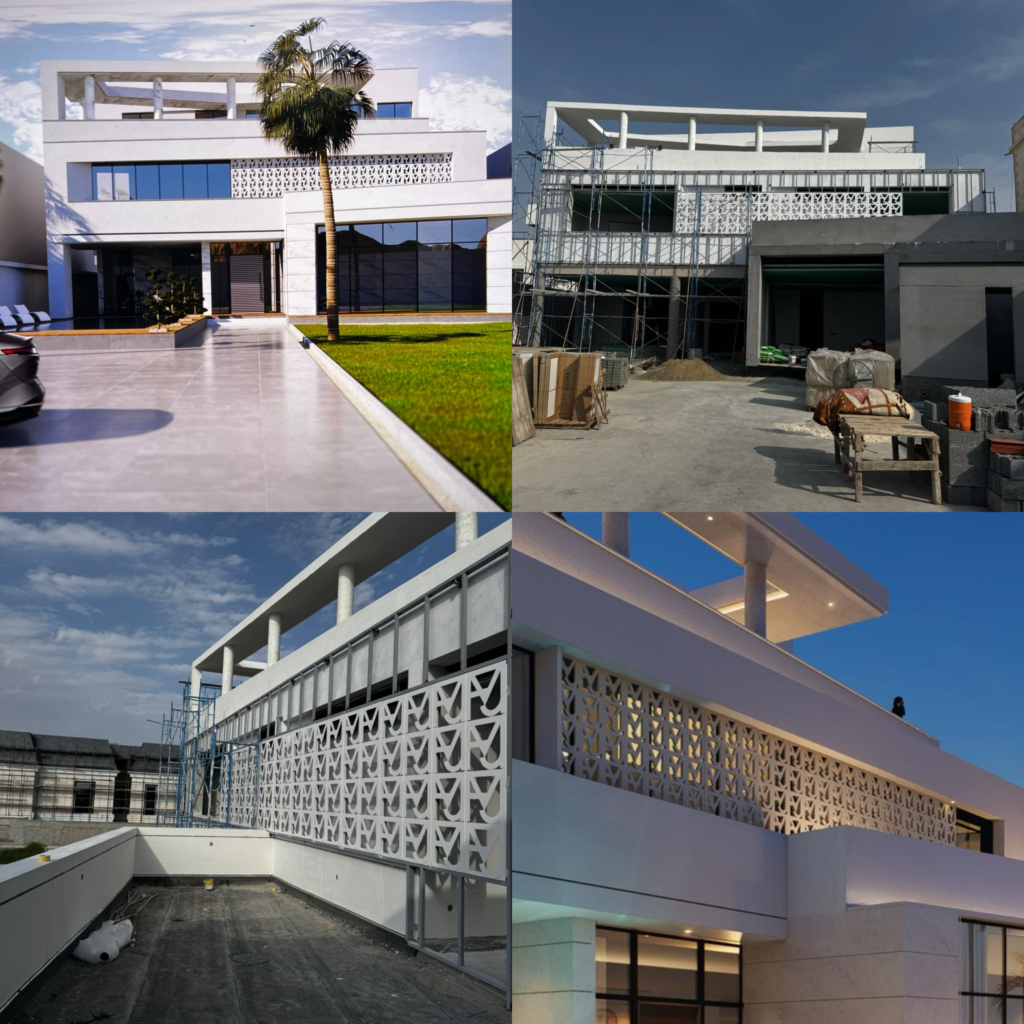
One thread runs through all five projects: the documentation of construction itself as part of the architectural record. Site photographs taken during critical stages — curved formwork, granite integration, screen installation — make visible the distance between a difficult brief and a finished building. In a practice where design and construction are managed under one hand, that distance is the architect’s full responsibility. These images are not behind-the-scenes material. They are evidence.
✦ ArchUp Editorial Insight
This article profiles Ibrahim Nawaf Joharji’s approach to bespoke mansion design as a calibrated intersection of luxury, contextual relevance, and client-centered spatial dynamics. The narrative and visuals emphasize crafted material expression, layered facades, and interior sequences that translate lifestyle into precise architectural moments rather than generic opulence. Yet, the text could further interrogate long-term sustainability strategies and how these large-scale residences negotiate energy use, adaptability, and broader urban responsibility. Even so, the focus on tailored design strategies, cultural identity, and guest experience positions the work as a valuable reference for future high-end residential practice in Saudi Arabia.