Flower Matter aims to cut down flower waste

Flower Matter aims to cut down flower waste
Ongoing research of ways to sustainably valorize bloom waste – ‘Flower Matter’ by Finland-based Irene Purasachit aims to cut down this waste stream by seamlessly fabricating it into environmentally responsible bio-based materials.
While flowers are breathtakingly beautiful they have an incredibly short life span and end their journey in landfills – 40% of them that are grown commercially are thrown away before they reach the consumers’ hands.
By skillfully integrating material production into the industry, one can – divert nearly 100% of bloom waste and innovatively offer alternatives for unsustainable materials, enabling circularity in the industry.
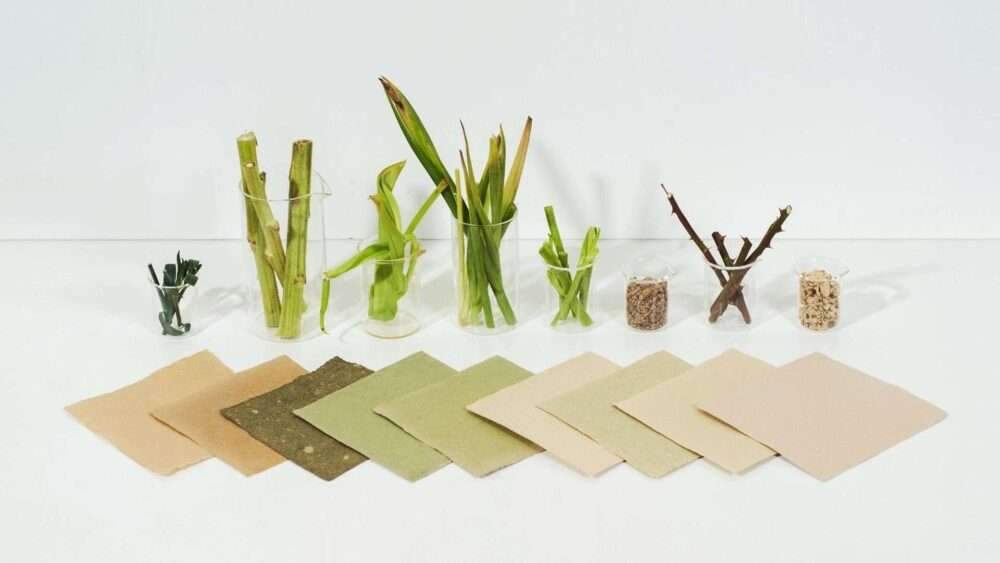
“As flowers are essentially plants – stems and leaves yield fiber.
Petals, on the other hand, contain less fiber but are vibrant enough to be pigments.
These two bases together can then turn into limitless bio-based materials. Who would have thought?” says Purasachit.
Materials in this truly one-of-a-kind organic collection brilliantly include – Flaux︎︎︎, Flower Paper, and ︎︎︎Bio-(Floral) Foam.
A natural microplastic-free leather-like material – Flaux encompasses bloom petals as the main ingredient as well as a color agent.
An eclectic clutch bag and a set of coin purses were prototyped from it, as a proof of concept and its ability to be effortlessly crafted into lifestyle products.
Made up of 100% pulp from various bloom stems and leaves. Flower Paper embodies only flower fiber and requires no additives at all.
Each flower species gives a unique texture as well as aesthetic. We can also color it with eye-catching pigments derived from petals.
Additionally, an alternative for floral foam – Bio-(floral) Foam is 100% fiber. It also has the properties to absorb and retain water together with the ability to hold flowers.
“Biodegradable with no oil-based ingredient or additive, it features 100% flower waste and is microplastic-free” Purasachit adds.
Finally, more on Archup:
Call for Submissions from the Istanbul Design Biennial: “Designing Resilience”
Health & Environmental Resilience and Livability in Cities (HERL) – The challenge of climate change