Hangzhou’s New Bridge: A Zaha Hadid Masterpiece Where Architectural Innovation Meets World Heritage

The Debut of a New Architectural Marvel in Hangzhou
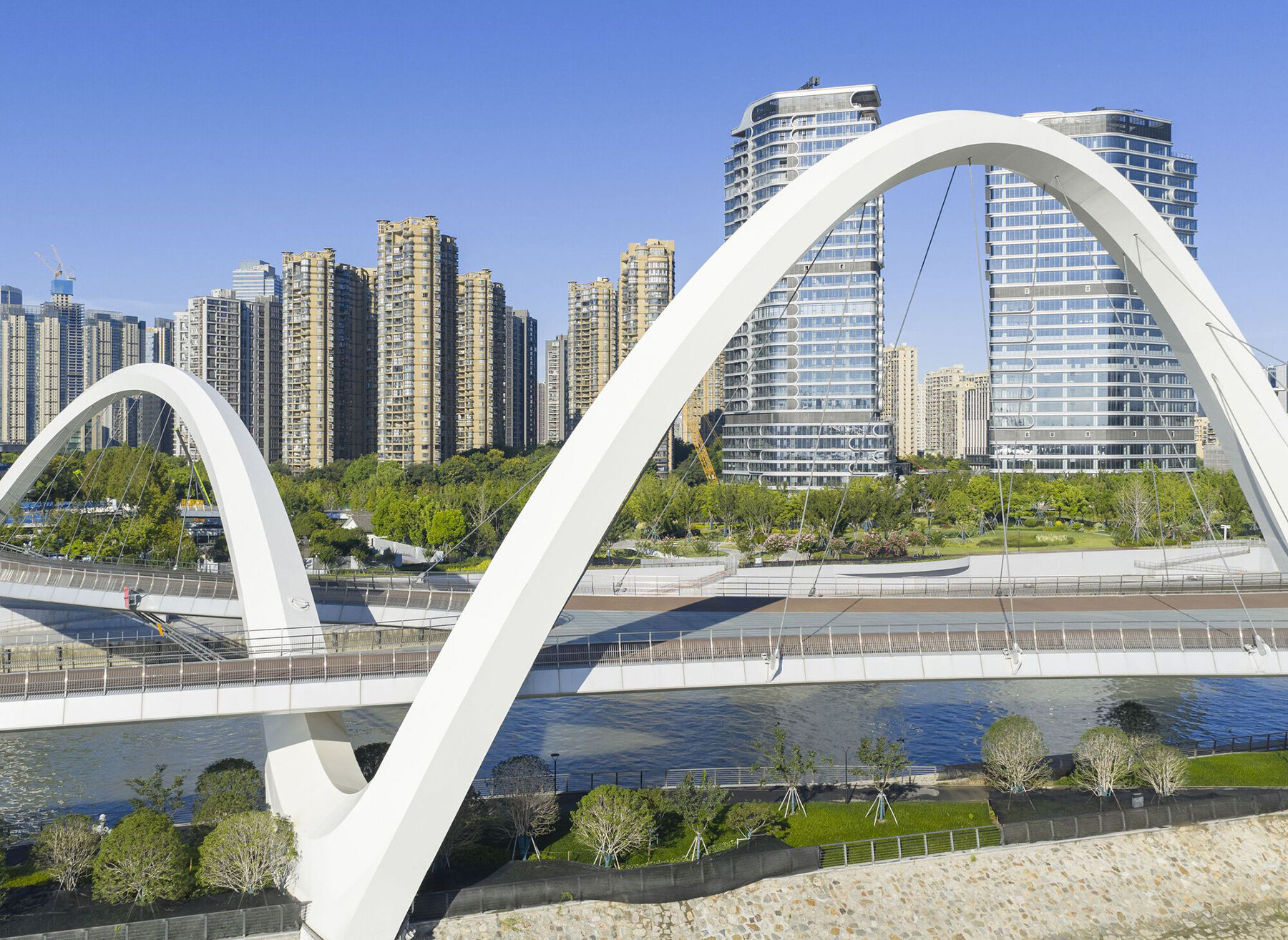
Hangzhou, China, witnesses a significant architectural and strategic milestone with the completion of the Grand Canal Gateway Bridge, a unique new crossing dedicated solely to pedestrians and cyclists, designed by the global firm Zaha Hadid Architects. The bridge is scheduled to open to the public later this year, poised to become a vital artery connecting the eastern and western banks of the historic Grand Canal. It aims not only to link but also to enhance and integrate the city’s seamless 800,000-square-meter masterplan. It is set to be the cornerstone of “River Middle Park,” a 14.7-hectare green space stretching along the waterfront, establishing it as a new hub for movement and community life.
An Exceptional Location on a World Heritage Stage
Zaha Hadid’s bridge is situated in an exceptional context, spanning the Grand Canal, a UNESCO World Heritage Site and the oldest and longest man-made waterway in the world. This canal links Beijing to Hangzhou and connects China’s great rivers, including the Yellow River, the Yangtze River, and the Qiantang River. The new bridge serves multiple roles beyond traditional crossing functions; it revitalizes this historic infrastructure into a modern civic backbone. It frames the picturesque landscapes of the riverbank and offers residents and visitors alike a unique and exciting crossing experience. Furthermore, the bridge integrates and unifies public spaces, residential areas, and workplaces along its banks, transforming the ancient waterway into an organic and vibrant part of the city’s daily urban fabric.
Design Inspiration: A Tale of Silk Embroidery and the “Silver Dragon” Phenomenon
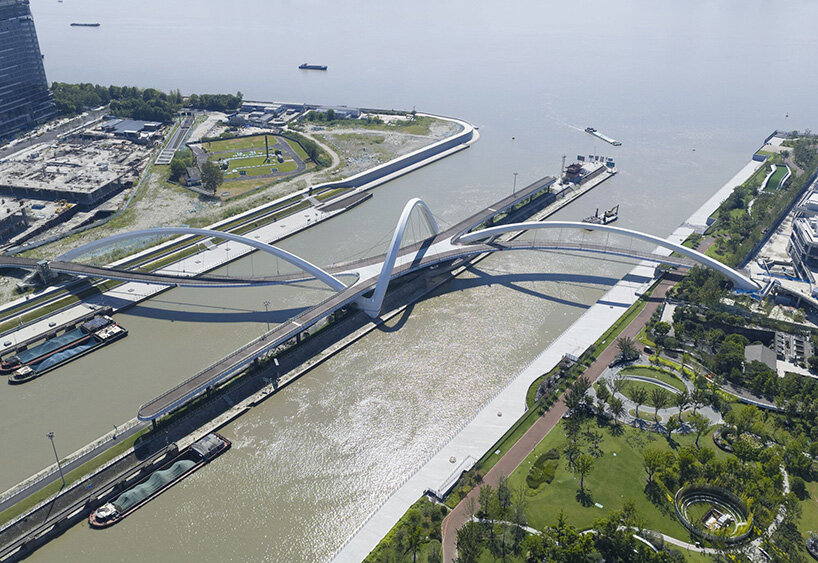
Zaha Hadid’s bridge in Hangzhou, nicknamed the “Silver Dragon,” draws its name from the stunning natural tidal bore of the Qiantang River, where waves surge from Hangzhou Bay reaching heights of up to nine meters, creating a spectacle resembling a silver dragon crawling across the water. The bridge was carefully designed to provide safe and ideal viewing points to observe and enjoy this rare natural phenomenon.
On the aesthetic front, the architects at Zaha Hadid drew design inspiration from Hangzhou’s rich cultural heritage, specifically the ancient Chinese art of silk embroidery. The architectural team reinterpreted the process of stitching and the precision characteristic of this traditional craft into a contemporary spatial and structural system. The bridge’s steel arches intertwine in stunning harmony to form a continuous loop that combines dynamic movement with structural support requirements simultaneously. In this way, the bridge’s architecture weaves the pathways and the supporting structure into a single, coherent entity, resulting in a structural surface that integrates beauty and durability in a tangible form.
Structural Innovation: Where Engineering Meets Environmental Challenges
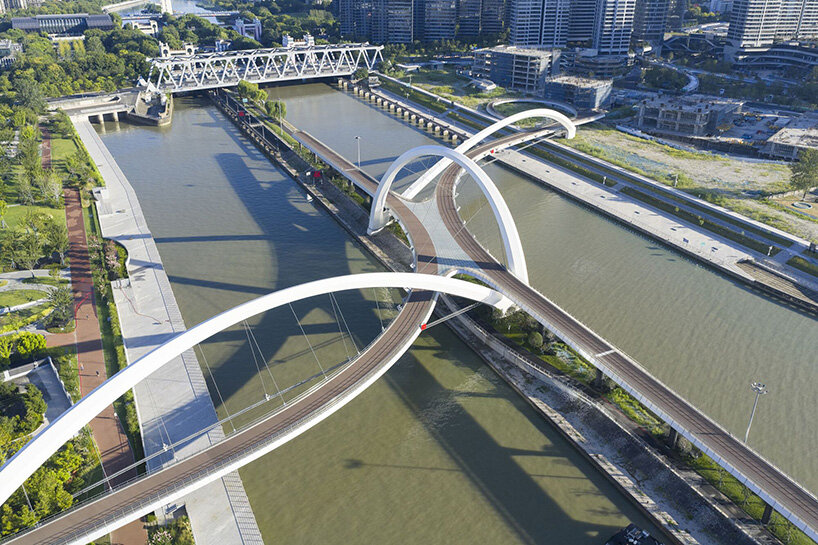
The Hangzhou bridge stands as a landmark of structural innovation, with a total length of 390 meters relying on an advanced steel structural system tied together by three main arches. This system was meticulously calibrated with high engineering precision to suit the soft, alluvial soil prevalent at the junction of the Grand Canal and the river. This sophisticated structural form helps reduce bending moments and lateral forces acting on the bridge, ensuring the highest levels of structural stability and construction efficiency.
To ensure construction efficiency and environmental preservation, the project utilized prefabricated modular elements manufactured off-site and then transported and assembled on-site. This approach significantly streamlined the construction process and minimized the negative impact on active river navigation, which still sees over 100,000 commercial barges pass through the Grand Canal annually. The final result is a structure notably lighter than traditional concrete bridges, while maintaining exceptional strength and durability that guarantees a long lifespan.

Environmental Sustainability: A Commitment to a Green Future
Environmental sustainability was a fundamental and central pillar in all phases of the bridge’s planning and execution. Advanced digital modeling contributed to the precise analysis and study of the structure, leading to the minimization of material use without compromising structural performance. The use of finishes and materials sourced locally also bolstered regional craftsmanship and supported the local economy.
In the realm of energy efficiency, the bridge’s lighting system relies entirely on state-of-the-art LED technology, powered by rechargeable batteries fed completely from renewable and clean energy sources. These lights illuminate the bridge’s features at night, casting serene and beautiful reflections on the river water. Furthermore, the sculpted concrete abutment plays a crucial engineering role in halving the required structural span, thereby enhancing the visual balance and aesthetic clarity of the final design.
✦ Archup Editorial Insight
The article presents the Grand Canal Gateway Bridge in Hangzhou as an urban infrastructure facility aimed at serving pedestrians and cyclists, based on an avant-garde design in a heritage location. Through an architectural lens, a disconnect is observed between the complex expressiveness of the bridge’s structural form and the simplicity and functionality of daily user movement, potentially creating a crossing experience not fully aligned with the fundamental human motive for transit. The massive structural scale of the bridge raises questions about its visual impact on the historic skyline of the canal, and the heavy reliance on prefabricated elements and on-site assembly, while efficient, limits the presence of local craftsmanship in its execution. However, the design’s ability to provide safe viewing platforms for the natural tidal bore phenomenon while maintaining the safety of active river traffic remains a successful solution to the challenge of reconciling tourism demands with heritage preservation.
Brought to you by the ArchUp Editorial Team
Inspiration starts here. Dive deeper into Architecture, Interior Design, Research, Cities, Design, and cutting-edge Projectson ArchUp.