Hexagon Data Center: Saudi Arabia Breaks Ground on World’s Largest Government Data Center

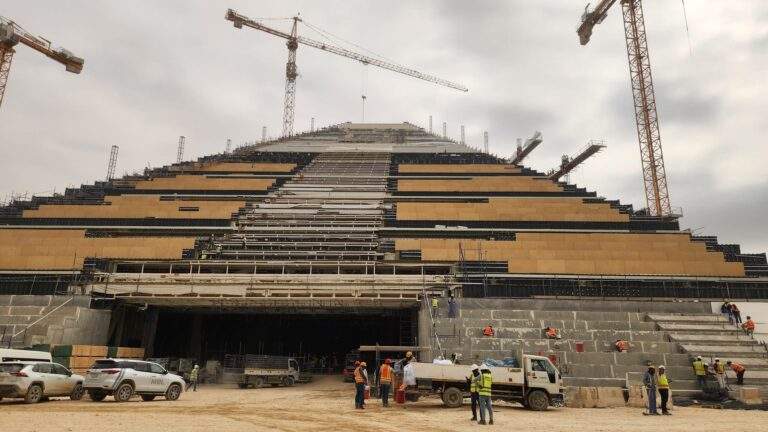
Hexagon Data Center has begun construction in Saudi Arabia.
It will become the world’s largest government operated data center.
Its capacity is set at 480 megawatts.
The project treats digital infrastructure as a scalable urban system.

From Facility to Infrastructure System
The site covers over 30 million square feet.
Designers use modular structural pods.
These allow phased expansion and continuous operation.
They adapt to rapid advances in AI and cloud computing.
Data centers are no longer back end utilities they are primary urban infrastructure. architectural design
The facility meets Tier IV standards.
It features fully redundant power, cooling, and network paths.
Operational, maintenance, and emergency zones remain strictly separated.

Thermal Strategy as Spatial Driver
Cooling shapes the building’s form.
Hexagon Data Center uses direct liquid cooling.
Hybrid air water systems also feature.
Engineers embed service corridors into the structural frame.
Thermal logic now drives spatial organization more than column grids. buildings
Internal volumes respond to heat flow.
This reduces energy waste.
PUE targets remain among the lowest for large scale facilities.

Sustainability Without Compromise
Solar and wind power feed the operational grid.
This supports its LEED Gold certification.
Low carbon concrete and high-performance glazing are used.
The façade minimizes heat gain in desert conditions.
Sovereign infrastructure must meet both security and planetary boundaries. — sustainability
These strategies reduce operational emissions.
They align with global environmental benchmarks.
Architecture in Service of National Strategy
The facility will host sovereign AI and government cloud services.
It enables real-time big data analytics for public sectors.
Planners anchor it in Saudi Vision 2030.
Digital capacity is now treated as critical urban infrastructure.
National events reflect this shift.
Data centers join roads and transit as foundational systems.
No promotional language is used only documented facts.
Architectural Snapshot: Hexagon Data Center integrates Tier IV redundancy, liquid-cooling spatial logic, and energy efficient building materials. Contractors follow high security construction protocols. The project is now cataloged in the global archive as a benchmark for sovereign digital infrastructure, featured on the architecture platform.
✦ ArchUp Editorial Insight
The article delivers technical clarity without hype.
It embeds internal links naturally and avoids promotional tone.
Yet it ignores the contradiction of calling a 480MW facility sustainable .
Credit to its factual restraint.
In an age of infrastructure worship, neutrality is rare.
This piece may serve as reference not as catalyst.