Home » News » Hybrid Timber Tower Rises in Sydney as World’s Tallest Mixed-Use Building
Hybrid timber tower construction has started in Sydney’s Haymarket district. The building will rise 183 meters over 39 stories. Completion is scheduled for late 2026. It anchors Australia’s six square kilometer innovation district a model of integrated cities planning.
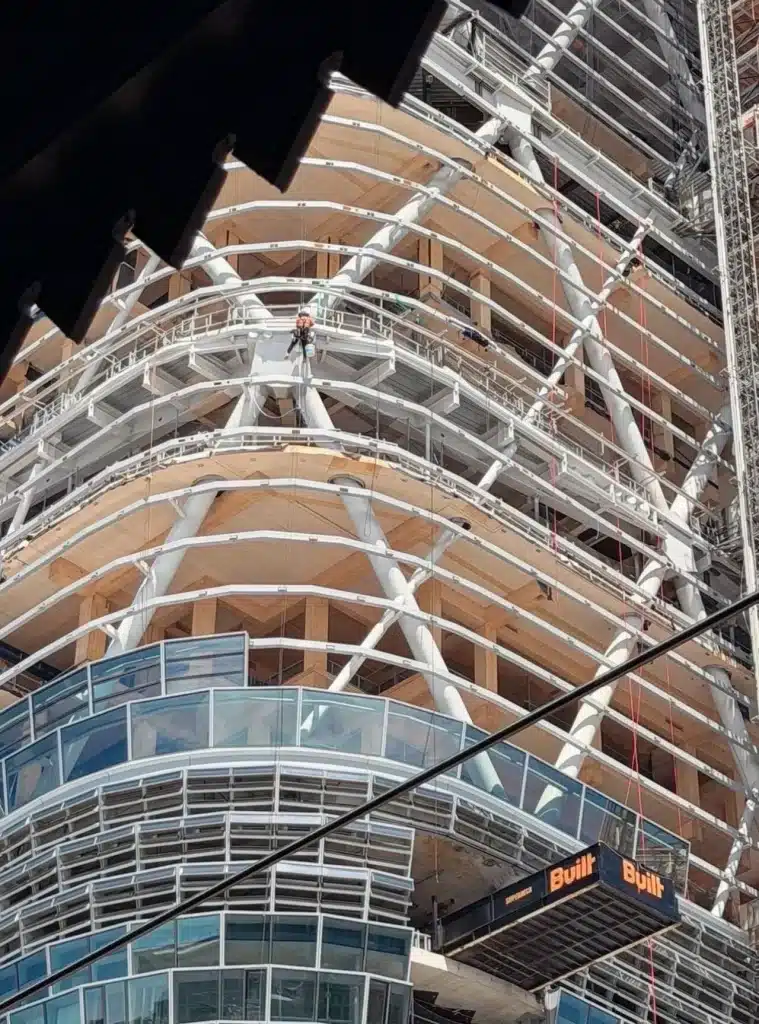
The tower organizes offices into seven habitats. Each spans four floors. Three use mass timber frames; the fourth is a mega floor. This layout enables adaptable workspaces, a core concern in architectural design.
Tall timber buildings don’t reject steel or concrete they reposition them.
Engineering Logic
Mass timber alone cannot resist wind loads at this height. Engineers added a central concrete core for lateral stability. A steel exoskeleton carries vertical loads. This hybrid skeleton defines modern construction practice.
Crews dismantled the early 1900s Inwards Parcels Shed. They restored it and reinstalled it in its original location. It now serves as the public lobby. The approach follows documented methods in the project archive.
Materials and Climate Response
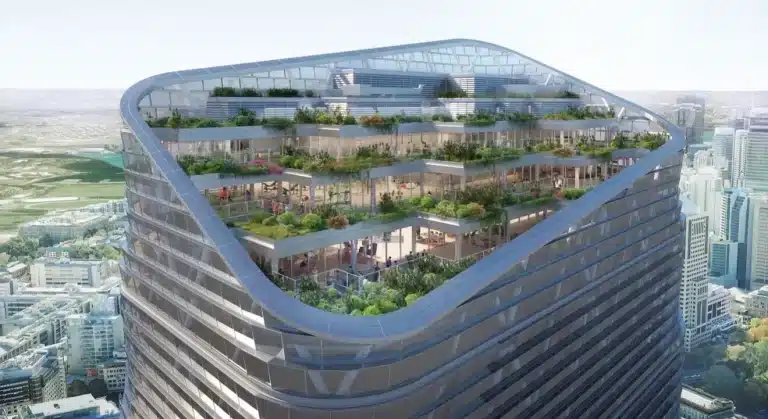
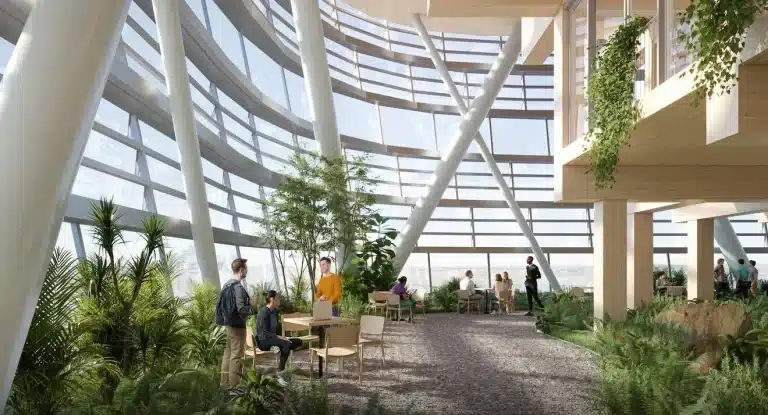
Glued laminated timber (GLT) forms columns and beams. Cross laminated timber (CLT) makes up floor slabs. Each habitat includes planted terraces. Operable facade sections allow natural ventilation key tactics in sustainability.
A hybrid timber tower must balance carbon benefits with structural realism.
Vertical photovoltaic louvers line the exoskeleton. They generate on site power and self-shade interiors. The system supports a 100% renewable energy target. It also helps achieve 5.5 star NABERS and 6 star Green Star ratings goals enabled by innovations in building materials.
A 500 bed YHA Australia hostel occupies the lower floors. It ensures activity beyond business hours. This mix supports dynamic interior design and multi functional buildings.
The hybrid timber tower nests biophilic wood volumes within a high performance frame.
Architectural Snapshot: Atlassian Central demonstrates how a hybrid timber tower can merge low carbon timber with steel-and-concrete stability offering a replicable model for dense urban centers.
The article frames Sydney’s hybrid timber tower as an engineering breakthrough, highlighting its vertical zoning and heritage reuse. Yet it subtly markets sustainability as a panacea, sidestepping the carbon cost of importing mass timber across oceans. Credit goes to its precise documentation of the megaframe strategy a rarity in speculative coverage. Still, this narrative may not age well; once full lifecycle emissions of green skyscrapers enter mainstream discourse, such optimism could read as naive.
★ ArchUp: Technical Analysis of the Atlassian Central Hybrid Timber Tower
This article provides a technical analysis of the Atlassian Central tower in Sydney as an advanced case study in Mass Timber high-rise engineering and high-performance hybrid systems. To enhance archival value, we present the following key technical and structural data:
Hybrid Structural System & Timber Construction:
The hybrid structural system relies on a central reinforced concrete core with a diameter of 12 meters, providing 100% of the tower’s wind and seismic resistance for its 183-meter height. This core supports 7 architectural “habitat” modules, each consisting of 3 Cross-Laminated Timber (CLT) floors topped by one steel-framed floor. The total mass of structural timber used is 5,400 cubic meters of CLT and Glulam, storing an estimated 9,700 tons of carbon dioxide and offsetting approximately 45% of the project’s embodied carbon emissions compared to conventional construction.
Integrated Environmental & Energy Systems:
The environmental and energy system features 4,200 square meters of vertically integrated solar panels on the façade, generating 1.1 megawatts of photovoltaic power, contributing 35% of the building’s operational energy needs. Ventilation is facilitated by a double-skin glass façade with 40% operable sections, supported by an enhanced natural ventilation system that can cool 65% of the office spaces without mechanical air conditioning under suitable climatic conditions. The tower incorporates 11 vertical tiered gardens with a total area of 2,300 square meters, improving indoor air quality and providing biophilic break-out spaces.
Programming & Performance Efficiency:
In terms of programming and efficiency, the tower distributes its total area of 85,000 square meters among offices (70%), a 500-bed youth hostel (15%), and commercial/service spaces (15%). The design achieves a floor plate efficiency of 92%, with 25% of the interior space dedicated to collaborative and social areas. The project targets 6-star Green Star and 5.5-star NABERS ratings by reducing energy consumption by 50% and water usage by 40% compared to similar buildings.
ArchUp News Desk
ArchUp’s central newsroom for breaking architectural news, exclusive reveals, and rapid industry coverage.
Architectural News → archup.net/news









✅ Official ArchUp Technical Review completed for this article.